Gallup: The Evolution of Public Opinion Polling and Management Consulting
Gallup is a globally recognized private, employee-owned company that has shaped how the world understands public sentiment. Based in Washington, D.C., the organization has evolved from a pioneering polling firm into a comprehensive management consulting and analytics powerhouse. With a presence in 30 to 40 offices worldwide—including major hubs in London, Berlin, Singapore, and Abu Dhabi—Gallup employs approximately 1,500 people dedicated to measuring the human experience.
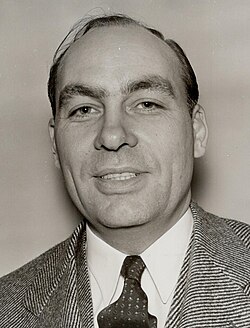
Founded by George Gallup in 1935, the company began as the American Institute of Public Opinion. Today, under the leadership of CEO Jon Clifton, who took the helm in 2022, Gallup continues to provide critical insights through opinion polling, corporate research, and publishing.
Key Facts
- Founded: 1935 by George Gallup in Princeton, New Jersey.
- Headquarters: The Gallup Building, 901 F Street, NW, Washington, D.C.
- Ownership: Employee-owned.
- Global Reach: 30–40 offices worldwide.
- Core Services: Management consulting, analytics, research, opinion polling, and publishing.
- Key Publication: StrengthsFinder 2.0, one of Amazon's top 20 best-selling books of all time.
A Legacy of Public Opinion
The history of Gallup is inextricably linked to the rise of scientific polling in the United States. George Gallup sought to bring fairness to data collection by using sampling demographics that were representative of the actual voting population. To maintain objectivity, the company established a strict policy of refusing surveys commissioned by political parties, such as the Republicans and Democrats—a standard it maintains to this day.
Gallup's ascent to prominence was cemented during the 1936 U.S. presidential election. While the popular Literary Digest predicted a different outcome, Gallup correctly predicted that Franklin Roosevelt would defeat Alfred Landon. This victory popularized the company's methodology and established it as a leader in American polling. By 1938, the firm expanded its expertise into market research for the film industry and advertising agencies.
The Gallup Poll and Methodology
The Gallup Poll is designed to track public attitudes on political, social, and economic issues. While the polling division provides immense brand visibility, it has historically operated at a financial loss, with yearly losses of approximately $10 million as of 2012. However, this visibility serves as a gateway for the company's more profitable corporate research and consulting services.
Accuracy and Challenges
For decades, Gallup was highly accurate in predicting U.S. presidential winners, though it faced notable misses in 1948 (predicting a Thomas Dewey victory over Harry S. Truman) and 1976 (projecting Gerald Ford over Jimmy Carter). A significant methodological challenge occurred during the 2012 election, where Gallup incorrectly predicted a Mitt Romney victory. A subsequent six-month review revealed flaws in the sampling process, including an overestimation of the white vote and an over-reliance on landline phones, which skewed results toward an older demographic.
![Gallup poll done Feb 3–16, 2025[51]](/images/8f/c1/8fc12f7240876cfa659836826b3feb7555b72ded06c6ceb311750148daaa5d36.png)
The Gallup World Poll
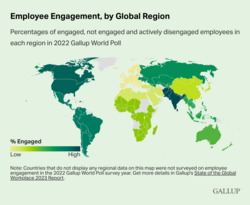
Expanding beyond U.S. borders, the Gallup World Poll interviews roughly 1,000 residents per country, targeting the non-institutionalized civilian population aged 15 and older. To ensure statistical comparability, questions are asked in the respondent's native language. The methodology adapts to local infrastructure: telephone surveys are used where coverage is at least 80%, while face-to-face interviews are conducted in regions with lower telephone penetration.
Beyond Polling: Consulting and Publishing
Gallup has diversified its offerings to include high-level management consulting and organizational health assessments. A cornerstone of this effort is the Q12 employee engagement survey, which analyzes data from over 2.7 million workers across 100,000+ teams. Organizations that meet these rigorous standards are honored with the Gallup Exceptional Workplace Award.
The company also operates Gallup Press, an in-house publishing arm. By 2015, it had released approximately 30 books focusing on business and personal well-being. Notable titles include It's the Manager, Wellbeing at Work, and the highly successful StrengthsFinder 2.0.
| Category | Details |
|---|---|
| Founder | George Gallup (1935) |
| Current CEO | Jon Clifton |
| Global Presence | 30–40 offices |
| Key Methodology | Representative demographic sampling |
| Major Publications | StrengthsFinder 2.0, It's the Manager |
Frequently Asked Questions
Who founded Gallup and when?
George Gallup founded the organization in 1935 in Princeton, New Jersey, originally as the American Institute of Public Opinion.
How does the Gallup World Poll ensure accuracy across different countries?
Gallup interviews approximately 1,000 residents per country in their own language. They use telephone surveys in countries with at least 80% telephone penetration and face-to-face interviews in countries where penetration is lower.
What is the Q12 employee engagement survey?
The Q12 is a survey used to measure employee engagement and organizational health. It has been used to analyze more than 2.7 million workers across over 100,000 teams to determine standards for the Gallup Exceptional Workplace Award.
Why did Gallup's 2012 presidential prediction fail?
A review found that Gallup's methodology was flawed because it relied too heavily on listed landlines (skewing the sample toward older voters), overestimated the white vote, and made too few phone calls in the Eastern and Pacific time zones.
Does Gallup work for political parties?
No. Following a policy established by George Gallup, the company refuses to conduct surveys commissioned by organizations such as the Republican and Democratic parties to maintain its independence.