Understanding Gene Flow: The Engine of Genetic Diversity and Evolution
In the study of population genetics, gene flow—also referred to as migration or allele flow—is the movement of genetic material from one population to another. This process is a fundamental driver of evolution, acting as a mechanism that transfers genetic diversity across different groups. By modifying allele frequencies (the proportion of members in a population carrying a specific variant of a gene), gene flow can significantly alter the genetic makeup of a species.
The rate of gene flow determines how closely related different populations remain. If the rate is high enough, two populations will develop equivalent allele frequencies and can be treated as a single, effective population. Interestingly, research suggests that it takes only "one migrant per generation" to prevent populations from diverging due to genetic drift (random changes in allele frequencies). However, if selection pressures are strong enough, populations can still diverge even while exchanging alleles.
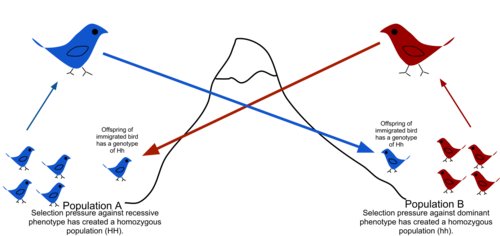
Measuring the Movement of Genes
Scientists use various methods to estimate the level of gene flow among populations. A direct method involves observing the dispersal of individuals and recording their reproductive success, though this is only practical for certain organisms. More commonly, indirect methods are used to infer gene flow by comparing allele frequencies among population samples.
The relationship between gene flow and genetic differentiation is inverse: the more genetically different two populations are, the lower the estimated gene flow. While isolation leads to divergence through drift, migration acts as a homogenizing force that reduces divergence. To quantify this, researchers often use the effective population size and the net migration rate per generation. A common measure of population structure, known as $F_{ST}$, helps determine the degree of genetic differentiation. For instance, when there is one migrant per generation, $F_{ST}$ is approximately 0.2. If there is no migration, the inbreeding coefficient (a measure of mating between closely related individuals) rises rapidly, leading to complete divergence.
Barriers to Gene Flow and the Path to Speciation
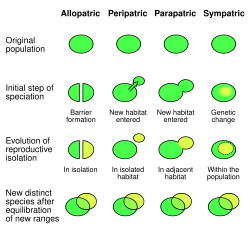
When gene flow is interrupted, populations begin to diverge, which can eventually lead to the creation of new species. This process is generally categorized into two types: allopatric and sympatric speciation.
Allopatric Speciation
Allopatric speciation occurs when gene flow is blocked by physical, geographic barriers. These barriers are typically natural, such as oceans, vast deserts, or impassable mountain ranges. However, human activity can also create these barriers; for example, the Great Wall of China has hindered the gene flow of certain native plant populations. In these cases, the lack of recombination between gene pools allows populations to develop distinct genetic differences.
Sympatric Speciation
Sympatric speciation happens when new species arise from a single ancestral species while living within the same geographic range. Instead of physical barriers, these populations are separated by reproductive barriers. This might include differences in flowering times, soil preferences, or the presence of specialist pollinators. Even in the same environment, limited gene flow can occur due to fragmentation or the production of unfit hybrids.
The Human Impact: Conservation and Challenges
Human intervention can influence gene flow in both beneficial and detrimental ways, ranging from active management to unintended environmental consequences.
Genetic Rescue and Assisted Gene Flow
To combat the risks of extinction in small, isolated populations, conservationists use genetic rescue. By introducing unrelated individuals into a population, they can increase genetic diversity and reduce the harmful effects of inbreeding. This has been successfully demonstrated in laboratory settings with Drosophila melanogaster.
Similarly, assisted gene flow is a management strategy used to simulate natural processes to help species adapt to rapid environmental changes, such as climate change. By moving individuals or gametes between populations, managers can introduce genotypes that are pre-adapted to projected local climate conditions, thereby increasing the overall genetic fitness of the species.
Genetic Pollution and Urbanization
Conversely, human activities can lead to genetic pollution. This occurs when the movement of species or landscape modification results in hybridization or introgression (the replacement of one species' alleles with those of another). This can lead to "genetic swamping," where a rare species is replaced by a more abundant one, such as the Mallard duck interbreeding with various other duck species.
Urbanization presents a dual model for gene flow. Habitat fragmentation can decrease genetic diversity by isolating populations. However, the urban facilitation model suggests that human-made changes can actually connect populations. For example, the Western black widow spider (*Latrodectus hesperus*) shows increased gene flow and higher diversity in urban environments compared to rural ones, allowing them to adapt and spread faster in cities.
Gene Flow Between Species
Gene flow is not limited to members of the same species. There are two primary ways genetic material moves between different organisms:
- Horizontal Gene Transfer (HGT): This is the transfer of genes through mechanisms other than traditional reproduction. It includes transformation (uptake of DNA from the environment), conjugation (direct contact between cells), and transduction (transfer via a virus).
- Hybridization: This occurs when two different species breed, exchanging traits. While this can increase diversity, it can also threaten the genetic integrity of rare species if the hybrid offspring begin to replace the native stock.
Real-World Examples of Gene Flow
The effects of gene flow are highly context-dependent, acting as both a stabilizer and a driver of change.
- Darwin's Finches: In the fragmented landscapes of the Galapagos Islands, these birds experienced adaptive radiation, where they evolved varying traits to compete for different resources.
- Marine Iguanas: These endemic Galapagos species evolved from mainland land iguanas. Limited gene flow due to geographic isolation allowed them to adapt unique traits, such as the ability to swim.
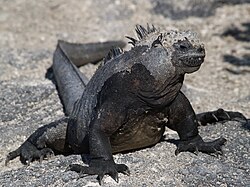
Marine iguana of the Galapagos Islands evolved via allopatric speciation, through limited gene flow and geographic isolation. - Human Evolution: Evidence suggests that early *Homo sapiens* interbred with Neanderthals, leaving Neanderthal alleles in modern European populations.
- Giant Pandas: In captive management, international breeding programs share genetic material to increase diversity and reduce inbreeding in small populations.
- Monkeyflowers: Two species, Mimulus lewisii and Mimulus cardinalis, became genetically isolated because they evolved to use different pollinators (bees vs. hummingbirds).
Key Facts
- Gene flow is the transfer of genetic material between populations, which can increase homogeneity or drive adaptation.
- A rate of one migrant per generation is often sufficient to prevent populations from diverging due to genetic drift.
- Allopatric speciation is driven by physical barriers, while sympatric speciation is driven by reproductive barriers.
- Genetic rescue involves introducing new individuals to a population to reduce inbreeding and increase diversity.
- Horizontal gene transfer allows for the movement of genes between organisms through methods other than reproduction.
| Feature | High Gene Flow | Low Gene Flow |
|---|---|---|
| Genetic Differentiation | Low (Homogeneous) | High (Divergent) |
| Speciation Risk | Low (Constrains speciation) | High (Promotes speciation) |
| Inbreeding Risk | Reduced | Increased |
Frequently Asked Questions
What is the difference between allopatric and sympatric speciation?
Allopatric speciation occurs when populations are physically separated by geographic barriers like mountains or oceans. Sympatric speciation occurs when populations inhabit the same area but are prevented from interbreeding by reproductive barriers, such as different mating seasons.
How does urbanization affect the gene flow of animals?
Urbanization can have two effects: habitat fragmentation can isolate populations and decrease diversity, but "urban facilitation" can also create new pathways that connect populations, increasing gene flow and diversity in urban-adapted species.
What is genetic rescue?
Genetic rescue is a conservation strategy where unrelated individuals are introduced into a small, inbred population to increase genetic diversity and improve the population's overall survival chances.
Can gene flow be harmful to a species?
Yes. Through processes like genetic pollution and introgression, gene flow can lead to "genetic swamping," where the unique genetic identity of a rare species is lost as it interbreeds with a more abundant species.
What is horizontal gene transfer?
Horizontal gene transfer is the movement of genetic material between organisms through means other than traditional reproduction, such as through direct contact between cells or via viruses.