Understanding Biogeography: The Science of Life's Distribution
Have you ever wondered why certain animals live in the rainforest while others are found only in the arctic? Or why specific plants thrive in one mountain range but vanish in another? This is the central question of biogeography, the scientific study of how species and ecosystems are distributed across geographic space and how these patterns have changed throughout geological time.
Biogeography is an integrative field, meaning it pulls together knowledge from many different sciences, including ecology, evolutionary biology, geology, and climatology. By studying how organisms vary along gradients of latitude, elevation, and habitat area, scientists can better understand the complex relationship between life and the Earth. The field is often divided into specialized branches: phytogeography (the study of plant distribution), zoogeography (the study of animal distribution), and mycogeography (the study of fungi, such as mushrooms).
The History of Biogeography
18th Century Discoveries
The foundations of biogeography were laid in the mid-18th century as European explorers began documenting the world's biodiversity. During this era, many scientific views were still heavily influenced by religious perspectives. Carl Linnaeus, a pioneer in biological classification, observed that species were not as permanent as previously believed. To explain why different species inhabited different elevations, he proposed the "Mountain Explanation," suggesting that as waters receded after Noah's Ark landed on Mount Ararat, animals dispersed to different heights on the mountain. While religious in origin, Linnaeus's work helped establish the basis for ecological biogeography by suggesting that an animal's structure is closely linked to its physical surroundings.
Following Linnaeus, Georges-Louis Leclerc, Comte de Buffon, observed how shifts in climate influenced the spread of species. Buffon was among the first to theorize that different groups of organisms originated from different regions. He even suggested that continents might have once been connected before being separated by water. In his massive work, Histoire Naturelle, he introduced Buffon's Law, noting that similar environments in different parts of the world often host entirely distinct species. His studies of fossils also led him to conclude that the Earth was much older than previously thought.
19th Century Advancements
The 19th century brought a more empirical approach to the science. Alexander von Humboldt, often called the "founder of plant geography," studied how climate and vegetation interact. He divided the Earth into tropical, temperate, and arctic regions and developed the concept of the isotherm—lines on a map representing equal temperatures—to visualize how life patterns correlate with climate. His work was detailed in his influential book, Cosmos.
As the era progressed, Charles Darwin revolutionized the field by introducing the theory of natural selection. By studying species in the Galapagos Islands, Darwin provided a mechanism to explain how species change over time rather than remaining static. This shifted biogeography from a purely descriptive science to a biological one, focusing on the processes of evolution.
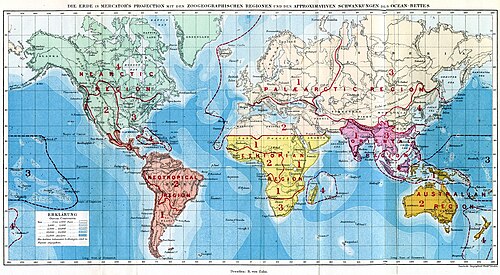
Alfred Russel Wallace, often nicknamed the "father of Biogeography," furthered this work through his extensive research in the Amazon Basin and the Malay Archipelago. Wallace studied how factors like food resources and geographical barriers influenced the habits and migrations of thousands of species. He and Philip Sclater used biogeographical patterns to support the theory of evolution, noting sharp differences in fauna, such as the famous Wallace Line, which separates distinct biological groups.
20th and 21st Century Revolutions
In 1912, Alfred Wegener introduced the revolutionary Theory of Continental Drift. He proposed that the continents were once joined in a single supercontinent called Pangea and had slowly drifted apart due to the movement of plates beneath the Earth's surface. This theory provided a massive new framework for understanding why similar species are found on continents separated by vast oceans.
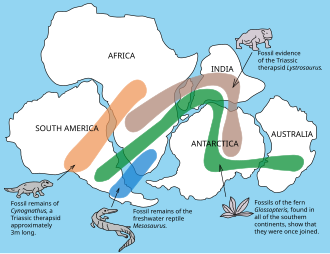
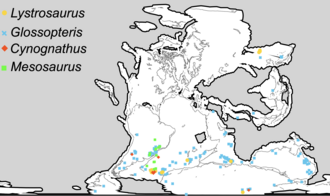
The evidence for Wegener's theory included the "jigsaw puzzle" fit of the continents and the distribution of specific fossils, such as the mesosaurs, across widely separated landmasses.
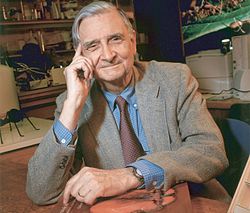
In the mid-20th century, the field moved toward more specialized ecological studies. Paul S. Martin's work in Mexico examined how complex environments, ranging from lowlands to cloud forests, influenced the distribution of reptiles and amphibians. Later, in 1967, Robert MacArthur and Edward O. Wilson published The Theory of Island Biogeography. This landmark work demonstrated that the number of species in an area (species richness) could be predicted by looking at habitat area, immigration rates, and extinction rates.
Modern Applications and Technology
Today, biogeography relies heavily on massive global databases. The Global Biodiversity Information Facility (GBIF) holds over 2.57 billion species occurrence records, while the Ocean Biodiversity Information System (OBIS) tracks 116 million marine records. These datasets allow scientists to map the presence of life with unprecedented precision.
Because it is impossible to sample every corner of the planet, scientists use Environmental Niche Modelling (ENM) or Species Distribution Modelling (SDM). These are predictive tools that use environmental data—such as food availability or climate preferences—to create maps of where a species is likely to live. These models are vital for predicting how species distributions might shift due to climate change.
Core Concepts and Fields
Biogeography is a synthetic science that relies on several fundamental biological and geological concepts:
- Allopatric speciation: The process where a species splits into new species due to the evolution of geographically isolated populations.
- Vicariance: The formation of physical barriers (like mountains or oceans) that subdivide a population, often leading to speciation or extinction.
- Dispersal: The movement of populations away from their original location, often related to migration.
- Endemic areas: Regions where specific species are found exclusively.
- Extinction: The complete disappearance of a species from Earth.
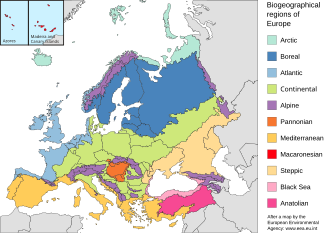
Researchers also engage in systematic biogeography, which involves the hierarchical classification and study of the relationships between different biotic areas.
Key Facts
- Biogeography integrates ecology, evolution, geology, and climatology to study species distribution.
- The three main branches are phytogeography (plants), zoogeography (animals), and mycogeography (fungi).
- Alfred Russel Wallace is widely considered the "father of Biogeography."
- Continental Drift explains how the movement of Pangea shaped modern species distributions.
- Predictive modelling (ENM/SDM) is used to forecast how species will move in response to climate change.
| Term/Field | Primary Focus | Key Concept |
|---|---|---|
| Phytogeography | Plants | Vegetation patterns |
| Zoogeography | Animals | Faunal distribution |
| Mycogeography | Fungi | Fungal distribution |
| Vicariance | Barriers | Speciation via isolation |
| Allopatric Speciation | Evolution |
Frequently Asked Questions
What is the difference between biogeography and ecology?
While ecology focuses on the interactions between organisms and their environment, biogeography specifically examines the spatial and temporal distribution of those organisms across the globe.
What is the significance of the Wallace Line?
The Wallace Line is a famous boundary that marks a sharp difference in the types of animals found on either side of it, serving as a key piece of evidence for how geographical barriers influence evolution.
How does continental drift affect biodiversity?
As continents move and separate (a process called vicariance), they create physical barriers that isolate populations. This isolation can lead to the evolution of new species or the extinction of existing ones.
What is Island Biogeography?
It is a theory suggesting that the number of species on an island is determined by a balance between the rate at which new species arrive (immigration) and the rate at which species die out (extinction), both of which are influenced by the island's size.
How do scientists use computers to study biogeography today?
Scientists use Species Distribution Modelling (SDM) to create predictive maps. By inputting environmental data, they can estimate where a species lives and how its habitat might change in the future due to human activity or climate change.