FLPP: Advancing European Space Launch Technology and Reusability
The Future Launchers Preparatory Programme (FLPP) is a cornerstone of the European Space Agency's (ESA) strategy to ensure long-term access to space. By focusing on the development and maturation of cutting-edge technologies, FLPP aims to equip future European launch vehicles with the capabilities needed to remain competitive, efficient, and cost-effective.
Whether upgrading existing systems or designing entirely new vehicles, FLPP serves as a bridge between theoretical research and practical application. This systematic approach helps reduce the time, risk, and financial burden associated with developing complex space transportation systems.
Bridging the Technology Gap
At the heart of FLPP is the concept of the Technology Readiness Level (TRL). TRL is a scale used to measure the maturity of a technology, ranging from basic principles (low TRL) to proven systems ready for flight (high TRL). Many promising space technologies begin at a TRL of 3 or lower, meaning they are still in the early stages of proof-of-concept.
The primary mission of FLPP is to mature these technologies from a TRL of 2 or 3 up to a TRL of 6. At level 6, a technology has been tested in a relevant environment using a prototype or model, making it safe and reliable enough to be integrated into major development programs like Ariane 6 or Vega C.
A System-Driven Approach
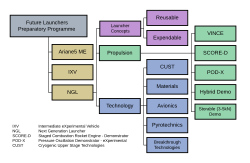
FLPP does not develop technology in isolation. Instead, it uses a system-driven approach. This involves conducting detailed studies of future launch systems to identify which specific technologies will provide the most significant benefits. Once identified, these technologies are integrated into demonstrators—test vehicles or models that simulate real-world conditions such as extreme pressures, temperatures, and vacuum environments.
Key Facts
- Objective: To mature technologies from low TRL (2–3) to high TRL (approx. 6).
- Core Focus: Reducing the cost, risk, and development time of European launchers.
- Key Partners: Close coordination with Ariane and Vega launcher programs.
- Methodology: Uses integrated demonstrators to test technologies in relevant environments.
- Evolution: Shifted from focusing on a specific Next Generation Launcher to a general technology maturation program.
Evolution of the Programme
Since its inception in February 2004 with the support of 10 ESA member states, FLPP has undergone several strategic shifts:
- Initial Phase (2004–2006): Focused on studies for future Reusable Launch Vehicles (RLV) and cost-reduction upgrades for existing launchers.
- Expansion (2006–2013): Continued development of propulsion and re-entry technologies. This period saw the transfer of the Vinci engine to Ariane 5 ME development.
- FLPP NEO (2013–2019): With the start of the Ariane 6 project, the scope broadened to identify and mature technologies for a wider range of future applications and low-cost launcher concepts.
- Modern Era (2020s): The program is now structured around seven specialized pillars, including propulsion (THRUST!), innovation (FIRST!), and reusable prototypes like Themis and Prometheus.
Notable FLPP Projects and Technologies
Propulsion and Engines
Propulsion is a major area of investment. Notable successes and ongoing projects include:
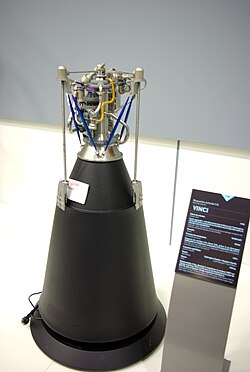
- Vinci Engine: A re-ignitable cryogenic upper stage engine powered by liquid oxygen and liquid hydrogen. After maturation within FLPP, it was successfully integrated into the Ariane 6.
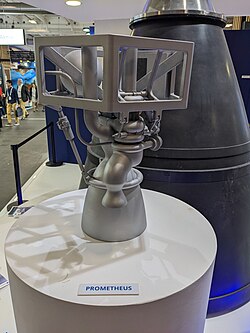
- Prometheus: A reusable methalox (methane and liquid oxygen) rocket engine designed for future reusable propulsion needs.
Re-entry and Structural Innovation
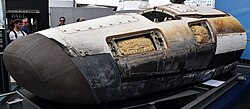
To achieve reusability, spacecraft must survive the intense heat of returning to Earth. The Intermediate eXperimental Vehicle (IXV) was a landmark re-entry demonstrator that flew in 2015 to test thermal protection and flight mechanics.
Other structural advancements include Additive Manufacturing (3D printing), which allows for lighter, more complex, and cheaper production of engine components and structures, and the development of lightweight cryogenic tank systems.
Summary of FLPP Program Structure (2020s)
| Programme Name | Primary Focus Area | Key Objective |
|---|---|---|
| THRUST! | Propulsion | High-thrust reusable space transportation |
| FIRST! | Innovation | Technology disruptors |
| InSPoC | In-space Transport | Proof-of-concepts for in-space movement |
| BEST! | Boosters | Reusable boosters and first stages |
| Themis | Reusable Prototype | Development of a reusable first stage |
| Prometheus | Engines | Reusable engine technology |
Frequently Asked Questions
What is the main goal of the FLPP?
The main goal is to develop and mature new technologies for European launch vehicles, reducing the overall cost, risk, and time required to bring new launchers to flight.
What does TRL mean in the context of FLPP?
TRL stands for Technology Readiness Level. FLPP takes technologies from low levels (TRL 2–3) and matures them to higher levels (TRL 6) so they can be used in real space missions.
How does FLPP contribute to the Ariane 6 rocket?
Many technologies matured through FLPP, such as the Vinci engine, have been directly integrated into the configuration and development of the Ariane 6 launcher.
What is a "demonstrator" in space technology?
A demonstrator is a model or prototype used to test a specific technology in a relevant environment—such as simulating the vacuum or heat of space—to prove it works before it is used on an actual rocket.
Is FLPP focused on reusable rockets?
Yes, reusability is a major focus, with projects like Themis, Prometheus, and the IXV specifically designed to advance the ability to reuse rocket stages and spacecraft.