Flocking Behavior: The Science of Collective Animal Motion
Nature is full of mesmerizing displays of synchronization, from the swirling clouds of starlings to the rhythmic movement of fish. This phenomenon, known as flocking, occurs when a group of animals—most notably birds, sheep, and goats—coordinate their movement while foraging or in flight. While it may look like a choreographed dance, flocking is actually an emergent behavior: a complex global pattern that arises from simple local rules followed by individuals, without any central leader or coordination.
In the animal kingdom, this behavior is closely related to schooling in fish, swarming in insects, and herding in land mammals. Biologists believe these patterns evolve primarily for protection, providing individuals with cover and safety from predators.
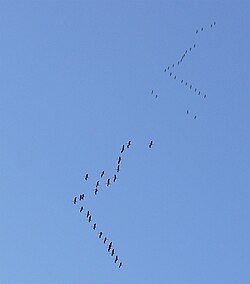
Key Facts
- Emergent System: Flocking requires no central leader; each individual reacts only to its immediate neighbors.
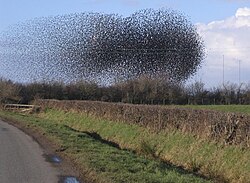
- Murmurations: These are the massive, swirling flocks of starlings seen during winter months.
- Topological Interaction: Starlings typically coordinate with their nearest 5 to 10 neighbors, regardless of the physical distance between them.
- Boids Model: The foundational computer simulation of flocking is based on three rules: separation, alignment, and cohesion.
- Human Parallel: Humans exhibit similar patterns when fleeing danger or moving toward a common focal point.
The Mechanics of Nature
One of the most striking examples of flocking is the starling murmuration. These huge aggregations of hundreds or thousands of birds create intricate patterns in the sky. Through high-speed camera analysis, researchers have discovered that these birds do not track every other member of the flock. Instead, they focus on a small number of topological neighbors.
Interestingly, this cohesion is anisotropic, meaning it is not uniform in all directions. Birds show a stronger tendency to cohere with neighbors to their sides rather than those directly in front or behind, likely because their field of vision is oriented laterally.
Algorithmic Models of Collective Motion
To understand these biological patterns, scientists and computer programmers have developed various mathematical models. In computer science, the term "flocking" is often expanded to describe any collective motion of self-propelled entities, including bacteria and robots.
Reynolds' Boids Model
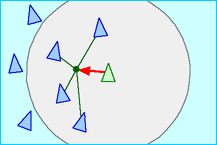
In 1987, Craig Reynolds created a program called Boids to simulate bird flight for motion picture visual effects. He discovered that realistic flocking could be achieved using just three basic rules:
- Separation: Avoid crowding neighbors (short-range repulsion).
- Alignment: Steer toward the average heading of neighbors.
- Cohesion: Steer toward the average position of neighbors (long-range attraction).
Advanced Theoretical Models
Since the Boids model, other researchers have added layers of complexity to better mirror reality:
- Vicsek Model (1995): A physics-based approach treating flocking as "active matter," demonstrating that fixed speed and neighbor alignment can create vortex structures called milling.
- Aerodynamic Models (2011): Hemelrijk and Hildenbrandt incorporated fixed-wing aerodynamics and the specific habit of starlings to stay near sleeping sites.
- Orientation Models (2024): Rama Carl Hoetzlein introduced a model that separates perception (mapped to a sphere) from aerodynamics, successfully simulating spontaneous orientation waves.
- Emotional Extensions: Some models incorporate "fear" transmitted via pheromones or the "change of leadership" to simulate escape behaviors.
Computational Complexity and Efficiency
Simulating thousands of autonomous agents is computationally expensive. A basic algorithm where every bird interacts with every other bird has a high complexity. To optimize this, developers use spatial subdivision, dividing the environment into bins so birds only calculate interactions with those in surrounding bins.
Research by Ballerini et al. (2008) empirically proved that starlings interact with at most seven topological neighbors, justifying these computational shortcuts. However, mathematical proofs by Bernard Chazelle suggest that converging to a perfectly steady state in very large flocks could theoretically take an immense amount of time, though real-world reactions (like dodging a predator) happen much faster due to the nature of biological nervous systems.
Practical Applications of Flocking
The principles of flocking extend far beyond biology and computer graphics. They are now used in various technological and social studies:
- Robotics: Controlling swarms of Unmanned Air Vehicles (UAVs).
- Entertainment: Creating realistic crowds and animals in films, such as the bats in Batman Returns (1992).
- Data Science: Visualizing complex information and performing optimization tasks.
- Human Behavior: Studying crowd dynamics, such as how a small percentage (5%) of a group changing direction can lead the rest of the crowd to follow.
| Model | Primary Focus | Key Characteristic |
|---|---|---|
| Boids | Visual Effects | Separation, Alignment, Cohesion |
| Vicsek | Physics/Active Matter | Fixed speed, neighbor alignment |
| Aerodynamic | Biological Accuracy | Wing physics and sleeping site loyalty |
| Orientation | Perceptual Vision | Spherical mapping and orientation waves |
Frequently Asked Questions
Does a flock have a leader?
No. Flocking is an emergent behavior governed by local rules. Each individual makes its own decisions based on the movement of its immediate neighbors, meaning there is no central coordination or single leader.
How many neighbors does a bird actually follow?
Empirical studies on starlings indicate that they typically interact with their nearest 7 topological neighbors, regardless of how far away those neighbors are physically.
What is a murmuration?
A murmuration is a specific type of flocking behavior exhibited by starlings, characterized by massive groups creating swirling, fluid-like patterns in the sky, usually during winter.
How is flocking used in technology today?
Flocking algorithms are used to program the movement of drone swarms (UAVs), create realistic CGI crowds in movies, design screensavers, and even optimize multi-channel radio station programming.
Can humans exhibit flocking behavior?
Yes. Humans show similar patterns when moving toward a common point of interest or when fleeing a threat, such as a crowd reacting to a sudden loud noise.