Flight Feathers: The Mechanics of Avian Lift, Steering, and Display
Flight feathers, known scientifically as pennae volatus, are the specialized, stiff, and asymmetrically shaped feathers that enable birds to conquer the skies. These pennaceous feathers are symmetrically paired across the wings and tail, working in harmony to generate the thrust and lift necessary for flight. While their primary role is aerodynamic, these feathers often evolve to serve critical biological functions, including courtship rituals, territorial defense, and specialized hunting techniques.
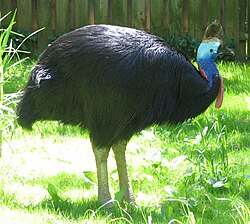
From the silent glide of an owl to the flamboyant plumes of a paradise whydah, flight feathers are a masterclass in biological engineering. Even in flightless birds, these structures persist, though they are often radically modified to suit a terrestrial lifestyle.
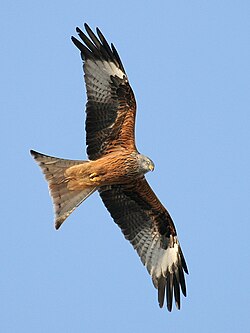
Key Facts
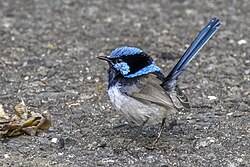
- Remiges are the flight feathers of the wings, while rectrices are those of the tail.
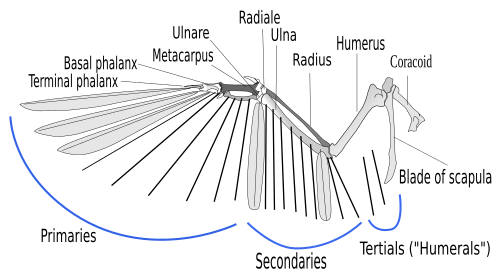
- Primary feathers attach to the manus (hand), and secondary feathers attach to the ulna (forearm).
- Diastataxis refers to the absence of the fifth secondary feather, common in many non-passerine families.
- Ptilochronology is the study of feather growth bars to determine a bird's nutritional history.
- Moult strategies vary from dropping all flight feathers at once to a gradual replacement over several years.
The Anatomy of Wing Feathers: Remiges
The remiges are categorized based on their position and attachment point along the wing. This organization is crucial for creating the airfoil shape required for lift.
Primary Feathers
Primaries are the outermost flight feathers attached to the manus. Typically, there are 11 primaries: six attached to the metacarpus and five to the phalanges. The outermost primary, the remicle, is often rudimentary or entirely absent. In certain species like storks, grebes, and flamingos, the count increases to 12. The primaries connected to the phalanges are specifically referred to as pinions.
Secondary Feathers
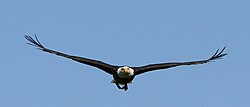
Secondaries attach to the ulna. Unlike primaries, secondaries remain close together during flight, forming the main body of the wing's airfoil to provide lift. They are generally shorter, broader, and have blunter ends than primaries. The number of secondaries varies wildly across species, from as few as six in hummingbirds to as many as 40 in some albatross species.
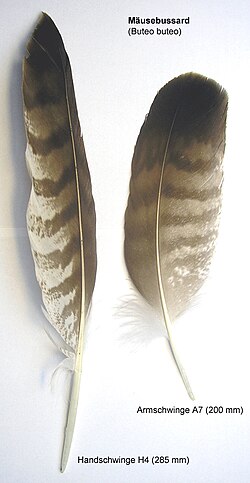
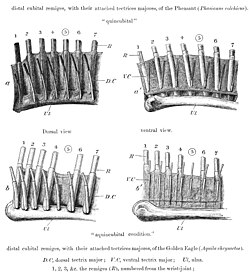
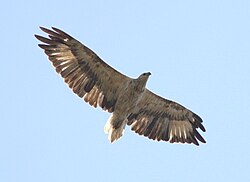
In many non-passerine families—including hawks, eagles, owls, and gulls—the fifth secondary feather is missing, a condition known as diastataxis. Birds that possess this feather are described as eutaxic.
Tertials and Other Structures
Tertiary feathers grow on the brachium (upper arm) but are not considered true remiges. Other specialized structures include the alula, a small group of feathers that help control airflow at slow speeds.
The Anatomy of Tail Feathers: Rectrices
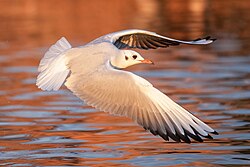
Derived from the Latin word for "helmsman," rectrices are the feathers of the anatomic tail. They are essential for braking and steering during flight. Most species possess six pairs of rectrices, though this varies; grouse often have more than 12, while penguins have greatly reduced them.
Only the central pair of rectrices is attached directly to the tail bones via ligaments. The remaining feathers are embedded in rectricial bulbs, which are complex structures composed of muscle and fat.
Specialized Adaptations and Functions
Beyond basic flight, many birds have evolved flight feathers for highly specific purposes:
- Silent Flight: Owls possess tiny serrations on the leading edge of their remiges to break up airflow, allowing them to hunt in near-silence.
- Structural Support: Woodpeckers have extra-stiff rectrices that act as a brace against tree trunks while drumming.
- Acoustic Displays: Some birds use feathers to create sound. Male club-winged manakins use modified secondaries to produce a trilling call via stridulation (rubbing feathers together), while snipes produce "winnowing" sounds with their outer tail feathers.
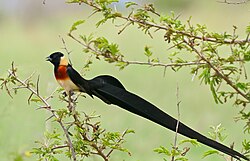
- Visual Courtship: The male long-tailed paradise whydah and certain nightjars possess modified primaries or rectrices that form long, showy plumes for mating displays.
Moult and Development
Because flight feathers are subject to wear and tear, birds must replace them through a process called moult. This process usually begins at a focus (a specific starting point) and proceeds sequentially. For example, many passerines start their moult between the innermost primary and outermost secondary.
Moult strategies vary by environment. Arctic-breeding birds may drop many feathers simultaneously to complete the process quickly before migration, even if it leaves them briefly flightless. In contrast, birds in lower latitudes undergo a more protracted, gradual moult.
Developmental timing also varies. Nestling hoatzins experience delayed remiges development because they possess claws on their first two digits for climbing; feathers would interfere with these hooks. These claws are typically shed between 70 and 100 days of age.
Ornithological Measurement and Analysis
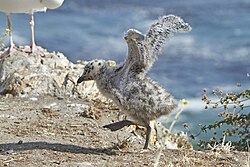
To standardize the study of birds, ornithologists use a specific numbering convention: P for primaries, S for secondaries, T for tertials, and R for rectrices. Secondaries are numbered from the outside in, while rectrices are numbered from the center pair outward.
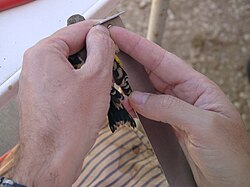
Researchers also use ptilochronology, analyzing the light and dark growth bars in a feather. Since each bar represents approximately 24 hours of growth, these patterns reveal the bird's daily nutritional status. Additionally, primary extension (the length of primaries beyond the secondaries) is often greater in long-distance migrants.
| Feather Type | Scientific Term | Attachment Point | Primary Function |
|---|---|---|---|
| Primaries | Remiges | Manus (Metacarpus/Phalanges) | Thrust and propulsion |
| Secondaries | Remiges | Ulna | Lift and airfoil shape |
| Tail Feathers | Rectrices | Tail bones / Rectricial bulbs | Steering and braking |
| Tertials | N/A | Brachium | Wing stability/coverage |
Frequently Asked Questions
What is the difference between a remex and a rectrix?
A remex (plural remiges) is a flight feather located on the wing, whereas a rectrix (plural rectrices) is a flight feather located on the tail.
What does diastataxis mean in bird anatomy?
Diastataxis is the condition where a bird is missing the fifth secondary feather on each wing, a trait found in many non-passerine families such as hawks, eagles, and owls.
How do owls fly so silently?
Owls have specialized tiny serrations on the leading edge of their remiges, which help to reduce noise during flight, making them more effective hunters.
What is ptilochronology?
Ptilochronology is the study of growth bars in feathers. Because these bars correspond to roughly 24-hour cycles, they can be used to analyze the nutritional status of a bird during the feather's growth.
Why do some birds have modified flight feathers?
Modified feathers often serve non-aerodynamic purposes, such as creating specific sounds for courtship (like the winnowing of snipes) or providing visual signals to attract mates (like the plumes of the paradise whydah).