Fisherian Runaway: The Evolutionary Logic of Extreme Ornamentation
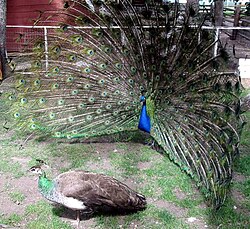
In the natural world, some animals possess traits that seem entirely counterintuitive to survival. The most famous example is the peacock's iridescent, oversized tail—a heavy, energy-consuming ornament that makes the bird more visible to predators and less agile in flight. From a strict survival standpoint, such traits appear maladaptive. However, these features are the result of Fisherian runaway (or runaway selection), a sexual selection mechanism that explains how ostentatious ornaments evolve through persistent female choice.
Proposed by mathematical biologist Ronald Fisher in the early 20th century, this theory suggests that when a female preference for a specific trait becomes genetically linked to that trait, a positive feedback loop is created. This can drive the evolution of extreme sexual dimorphism—the distinct difference in size or appearance between males and females of a species—even if the resulting trait provides no survival advantage.

Key Facts
- Origin: Proposed by Ronald Fisher to explain why males often evolve elaborate ornaments that seem to hinder survival.
- Mechanism: A positive feedback loop where female preference and male ornamentation reinforce each other over generations.
- Genetic Link: The theory assumes that the genes for the preference (in females) and the trait (in males) become correlated.
- Modern Name: Often referred to in contemporary biology as the sexy son hypothesis.
- Limit: The process continues until the survival cost of the ornament outweighs the reproductive benefit.
The History of Sexual Selection
From Darwin to Fisher
The paradox of maladaptive ornaments puzzled biologists since the time of Charles Darwin. In his 1871 work, The Descent of Man, and Selection in Relation to Sex, Darwin suggested that higher animals possessed an "aesthetic sense," leading them to select mates based on beauty. While influential, these ideas were largely neglected by the 1880s and were openly contested by Alfred Russel Wallace, who argued that animals did not show such preferences.
Ronald Fisher challenged Wallace's skepticism in 1915, arguing that the existence of elaborate "love-dances" and secondary sexual characters provided strong evidence of female choice. In his 1930 book, The Genetical Theory of Natural Selection, Fisher formalized the model of runaway inter-sexual selection. He proposed that if a trait initially signaled greater fitness (the likelihood of leaving more descendants), females who preferred that trait would have a selective advantage.

How Fisherian Runaway Works
Initiation and Genetic Basis
For runaway selection to begin, two conditions must be met: there must be a sexual preference in at least one sex, and that preference must provide a reproductive advantage. Fisher noted that the initial trait does not need to be "beautiful" in a human sense; it only needs to be a visible feature that varies among males and allows females to compare them. This makes the choice of the ornament essentially arbitrary.
The mechanism relies on heritability. Both the male's ornament and the female's preference for that ornament are genetically variable. When a female chooses a male with an exaggerated trait, her sons inherit the genes for the ornament, and her daughters inherit the genes for the preference.
The Positive Feedback Loop
As the preference and the trait become genetically correlated, they advance together. This creates a loop: choosier daughters produce more ornamented sons, who are then more attractive to those choosier daughters. This process can increase exponentially in speed, driving the trait to extremes.

The Breaking Point
Runaway selection cannot continue indefinitely. Eventually, counter-selection occurs. This happens when the cost of the ornament—such as increased predation or extreme energy expenditure—becomes so high that it diminishes the male's chance of surviving long enough to mate. Stability is reached when the reproductive benefit of the ornament is exactly balanced by its survival cost.
Comparison of Selection Hypotheses
While Fisherian runaway focuses on the feedback loop of preference, other theories explain ornamentation differently.
| Theory | Primary Driver | Role of the Ornament |
|---|---|---|
| Fisherian Runaway | Positive feedback loop | Arbitrary trait linked to female preference |
| Handicap Principle | Indicator of vigor | A "costly signal" proving the male's high quality |
| Sensory Exploitation | Pre-existing sensory bias | Stimulus that triggers a built-in neural response |
Frequently Asked Questions
What is the "sexy son hypothesis"?
The sexy son hypothesis is the modern term for the Fisherian runaway mechanism. It suggests that females choose attractive mates so that their male offspring will also be attractive, thereby increasing the likelihood that those sons will successfully reproduce.
Does the ornament have to be useful for survival?
No. In a pure Fisherian runaway scenario, the ornament can be entirely non-adaptive or even harmful to survival, provided the reproductive advantage gained through female choice outweighs the survival cost.
How does the handicap principle differ from Fisherian runaway?
While Fisherian runaway suggests the trait is an arbitrary result of a feedback loop, the handicap principle argues that the ornament is a reliable signal of genetic quality because only the healthiest, most fit males can afford the high cost of producing and maintaining it.
Why are females usually less ornamented than males?
This is known as sexual dimorphism. In many species, the pressure of sexual selection acts more strongly on males, who compete for access to females. Females often remain cryptic (camouflaged) to increase their own survival and the survival of their offspring.
Can Fisherian runaway apply to behaviors?
Yes. The theory is not limited to physical traits; it can also apply to sexually dimorphic behaviors, such as complex courtship dances, if those behaviors are preferred by the opposite sex and are heritable.