Fish Locomotion: The Mechanics of Swimming, Gliding, and Walking
Fish have evolved a diverse array of mechanisms to move through their aquatic environments. While swimming is the primary mode of transport, the methods used to achieve propulsion vary wildly across species, ranging from the undulating waves of an eel to the powerful, high-speed thrust of a tuna. These movements are governed by the laws of hydrodynamics—the study of fluids in motion—and are adapted to the specific ecological needs of each fish.
Beyond simple swimming, some specialized species have developed the ability to glide through the air, burrow into mud, or even "walk" across land using their fins. This versatility allows fish to occupy nearly every niche in the world's waters.
Key Facts
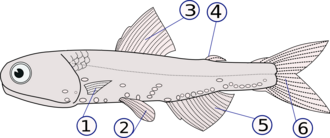
![Skeletal anatomy of Tilapia[3]](/images/e1/02/e102fd6fd6bb968a129025c74978c01ec528bd10400410543fa953d9966be606.png)
- Propulsion Methods: Fish primarily move via lateral body flexions or specialized fin movements.
- Swimming Categories: Locomotion is classified into groups like Anguilliform, Carangiform, and Thunniform based on how much of the body moves.
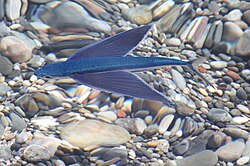
- Flight Adaptation: Flying fish use monoplane or biplane body plans to glide above water.
- Larval Challenges: Young fish face a "Critical Period" where hydrodynamic constraints can lead to a 99% mortality rate due to feeding difficulties.
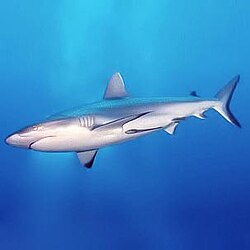
- Dynamic Lift: Sharks must swim constantly to maintain depth because they are denser than water.
The Mechanics of Swimming
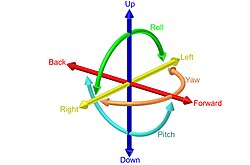
Most fish propel themselves using a combination of their body and the caudal (tail) fin. The efficiency and speed of this movement depend on the fraction of the body that is displaced laterally during a swimming stroke.
Body and Caudal Fin Propulsion
Scientists categorize body-driven swimming into several distinct modes:
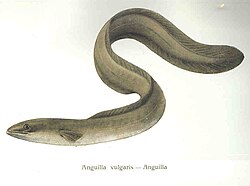
- Anguilliform: Characterized by long, slender bodies (such as eels) where a wave of flexion passes evenly along the entire length of the fish.
- Sub-carangiform: The wave of movement increases in amplitude as it moves toward the tail.
- Carangiform: Movement is concentrated near the tail, which oscillates rapidly to provide thrust.
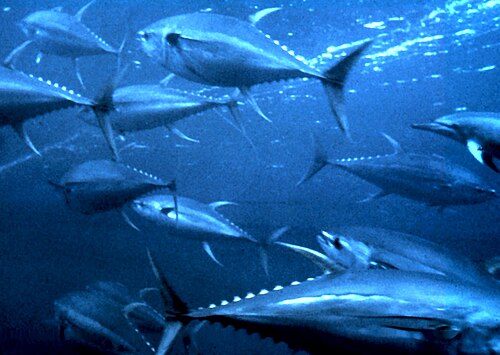
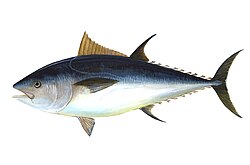
- Thunniform: The most efficient high-speed mode, utilized by tunas, featuring a powerful, crescent-shaped tail.
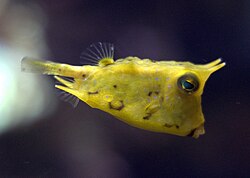
- Ostraciiform: Movement is limited primarily to the tail, as the body remains rigid.
Median and Paired Fin Propulsion
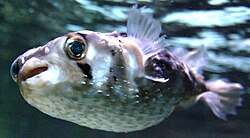
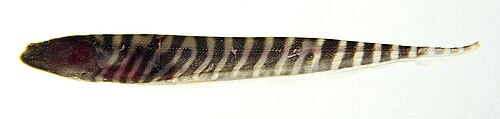
Some fish rely less on their bodies and more on their fins for movement. For example, Diodontiform locomotion, seen in porcupinefish, involves propagating undulations along large pectoral fins. Other specialized modes include Balistiform (used by boxfish, who rely on pectoral fins due to their non-streamlined bodies) and Gymnotiform (used by Gymnotus, which keeps a straight back to avoid interfering with its electric sense).
Advanced Adaptations: Lift, Flight, and Walking
Not all fish simply push water backward to move forward. Some utilize dynamic lift, a force generated by the movement of a wing-like surface through a fluid. Sharks, for instance, are denser than water and must swim continuously, using their pectoral fins to create lift and maintain their depth.
The Physics of Gliding
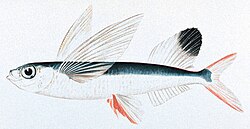
Flying fish have evolved two primary body plans to achieve temporary flight:
- Biplane Body Plan: Utilizes both pectoral and pelvic fins to produce lift during takeoff.
- Monoplane Body Plan: Found in Exocoetus, where only the pectoral fins are enlarged. These fish are more streamlined and adapted for higher flight speeds, launching at steep angles of attack (up to 45 degrees).
Non-Swimming Locomotion
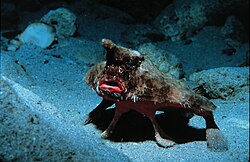
Certain species have adapted to environments beyond open water. Some fish can "walk" or crawl over land using their pectoral and pelvic fins, while others are specialized for burrowing in mud, often using a bony tail to move forward or backward.
Larval Locomotion and the "Critical Period"
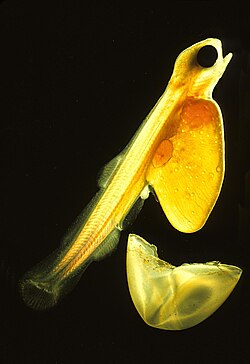
The swimming abilities of larval fish are vital for survival, particularly for reef fish that must locate a home while avoiding predators. Larvae operate in an intermediate flow regime where both viscous forces (friction) and inertial forces are significant. This relationship is measured by the Reynolds number (Re).
Hydrodynamic Constraints on Feeding
Larval fish experience a "Critical Period" shortly after they begin feeding (5–7 days post-fertilization), with mortality rates reaching approximately 99%. This is largely due to hydrodynamic constraints. Successful prey capture requires a higher Reynolds number (around Re~200); failed strikes typically occur at lower numbers (Re~20). In very small larvae, up to 40% of the energy used to open the mouth is lost to frictional forces, making suction feeding inefficient.
The Role of the Strouhal Number
The Strouhal number is a design parameter used to analyze vortex shedding (the swirling patterns of water left behind a swimming fish). It is the ratio of the product of tail beat frequency and amplitude to the mean swimming speed. While adult fish maintain a relatively constant Strouhal number, larvae show significant variation based on their size and the flow regime they encounter.
Summary of Fish Locomotion Modes
| Mode | Primary Mechanism | Example Species | Key Characteristic |
|---|---|---|---|
| Anguilliform | Full-body wave | Eels | Constant amplitude wave |
| Thunniform | Crescent tail | Tuna | High-speed, high-efficiency |
| Diodontiform | Pectoral fins | Porcupinefish | Fin undulation |
| Monoplane | Enlarged pectoral fins | Exocoetus | High-speed gliding |
Frequently Asked Questions
Why do sharks have to keep swimming?
Sharks are denser than the surrounding seawater. To avoid sinking, they rely on dynamic lift generated by their pectoral fins, which requires constant forward motion to maintain their depth.
What is the difference between a monoplane and biplane body plan in flying fish?
A monoplane plan features only enlarged pectoral fins and is adapted for higher flight speeds and steep launches. A biplane plan utilizes both pectoral and pelvic fins to maximize lift during takeoff.
How does the Reynolds number affect larval fish?
The Reynolds number indicates the balance between inertial and viscous forces. For larvae, a low Reynolds number means viscous forces (friction) dominate, which can hinder their ability to capture prey and lead to high mortality rates.
What is the "Critical Period" for larval fish?
The Critical Period occurs 5–7 days after fertilization when larvae start feeding. During this time, hydrodynamic limitations often prevent them from successfully capturing prey, leading to extreme mortality rates.
How do boxfish swim if they aren't streamlined?
Because they lack a streamlined body, boxfish use median-paired fin swimming, relying primarily on their pectoral fins to produce the necessary thrust for movement.