First Battle of Ypres: The Bloody Stalemate of 1914
The First Battle of Ypres, fought between 19 October and 22 November 1914, stands as one of the most pivotal encounters of the early First World War. Located in West Flanders, Belgium, this clash was a critical component of the broader First Battle of Flanders. It marked the transition from a war of rapid movement to the grueling, static attrition of trench warfare that would define the Western Front for years to come.
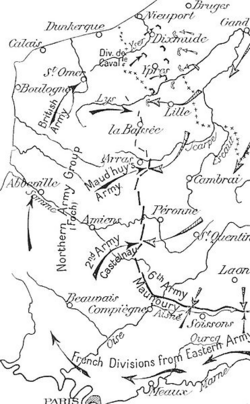
The conflict emerged from the "Race to the Sea," a series of reciprocal attempts by the German and Franco-British armies to outflank one another to the north. As both sides reached the Belgian coast, the open flanks disappeared, forcing the armies into a direct and brutal confrontation around the municipality of Ypres.
Key Facts
- Date: 19 October – 22 November 1914.
- Location: Ypres, West Flanders, Belgium.
- Belligerents: The German Empire against the Allied forces of France, Belgium, and the United Kingdom (British Empire).
- Result: Indecisive; the front stabilized into a line of trenches.
- Strategic Shift: Transitioned the conflict from a war of maneuver to static attrition.
Strategic Background and the Race to the Sea
Following the "Great Retreat"—a long withdrawal by French and British forces to the Marne in August and September 1914—the Allies managed to halt the German advance during the First Battle of the Marne. However, the war remained fluid. By late September, both sides were attempting to secure the northern flank in Flanders.
The German high command, led by Erich von Falkenhayn, aimed to deliver an annihilating blow to the Allied forces. Falkenhayn deployed the 4th Army to Flanders, supported by heavy artillery and several new reserve corps. These reserve units, composed largely of volunteers, were often poorly trained and ill-equipped, yet they were ordered to advance regardless of losses to isolate the ports of Dunkirk and Calais.
The Progression of the Battle
The fighting at Ypres is generally divided into five distinct stages, evolving from encounter battles to concentrated offensives.
The Battle of Langemarck (21–24 October)
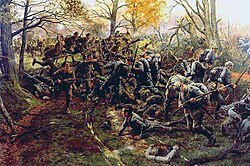
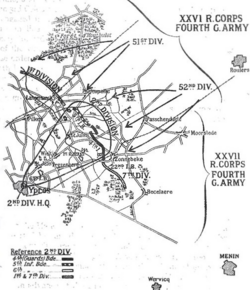
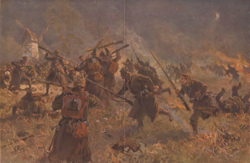
The Battle of Langemarck saw the German 4th and 6th armies launch a series of badly organized attacks against the British IV Corps and French territorial units. Despite their numerical superiority, the Germans suffered staggering losses—up to 70% in some reserve units—due to the disciplined fire of the British Expeditionary Force (BEF).
During this phase, the British employed a tactic known as the "mad minute," firing rapid, short bursts at close range to conserve ammunition while maximizing lethality. This efficiency, combined with the use of Hotchkiss machine guns, devastated the advancing German infantry.
The Battle of Gheluvelt and Nonne Bosschen
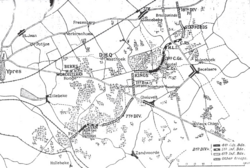
As the conflict progressed, the Germans focused their efforts on the Gheluvelt sector (29–31 October) and later the Battle of Nonne Bosschen on 11 November. These attacks were designed to break the Allied line and capture Ypres. While the Germans managed to seize small amounts of ground, they failed to achieve a decisive breakthrough.
Winter Operations and Stabilization
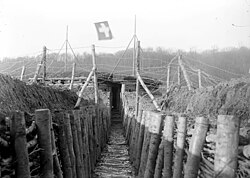
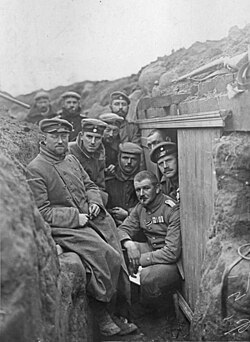
By mid-November, the weather turned severe. Rain, snow, and freezing frosts turned the battlefield into a wasteland of mud and ice. Soldiers suffered from frostbite while occupying trenches half-filled with freezing water. By 17 November, the German 4th Army ceased its major attacks, and the front stabilized into a continuous line of defenses stretching from Switzerland to the Belgian coast.
Casualties and Aftermath
The First Battle of Ypres was a costly endeavor for all involved. The lack of sufficient reinforcements on both sides prevented a decisive victory, leaving both armies exhausted and short of ammunition.
| Belligerent | Estimated Casualties (Various Sources) |
|---|---|
| German Empire | 80,000 to 134,315 |
| France | 50,000 to 86,237 |
| United Kingdom (BEF) | 54,000 to 58,155 |
| Belgium | 21,562 |
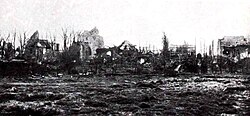
The battle concluded with the realization that Ypres could not be captured through direct assault. The conflict had evolved into a war of attrition, where gains were measured in yards and paid for with thousands of lives.
Frequently Asked Questions
What was the primary result of the First Battle of Ypres?
The result was indecisive. While the German Empire failed to capture Ypres or break the Allied line, the Allied forces were unable to push the Germans back. The battle ended with the establishment of a static trench system.
What was the "Race to the Sea"?
The Race to the Sea refers to the series of maneuvers by both the German and Allied armies to outflank each other's northern wing, eventually leading them to the Belgian coast where no further flanking was possible.
Who were the primary commanders during this battle?
Key leaders included Joseph Joffre and Ferdinand Foch for the French, John French for the British, Albert I for the Belgians, and Erich von Falkenhayn, Albrecht of Württemberg, and Rupprecht of Bavaria for the Germans.
What was the "mad minute"?
The "mad minute" was a British infantry tactic involving rapid, disciplined rifle fire at close range. This allowed the BEF to inflict massive casualties on attacking German forces, particularly the poorly trained reserve corps.
How did the weather affect the battle?
Severe autumn and winter weather, including heavy rain and snow, created miserable conditions. Trenches became flooded with freezing water, leading to widespread frostbite and extreme physical strain on the soldiers.