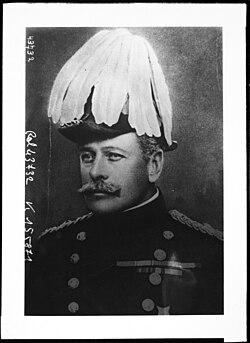
Douglas HaigField MarshalBritish Expeditionary ForceFirst World WarWestern Front

Field Marshal Douglas Haig: Commander of the British Expeditionary Force

Field Marshal Douglas Haig: Commander of the British Expeditionary Force Field Marshal Douglas Haig, 1st Earl Haig, stands as one of the most significant and debated figures in British mi...

Field Marshal Douglas Haig: Commander of the British Expeditionary Force

Field Marshal Douglas Haig, 1st Earl Haig, stands as one of the most significant and debated figures in British military history. As the commander of the British Expeditionary Force (BEF)—the primary British army deployed overseas—on the Western Front from late 1915 until the end of the First World War, Haig oversaw some of the largest and most costly engagements in human history.

Born in Edinburgh, Scotland, Haig's journey from a junior cavalry officer to the highest rank in the British Army is a study in professional ascent, strategic evolution, and the immense pressures of industrial warfare.
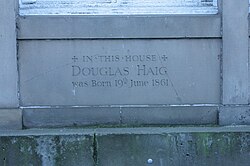
Plaque marking Earl Haig's birthplace, Charlotte Square, Edinburgh

Key Facts

  • Full Name: Field Marshal The Right Honourable The Earl Haig.
  • Role: Commander-in-Chief of the British Expeditionary Force (BEF) from 1915 to 1918.
  • Major Conflicts: Mahdist War, Second Boer War, and First World War.
  • Highest Rank: Field Marshal.
  • Post-War Role: President of the British Legion.
  • Death: January 29, 1928, in London, England.

Early Life and Military Ascent

Douglas Haig was born on June 19, 1861, in Edinburgh. His early career was defined by his service in the cavalry, where he developed a lifelong passion for horse-mounted warfare. By 1885, he was serving as a young officer in the hussars, a type of light cavalry known for reconnaissance and skirmishing.
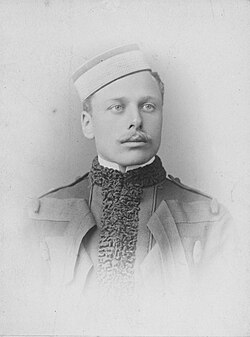
Age 23 in 1885, in his hussar's uniform

Haig's early experience included service in the Mahdist War (1898) and the Second Boer War (1899–1902). During the Boer War, Haig formed a critical professional relationship with John French. In a notable gesture of support, Haig lent French £2,500 (approximately £400,000 in 2024 value) to cover losses from mining speculations, a loan that allowed French to maintain his military commission.
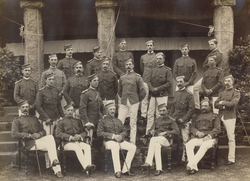
Officers of the 7th Hussars, Secunderabad, 1890. Lieutenant Haig is stood in the third row, with cane, second on the left.

Following the Boer War, Haig's career continued to climb. He served as the Inspector General of Cavalry in India and later as the GOC (General Officer Commanding) of the Aldershot Command in March 1912, where he managed the 1st and 2nd divisions and the 1st Cavalry Brigade.
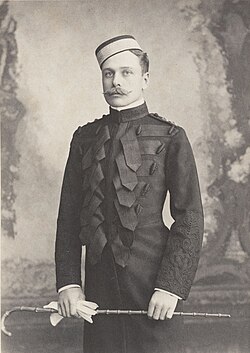
Photograph of the young Douglas Haig as an officer with the 7th Hussars.

Education and Professional Development

Haig was a product of formal military education, attending the Staff College at Camberley in 1897. This training provided him with the theoretical foundation in logistics and command that would be essential for managing the millions of men he would later lead in France.

Officers, many of whom later became generals, at the Staff College, Camberley, 1897. Stood in the third row, fifth from the left, is Captain Haig, head tilted to the left.

Command During the First World War

At the outbreak of the First World War in 1914, Haig was an aide-de-camp to King George V. While he initially supported the appointment of John French as Chief of the Imperial General Staff (CIGS), he later expressed "grave doubts" to the King regarding French's temperament and military knowledge.
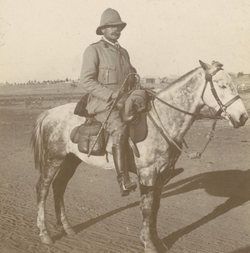
Major Douglas Haig seen mounted on a grey horse near Pretoria, in the Transvaal Republic on Friday, 8 June 1900.

Haig's role expanded as the conflict progressed. He played a key part in the early battles of the war, from Mons to the Marne and the First Battle of Ypres. By late 1915, Haig replaced French as the commander of the BEF, taking responsibility for the British effort on the Western Front.
General Sir O'Moore Creagh, the C-in-C, India, and members of his staff, c. 1910. Major General Douglas Haig is sat in the second row, seventh from the left.

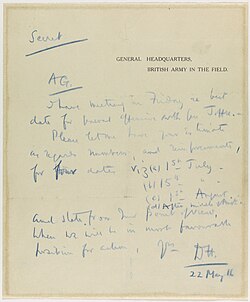
His tenure was marked by massive offensives, most notably the Battle of the Somme in 1916. Internal documents, such as a memorandum to Lieutenant General Sir Nevil Macready dated May 22, 1916, reveal the meticulous planning and deliberation regarding the launch dates of such offensives.
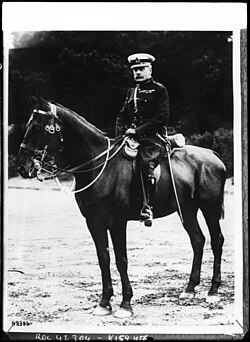
Haig on horseback in 1914.

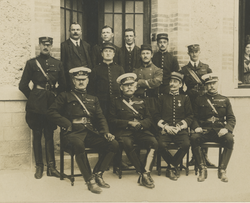
British and French officers at French manoeuvres, 1914. Lieutenant General Haig is sat in the front row on the extreme right.

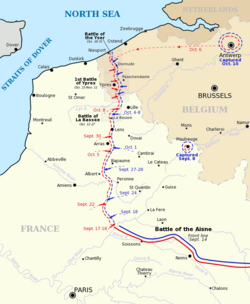
Map of the Western Front in 1914.

Throughout 1917 and 1918, Haig navigated complex political relationships with leaders like David Lloyd George and coordinated closely with French allies, including General Ferdinand Foch and General Joseph Joffre.
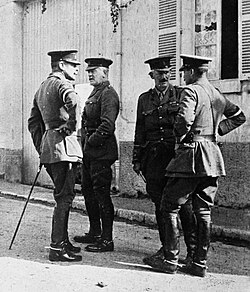
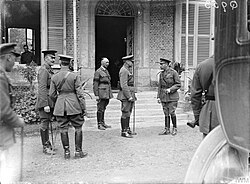
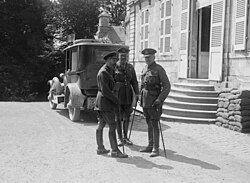
Haig (left) with Major-General Charles Monro (GOC 2nd Division), Brigadier-General John Gough (Haig's BGGS), and Brigadier-General E. M. Perceval (commanding the 2nd Division's artillery) in a street in France, 1914.

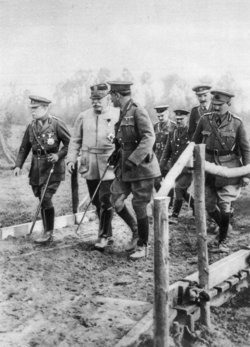
French, Joffre and Haig (left to right) visit the front line during 1915. Henry Wilson is second from the right, with Hubert Gough to his left.

Haig as commander of the First Army.

Haig (centre), King George V and General Rawlinson, GOC Fourth Army, at Querrieu, 1916.

By January 1, 1917, Haig had been promoted to the rank of Field Marshal. He led the BEF through the German Michael, Georgette, and Bluecher offensives of 1918, eventually overseeing the "Hundred Days Offensive" that contributed to the Allied victory.
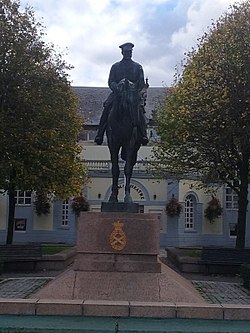
The statue of Field Marshal Haig, standing outside the theatre in Montreuil-sur-Mer.

Memorandum from Haig to the army's adjutant general, Lieutenant General Sir Nevil Macready, asking his opinion on possible dates for launching the Somme offensive, 22 May 1916

King George V with General Sir Douglas Haig and Major General Geoffrey Feilding, commanding the Guards Division, at Beauquesne, France, 12 August 1916.

British and French leaders at Beauquesne, France, August 1916. From left to right: General Joseph Joffre, Raymond Poincaré, King George V, General Ferdinand Foch, General Sir Douglas Haig.

General Haig (second left) in discussion with David Lloyd George in September 1916.

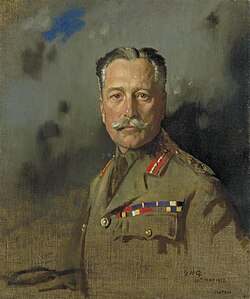
Portrait of Haig at General Headquarters, France, by Sir William Orpen, May 1917

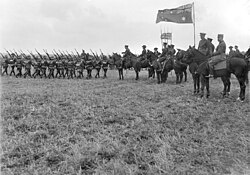
Field Marshal Sir Douglas Haig reviews the 5th Australian Division at Ebblinghem, 29 August 1917.

Haig and Clemenceau at Doullens, April 1918.

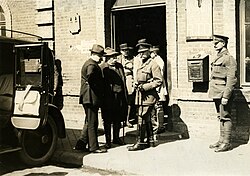
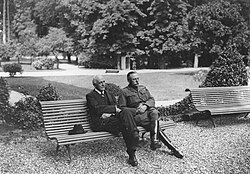
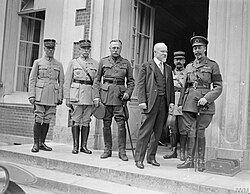
Haig and Lord Arthur Balfour at Versailles, France, July 1918.

Haig attending a service on the fourth anniversary of the declaration of war at Montreuil, France, 4 August 1918. Stood to his left is Lieutenant General Fowke, the BEF's adjutant general, while his CGS, Lieutenant General Lawrence, Kiggell's successor, is on his right.

King George V, French President Raymond Poincaré and Haig at GHQ at Montreuil, 7 August 1918

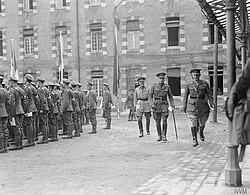
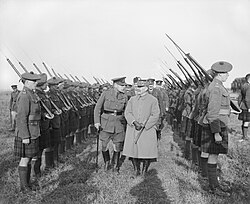
Haig and Ferdinand Foch inspecting the Gordon Highlanders, 1918

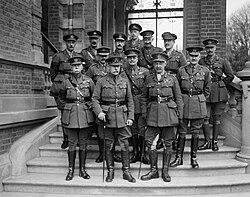
Sir Douglas Haig with his army commanders and their chiefs of staff, November 1918. Front row, left to right: Sir Herbert Plumer, Sir Douglas Haig, Sir Henry Rawlinson. Middle row, left to right: Sir Julian Byng, Sir William Birdwood, Sir Henry Horne. Back row, left to right: Sir Herbert Lawrence, Sir Charles Kavanagh, Brudenell White, Percy, Louis Vaughan, Archibald Montgomery-Massingberd, Hastings Anderson.

Later Life and Legacy

After retiring from active service in 1920, Haig remained deeply connected to the military and public service. He served as the president of the British Legion until his death and was the chairman of the United Services Fund. He also held academic honors, serving as the Lord Rector and later Chancellor of the University of St Andrews.
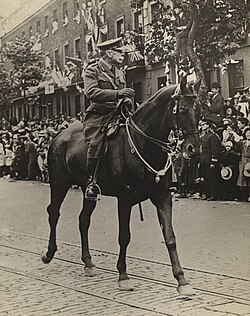
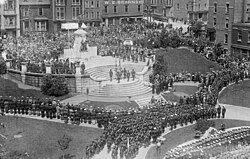
Field Marshal Haig during the London Victory Parade of 1919.

ภาพประกอบบทความ
ภาพประกอบจากบทความต้นฉบับ

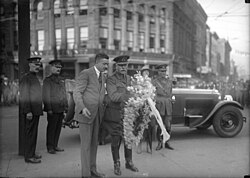
Haig in Vancouver, British Columbia

Haig was also an avid golfer and served as the captain of The Royal and Ancient Golf Club of St Andrews from 1920 to 1921.

Historical Reputation

Haig's legacy is polarized. To some, he is the "Butcher Haig," a general who wasted lives in futile attacks. To others, such as historians Robin Prior and Trevor Wilson, he was a commander who adapted to the unprecedented challenges of modern warfare. Historian John Terraine argued that the casualties were an inevitable result of the nature of the conflict rather than individual failure.

Haig died on January 29, 1928, and was buried at Dryburgh Abbey in the Scottish Borders.

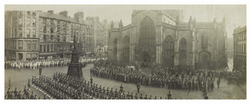
Funeral of Earl Haig, St Giles Kirk, Edinburgh, February 1928.

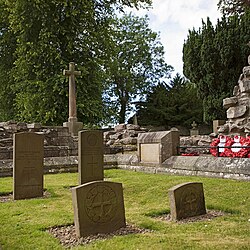
Douglas Haig's grave (right) next to his wife, with the standard military headstone used in the First World War.

Earl Haig statue, Edinburgh Castle. The statue was commissioned by Sir Dhunjibhoy Bomanji of Bombay.[246] It was in full view near the Castle entrance, but now relatively hidden in a back courtyard at the entrance to the National War Museum.[247]

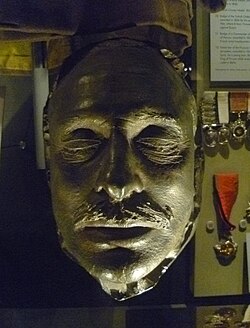
Haig's death mask, Edinburgh Castle

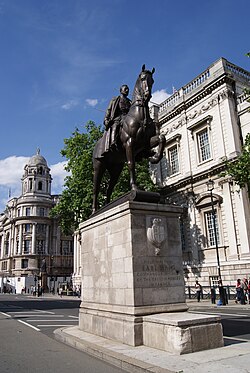
Earl Haig Memorial, Whitehall, London

Summary of Career and Honors

Category Details
Service Years 1884–1920
Key Commands GOC Aldershot, Commander-in-Chief of the BEF
Major Awards Knight of the Order of the Thistle (KT), Order of Merit (OM), GCB, GCVO
Academic Degrees Honorary Doctorates from Edinburgh, Aberdeen, Glasgow, Oxford, and Leeds
Family Spouse: Dorothy Maud Vivian; Children: George Haig and Lady Irene Haig

Frequently Asked Questions

Why was Douglas Haig nicknamed "Butcher Haig"?

The nickname stems from the high casualty rates suffered by British troops during major offensives under his command, particularly the Battle of the Somme, leading critics to view his tactics as callous or outdated.

What was Haig's relationship with John French?

Haig and French were professional colleagues; Haig notably provided a significant financial loan to French during the Boer War to help him keep his commission, though Haig later expressed doubts about French's military capabilities to King George V.

What roles did Haig hold after his military retirement?

He was the president of the British Legion, chairman of the United Services Fund, and served as the Chancellor of the University of St Andrews.
Where is Field Marshal Haig buried?

He is buried at Dryburgh Abbey in the Scottish Borders, alongside his wife.

Which major conflicts did Haig participate in?

Haig served in the Mahdist War, the Second Boer War, and the First World War.