2nd Indian Cavalry Division
The 2nd Indian Cavalry Division was a specialized formation of the British Indian Army established at the onset of World War I. Serving under the British Crown, this division played a complex role on the Western Front, transitioning between traditional cavalry duties and the grueling demands of trench warfare.
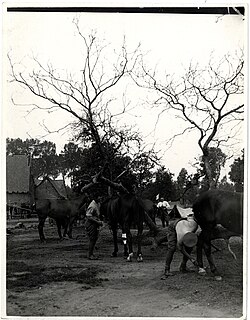
Formed in September 1914, the division was part of the larger Indian Cavalry Corps. Its journey began on October 16, 1914, when it sailed from Bombay to France under the command of Major-General G. A. Cookson. Throughout its deployment, the division faced the unique challenges of adapting cavalry training to the static, industrial nature of the First World War.
Key Facts
- Active Period: September 1914 – March 1918.
- Primary Theater: Western Front, France.
- Major Transitions: Renamed the 5th Cavalry Division on November 26, 1916.
- Combat Role: Operated both as mounted cavalry and as dismounted infantry in the trenches.
- Final Disposition: Broken up in March 1918; Indian units moved to Egypt for the 2nd Mounted Division.
Operational History on the Western Front
Due to the nature of the Western Front, the division frequently served as infantry. When dismounted, each cavalry brigade was reorganized into a dismounted regiment to better suit troop levels for trench duty. By March 1916, the division was attached to the British Fourth Army.
The Battle of the Somme
The division's most significant engagements occurred during the Battle of the Somme. On July 1, 1916, the 9th (Secunderabad) Cavalry Brigade was placed in reserve to exploit any potential breakthroughs in the enemy line. On July 14, the brigade moved to Montauban to support the attack on the Bazentin–Longueval ridge.
At 17:30, the 20th Deccan Horse and the British 7th Dragoon Guards galloped forward between High Wood and Delville Wood. Despite the bold advance, the operation achieved little, and the units returned to Montauban on July 15, having suffered 74 men and 110 horses as casualties.
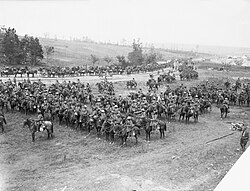
While cavalry units were brought forward again on September 15 to support the attack on Flers-Courcelette, they were not drawn into active fighting. For the remainder of the Battle of the Somme, they served primarily as reserve labor units.
Challenges and Reorganization
The division struggled with a high rate of officer casualties early in the war. This was particularly damaging because British officers who possessed the necessary knowledge of the language, customs, and psychology of the Indian soldiers were difficult to replace. This loss of leadership, combined with the alien environment of the Western Front, impacted the division's overall performance.
On November 26, 1916, the unit was renamed the 5th Cavalry Division and attached to the 5th Army. It continued to serve through engagements including the Hindenburg Line and the Battle of Cambrai.
Order of Battle
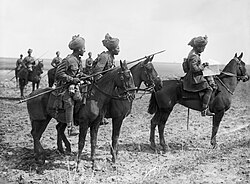
The division comprised a diverse array of British, Indian, and eventually Canadian units. The structure evolved as brigades were transferred to other theaters, such as Mesopotamia.
| Brigade/Unit | Notable Regiments/Batteries | Notes |
|---|---|---|
| 5th (Mhow) Cavalry Brigade | 6th (Inniskilling) Dragoons, 2nd Lancers, 38th King George's Own Central India Horse | Left for 1st Indian Cavalry Division in Sept 1915 |
| 7th (Meerut) Cavalry Brigade | 13th Hussars, 3rd Skinner's Horse, 30th Lancers | Transferred to Mesopotamia in June 1916 |
| 9th (Secunderabad) Cavalry Brigade | 7th Dragoon Guards, 20th Deccan Horse, 34th Poona Horse | Active at Bazentin Ridge |
| 3rd (Ambala) Cavalry Brigade | 8th Hussars, 9th Hodson's Horse, 18th King George's Own Lancers | Joined from 1st Indian Cavalry Division in 1915 |
| Canadian Cavalry Brigade | Royal Canadian Dragoons, Lord Strathcona's Horse, Fort Garry Horse | Joined June 1916 from 3rd Cavalry Division |
| II Indian Brigade, RHA | N, X Batteries, Royal Horse Artillery | Artillery support; renamed XVII Brigade in Nov 1916 |
Frequently Asked Questions
When was the 2nd Indian Cavalry Division renamed?
The division was renamed the 5th Cavalry Division on November 26, 1916, at which point it was attached to the 5th Army.
Did the division fight only as cavalry?
No. Due to the nature of the Western Front, the division frequently served in the trenches as dismounted infantry, with each cavalry brigade forming a dismounted regiment.
What happened to the division in March 1918?
The division was broken up. The British and Canadian units remained in France, while the Indian elements were transferred to Egypt to help form the 2nd Mounted Division.
Which major battles did the division participate in?
The division was involved in the Battle of the Somme (specifically the Battle of Bazentin Ridge and the attack on Flers-Courcelette), the Hindenburg Line, and the Battle of Cambrai.
Why did officer casualties significantly impact the division?
The loss of officers was critical because replacements often lacked the specific linguistic and cultural understanding required to lead and manage the Indian soldiers effectively in a foreign environment.