Field Marshal Lord Richards of Herstmonceux: A Legacy of British Military Leadership
Field Marshal David Julian Richards, Baron Richards of Herstmonceux, stands as one of the most distinguished figures in modern British military history. From his early commissions in the Royal Artillery to serving as the professional head of the British Armed Forces, his career spans over four decades of operational command and strategic governance. Known for his decisive action in West Africa and his leadership during the expansion of NATO forces in Afghanistan, Lord Richards has transitioned from the battlefield to the halls of Parliament as a respected peer.
Key Facts
- Highest Rank: Field Marshal (promoted honorary in June 2025).
- Top Position: Chief of the Defence Staff (2010–2013).
- Key Commands: International Security Assistance Force (ISAF) in Afghanistan and UK forces in Sierra Leone.
- Political Role: Life Peer and Crossbencher in the House of Lords since 2014.
- Education: University College, Cardiff (Degree in International Relations).
Early Life and Commissioning
Born on 4 March 1952 in RAF Fayid, Egypt, David Richards was the son of an officer in the Royal Army Pay Corps. His upbringing was nomadic, moving between Egypt, Cyprus, and Wiltshire before settling in East Sussex. After attending Eastbourne College, he was commissioned into the Royal Artillery as a second lieutenant in 1971.
Richards' early career was marked by rigorous training and international deployment. He completed the Commando course at Lympstone and served in Singapore. He furthered his academic credentials by graduating from University College, Cardiff, in 1974 with a degree in international relations, blending tactical military training with strategic academic study.
Rise Through the Ranks
Throughout the 1970s and 80s, Richards served across the Far East, Germany, and Northern Ireland. His progression was steady, moving from lieutenant in 1974 to captain in 1977, and major in 1984. He gained significant experience as the Chief of Staff of the Berlin Brigade and as an instructor at the Staff College, Camberley.
By the mid-1990s, Richards moved into high-level planning and command. After serving as Colonel Army Plans at the Ministry of Defence, he was promoted to brigadier and commanded the 4th Armoured Brigade in Germany. His role as Chief of Joint Force Operations at the Permanent Joint Headquarters positioned him as the primary commander for short-notice expeditionary operations.
Operational Command in East Timor and Sierra Leone
In 1999, Richards commanded the UK Contingent in East Timor as part of INTERFET. However, he is perhaps most noted for his leadership during the Sierra Leone Civil War in 2000. While commanding a UK Joint Task Force, he took decisive action without official sanctioning to protect Freetown from rebel attacks, a move that is widely credited with stabilizing the region.
Global Leadership and NATO
Richards' career expanded into international diplomacy and coalition warfare. He served as the Chief of Staff and later the Commander of NATO's Allied Rapid Reaction Corps (ARRC), reaching the rank of lieutenant general.
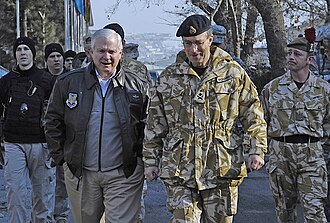
Between 2006 and 2007, he commanded the International Security Assistance Force (ISAF) in Afghanistan. During this period, he was promoted to the acting rank of full general. He focused on coordinating with President Hamid Karzai's government and establishing Afghan Development Zones to integrate targeted aid with security operations.
Chief of the General Staff and Chief of the Defence Staff
In 2009, Richards became the Chief of the General Staff, the professional head of the British Army. His tenure was marked by public debate over the duration of the conflict in Afghanistan, including a controversial suggestion that British troops might be required there for up to 40 years.
On 29 October 2010, he ascended to the highest professional post in the military: Chief of the Defence Staff (CDS). In this role, he managed the overarching strategy for the British Armed Forces. During the Syrian Civil War, he proposed an ambitious plan to train a 100,000-strong rebel army to overthrow President Bashar al-Assad, though this was ultimately rejected by the National Security Council.
Post-Military Career and Peerage
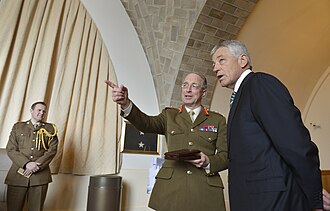
After retiring from active service in July 2013, Richards was created a life peer on 24 February 2014, taking the title Baron Richards of Herstmonceux. He serves as a crossbencher in the House of Lords, providing non-partisan expertise on defense and international security.
Beyond politics, he has served on the global advisory board of the asset management firm CQS and acted as an advisor to the government of the United Arab Emirates and the arms company DynCorp. In June 2022, he continued to contribute to strategic discourse by criticizing the West's incremental approach to the Russian invasion of Ukraine.
| Period | Role/Rank | Key Focus/Achievement |
|---|---|---|
| 1971 | Second Lieutenant | Commissioned into Royal Artillery |
| 2000 | Brigadier | Protected Freetown during Sierra Leone Civil War |
| 2006–2007 | Commander, ISAF | Led international forces in Afghanistan |
| 2009–2010 | Chief of the General Staff | Professional head of the British Army |
| 2010–2013 | Chief of the Defence Staff | Professional head of the British Armed Forces |
| 2014–Present | Life Peer | Crossbencher in the House of Lords |
| 2025 | Field Marshal | Promoted to honorary Field Marshal |
Frequently Asked Questions
What was Lord Richards' most significant achievement in Sierra Leone?
Lord Richards is highly regarded for his leadership during the Sierra Leone Civil War, where he took action without official sanctioning to protect the capital, Freetown, from rebel attacks.
What role did he play in the conflict in Afghanistan?
He commanded the International Security Assistance Force (ISAF) from 2006 to 2007, overseeing the expansion of the force across Afghanistan and establishing Afghan Development Zones for targeted aid.
What is a "crossbencher" in the House of Lords?
A crossbencher is a member of the House of Lords who does not belong to any political party, allowing them to provide independent and non-partisan contributions to legislative debates.
When was he promoted to Field Marshal?
Lord Richards was promoted to honorary Field Marshal in the British Army on 14 June 2025.
What was his proposed strategy for the Syrian Civil War?
He proposed training and equipping a Syrian rebel army of 100,000 soldiers to overthrow President Bashar al-Assad, though the National Security Council rejected the plan as too ambitious.