Ferdinand VII: The Controversial King of Spain
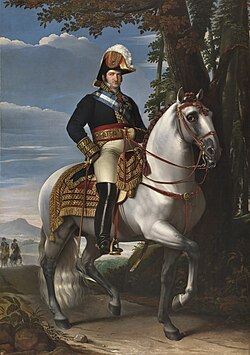
Ferdinand VII was a pivotal and polarizing figure in early 19th-century Spanish history. Known by two starkly different nicknames—el Deseado (the Desired) before his restoration and el Rey Felón (the Criminal King) afterward—his reign was defined by a violent tug-of-war between absolute monarchy and emerging liberal democracy.
His life was marked by two distinct periods of rule, interrupted by the Napoleonic Wars and characterized by a deep ideological rift that split Spain into reactionary right-wing forces and progressive liberals.
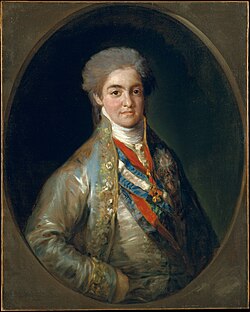
Key Facts
- Reign: Two periods (March–May 1808 and December 1813–September 1833).
- Dynasty: House of Bourbon.
- Major Conflict: The Peninsular War, triggered by Napoleon's overthrow of the Spanish monarchy.
- Political Stance: Staunch absolutist who repeatedly rejected the liberal Constitution of 1812.
- Succession: His daughter, Isabella II, succeeded him, sparking the Carlist Wars.
Early Life and the Path to the Throne
Born on October 14, 1784, at El Escorial, Ferdinand was the eldest surviving son of King Charles IV and Maria Luisa of Parma. Despite being the heir apparent, he was largely excluded from government affairs by his parents and their influential advisor, Manuel Godoy.
This exclusion bred resentment, leading Ferdinand to become involved in the El Escorial Conspiracy of 1807, an attempt to secure support from Napoleon Bonaparte to overthrow his father's government. Although the plot failed and Ferdinand was arrested, the growing national discontent eventually culminated in the Tumult of Aranjuez in 1808.
The First Reign and Napoleonic Captivity
In March 1808, following popular riots, Charles IV abdicated, and Ferdinand VII ascended the throne. However, his first reign was incredibly brief. By May 6, 1808, Napoleon forced Ferdinand to abdicate, replacing him with his brother, Joseph Bonaparte.
Ferdinand spent the next six years under guard at the Château de Valençay in France. While the Spanish elite initially accepted the change, the general population did not. This sparked the Peninsular War, a brutal conflict where provincial juntas rose up against French rule.
![Silver coin: 8 reales New Spain with a portrait of King Fernando VII, 1810[3]](/images/59/d4/59d406aa368eb5563da5987fff969cac9aa0e919024ae27f113c90cb0a2f2b4b.png)
![Silver coin: 8 reales Viceroyalty of the Río de la Plata with a portrait of King Fernando VII, 1823[4]](/images/08/81/0881601e22d4ef2da95ad71916d06520b09d6a36679f35b5f642dde20b2526f5.png)
The Second Reign: Restoration and Absolutism
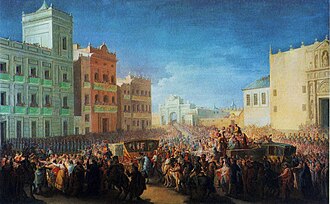
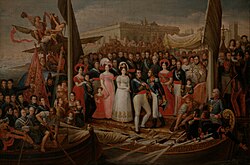
By December 1813, Napoleon's fortunes had shifted, and the Treaty of Valençay allowed Ferdinand to return to Spain. He was initially welcomed as a liberator, but the Spain he returned to had changed. In his absence, liberals had drafted the Constitution of 1812, which sought to limit royal power.
Although Ferdinand gave lukewarm promises to uphold the constitution to secure his return, he quickly moved to re-establish an absolute monarchy. He suppressed the liberal press, jailed writers, and relied on a small circle of favorites known as a camarilla.
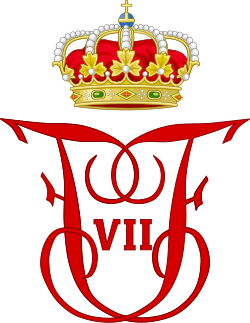
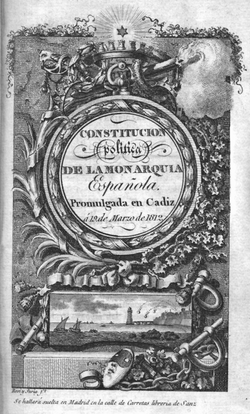
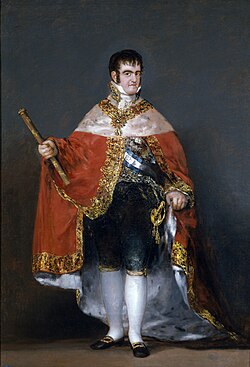
The Liberal Triennium and the Ominous Decade
The tension between the crown and the people peaked in 1820 when Rafael del Riego led a military uprising (a pronunciamiento). This forced Ferdinand to restore the Constitution of 1812, beginning a three-year period of liberal rule known as the Liberal Triennium.
This period ended in 1823 when the Congress of Verona authorized a French intervention. The French army restored Ferdinand to absolute power, ushering in the "Ominous Decade." During this time, Ferdinand intensified his persecution of liberals and Freemasons, whom he viewed as traitors and enemies of the Catholic faith.
Death and the Succession Crisis
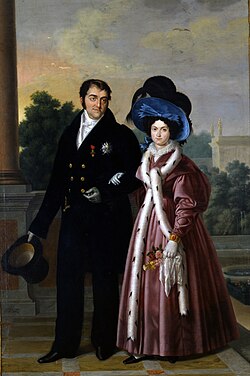
Ferdinand's personal life was marked by tragedy; he married four times, with three of his wives dying young. It was only with his fourth wife, Maria Christina of the Two Sicilies, that he produced surviving heirs.
In 1830, Ferdinand published the Pragmatic Sanction, a decree allowing daughters to inherit the throne. This meant his daughter, Isabella, displaced her uncle, Infante Carlos, as the heir. When Ferdinand died on September 29, 1833, Carlos refused to recognize Isabella's legitimacy, leading to the devastating Carlist Wars.
Summary of Ferdinand VII's Life
| Category | Details |
|---|---|
| Full Name | Ferdinand VII (Fernando VII) |
| House | Bourbon |
| Reign Periods | 1808 (Brief); 1813–1833 |
| Key Opponents | Napoleon Bonaparte, Liberal Reformers, Infante Carlos |
| Major Legacy | Restoration of Absolutism, Pragmatic Sanction of 1830 |
| Burial Site | El Escorial |
Frequently Asked Questions
Why was Ferdinand VII called "the Desired" and then "the Criminal King"?
He was called "the Desired" (el Deseado) during his captivity in France, as the Spanish people hoped his return would end the Napoleonic occupation. He became known as "the Criminal King" (el Rey Felón) after he betrayed the liberal hopes of the people by abolishing the Constitution of 1812 and reinstating absolute rule.
What was the significance of the Constitution of 1812?
The Constitution of 1812 was a liberal document that aimed to transform Spain from an absolute monarchy into a constitutional monarchy, limiting the power of the king and granting more rights to citizens.
How did Ferdinand VII view Freemasonry?
Ferdinand VII was an ardent opponent of Freemasonry, viewing it as a vehicle for secular liberal revolutions and a threat to the Spanish Crown and the Catholic faith. He declared Freemasons traitors and suppressed their lodges.
What caused the Carlist Wars after his death?
The wars were caused by a succession dispute. Ferdinand's Pragmatic Sanction allowed his daughter Isabella II to inherit the throne, but his brother Carlos claimed the throne for himself, arguing that the sanction was invalid.
Who were the afrancesados?
The afrancesados were Spaniards who supported the policies of the French during the Napoleonic occupation, believing that French reforms would modernize Spain.