Feral Pigeons: Biology, Urban Impact, and Population Management
The feral pigeon (Columba livia) is a descendant of the domesticated rock dove. While often viewed as a common fixture of city life, these birds possess a complex biological profile and a unique relationship with human urban environments. From their resilience against certain pathogens to the various methods cities use to manage their numbers, the feral pigeon is a subject of significant scientific and municipal interest.
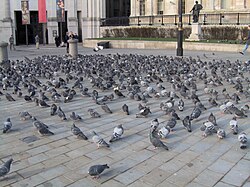
In many global cities, these birds congregate in high densities, particularly in central districts. This proximity to humans often leads to a paradoxical relationship where pigeons are both fed by residents and managed as pests by local governments.
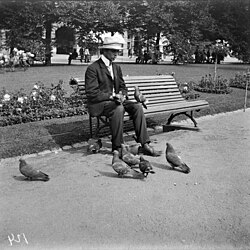
Key Facts
- Scientific Name: Columba livia.
- Conservation Status: Least Concern (IUCN 3.1).
- Disease Resistance: Adult pigeons are generally not clinically susceptible to H5N1 avian influenza.
- Urban Distribution: Highest densities are typically found in central city areas.
- Legal Status: Protected under the Indian Penal Code (Sections 428 and 429) and the Wildlife Protection Act of 1972 in India.
Health and Disease Profile
A significant area of research regarding feral pigeons is their role in transmitting pathogens. One of the most extensively studied areas is avian influenza (bird flu). Research indicates that adult pigeons are not clinically susceptible to the H5N1 strain and do not transmit the virus to poultry.
Studies conducted by the US Agriculture Department's Southeast Poultry Research Laboratory in Athens, Georgia, further support this. In experiments where pigeons were exposed to H5N1 concentrations 100 to 1,000 times higher than what is found in nature, researchers were unable to infect the birds. Additionally, pigeons have shown resistance or minimal susceptibility to other strains, such as H7N7.
Urban Impact and Human Conflict
Despite their prevalence, feral pigeon populations are often small relative to the human population of a city. For instance, in 2005, the breeding population in Sheffield, England, was estimated at approximately 12,130 individuals in a city of 500,000 people. However, because they concentrate in city centers, they are encountered frequently, which can lead to conflict regarding faeces and property maintenance.
Population Control and Management
Cities employ various strategies to manage feral pigeon populations, ranging from physical deterrents to biological interventions.
Artificial Control and Deterrents
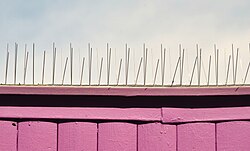
Physical barriers are common in urban architecture to prevent pigeons from nesting or roosting in specific areas. This often includes the installation of spikes on ledges and beams.
Biological and Chemical Methods
- Avian Contraceptives: Some regions use contraceptives to reduce reproduction rates.
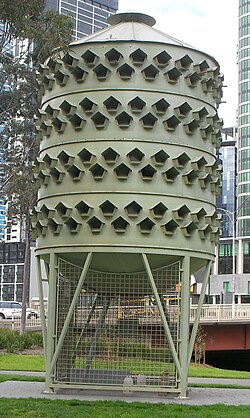
- Dummy Egg Nesting: This involves replacing fertilized eggs with dummy eggs to prevent population growth. A notable example was a large pigeon trap in Batman Park, Melbourne, which encouraged nesting for egg removal before its removal around 2015.
- Poisons: Most avian poisons are now banned due to their non-selective nature. In the United States, only 4-aminopyridine (Avitrol) and DRC-1339 remain registered by the EPA, with DRC-1339 limited to USDA use and 4-AP restricted to licensed applicators.
Monitoring Populations
To manage populations effectively, scientists use stratified grids. This method involves dividing an area into 500x500m squares, randomly selecting 34% of those squares, and counting pigeons within a 5-meter radius for five minutes.
Cultural Presence
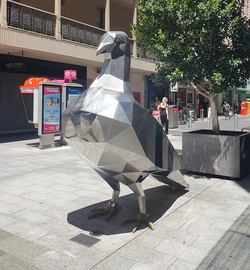
Beyond being viewed as a nuisance, pigeons have inspired art and landmarks. For example, a large pigeon sculpture by artist Paul Sloan is located at Rundle Mall in Adelaide.
| Category | Details |
|---|---|
| Scientific Classification | Genus: Columba, Species: C. livia |
| H5N1 Susceptibility | Low/Resistant in adults |
| Primary Urban Conflict | High density in city centers and faeces |
| Common Control Methods | Spikes, contraceptives, dummy eggs, restricted poisons |
| Monitoring Technique | Stratified grid sampling |
Frequently Asked Questions
Do feral pigeons spread bird flu to chickens?
Research indicates that adult pigeons are not clinically susceptible to H5N1 and do not transmit the virus to poultry, even when in direct contact.
Are feral pigeons protected by law?
Protection varies by region. In India, they are protected under the Indian Penal Code (Sections 428 and 429) and the Wildlife Protection Act of 1972.
How do cities monitor pigeon populations?
One common scientific method is the use of stratified grids, where random 500x500m squares are sampled to estimate the total population based on counts within a 5-meter radius.
What are the most common ways to deter pigeons?
Common methods include the use of physical spikes on landing surfaces, the administration of avian contraceptives, and the use of dummy eggs to prevent successful hatching.