Chicken: Origins, Biology, and Global Impact of Gallus gallus domesticus
The chicken, known scientifically as Gallus gallus domesticus, is one of the most widespread and economically significant domesticated birds in the world. From their roles as essential livestock for meat and eggs to their presence as beloved pets and cultural symbols, chickens have integrated themselves into nearly every human society across the globe.
Key Facts
- Scientific Name: Gallus gallus domesticus
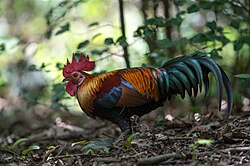
- Wild Ancestor: The Red junglefowl
- Primary Uses: Meat production, egg production, pets, and scientific research
- Global Distribution: Found on every continent except Antarctica
- Classification: Order Galliformes, Family Phasianidae
Terminology and Nomenclature
Depending on the age, sex, and purpose of the bird, various terms are used to describe chickens. Understanding these distinctions is fundamental to poultry science and farming.
- Chick: A young chicken.
- Cockerel: A young male chicken.
- Cock: A fertile adult male chicken (also commonly called a rooster).
- Hen: An adult female chicken.
- Capon: A castrated or neutered male chicken.
- Biddy: A general term for a chicken or a newly hatched one.
- Chook: An informal term used primarily in Australia and New Zealand.
- Yardbird: A dialectal term used in the southern United States.
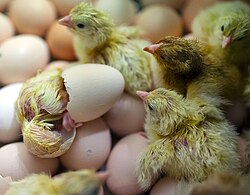
Origins and Domestication
The domestic chicken is a subspecies of the Red junglefowl, a wild bird native to Southeast Asia. Through a process of domestication, these birds were bred for traits favorable to humans, such as increased egg production and docility.
Global Dispersal
The spread of chickens across the world occurred in several waves. Genetic markers on ancient and modern DNA indicate that chickens were introduced into Oceania from the Philippines via the Neolithic Austronesian expansion, beginning approximately 4,000 years ago (BP).
![Prehistoric introduction of domesticated chickens into Oceania from the Philippines via Neolithic Austronesian expansion (starting at c. 4000 BP), inferred from genetic markers on ancient and modern chicken DNA (Thomson et al., 2014)[63]](/images/6c/d4/6cd4057749872dcb8d5f724b612ccf6892796fb77eff51fef745f201a9e4f1be.png)
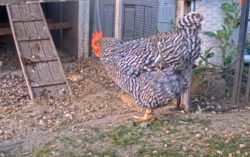
Following these early movements, chickens spread through Eurasia and Africa, eventually reaching the Americas. In the post-colonial era, specific breeds were developed to suit local environments and agricultural needs, such as the Plymouth Rock in the United States.
Biology and Health
Chickens are members of the order Galliformes and the family Phasianidae. They are characterized by their distinct combs and wattles, with females generally possessing smaller combs than males.
Disease and Welfare
Like all livestock, chickens are susceptible to various diseases. One of the most significant is avian influenza, a viral infection that can affect poultry health and productivity.
Human Use and Industry
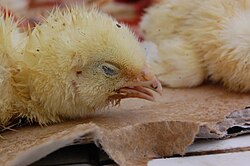
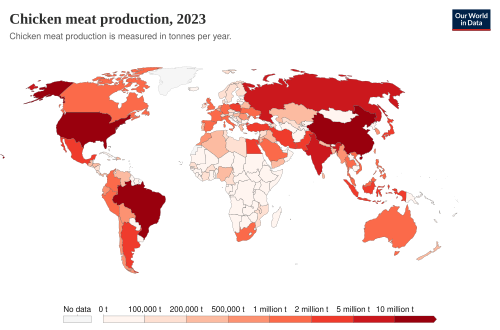
The primary driver for chicken farming is the production of meat and eggs. Modern agriculture has optimized these yields through specialized breeding and housing systems.
Meat and Egg Production
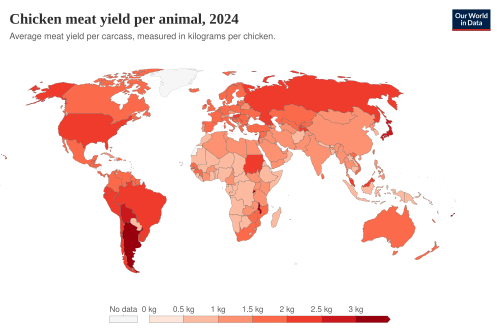
Commercial farming often distinguishes between layers (birds bred for eggs) and broilers (birds bred for meat). The efficiency of meat yields per animal has increased significantly over time due to selective breeding.
Alternative Roles
Beyond food production, chickens serve several other roles in human society:
- Pets: Increasingly, chickens are kept in suburban backyards for companionship and fresh eggs.
- Science: The chicken genome has been sequenced, providing unique perspectives on vertebrate evolution and the ancient ability to grow teeth.
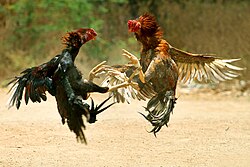
- Culture: Chickens appear in folklore, religion, and art worldwide, and in some regions, they are used in cockfighting.
Summary of Chicken Classification and Terms
| Category | Details |
|---|---|
| Kingdom | Animalia |
| Class | Aves |
| Genus | Gallus |
| Wild Ancestor | Red junglefowl |
| Key Breeds | Plymouth Rock (Example) |
Frequently Asked Questions
What is the difference between a cockerel and a cock?
A cockerel is a young male chicken, while a cock (or rooster) is a fertile adult male.
Where did domestic chickens originally come from?
Domestic chickens are descended from the Red junglefowl, a wild species native to Southeast Asia.
What is a capon?
A capon is a male chicken that has been castrated or neutered, typically to improve the quality of the meat.
How did chickens reach Oceania?
They were introduced from the Philippines via the Neolithic Austronesian expansion starting around 4,000 years ago, as evidenced by genetic markers in ancient DNA.
What is the scientific name for the domestic chicken?
The scientific trinomial name is Gallus gallus domesticus.