Farnley Hall: A Legacy of Art and Aristocracy
Farnley Hall stands as a testament to the intersection of English architectural ambition and a profound passion for the arts. From its expansion in the late 18th century to its role as a sanctuary for some of the world's most celebrated artworks, the estate has been shaped by the Fawkes family and their enduring connections to cultural icons.
The Evolution of the Estate
The history of the hall in the modern era began in the 1780s when it was occupied by Francis Fawkes. Following his death in 1786, the property was inherited by a distant relative, Walter Hawkesworth of Hawksworth Hall. To honor the lineage, Hawkesworth adopted the surname Fawkes by royal licence. He sought to expand the estate, commissioning the renowned architect John Carr to construct a new range adjacent to the original structure.
Upon Walter Fawkes' death in 1792, the estate passed to his son, Walter Ramsden Fawkes. A prominent figure in regional governance, Ramsden Fawkes served as the Member of Parliament (MP) for Yorkshire in 1806 and later held the position of High Sheriff of Yorkshire in 1823.
A Sanctuary for J.M.W. Turner
Farnley Hall is perhaps most famous for its intimate association with the legendary artist J.M.W. Turner. Between 1808 and 1824, the hall served as a second home to Turner, who developed a close friendship with Walter Ramsden Fawkes. This relationship resulted in one of the most significant private collections of Turner's work in history.
Ramsden Fawkes amassed an extraordinary collection, including over 250 Turner watercolours and six large oil paintings. This collection later attracted the attention of the Victorian artist and philosopher John Ruskin, who became a regular visitor to the hall, captivated by the scale and quality of the works.
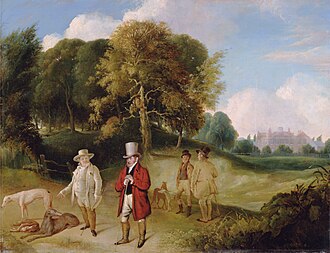
The financial value of this artistic legacy was highlighted in 1890, when a selection of works from the Farnley Hall collection was sold for £25,000.
Modern History and Preservation
The estate continued to be managed by the Fawkes family through the 20th century. Frederick Hawksworth Fawkes served as High Sheriff in 1932. During the Second World War, the hall transitioned from a private residence to a public service role, serving as a maternity hospital.
In more recent years, the house was meticulously restored by Nicholas Horton-Fawkes, who owned the property until his death in 2011. Reflecting the family's lifelong commitment to art, Horton-Fawkes also served as the President of the Turner Society. Notably, the Fawkes of Farnley share a familial relation to the historical figure Guy Fawkes.
Key Facts
- Architectural Expansion: The new range of the hall was designed by architect John Carr.
- Artistic Patronage: Walter Ramsden Fawkes owned more than 250 Turner watercolours and six oil paintings.
- Turner's Residency: J.M.W. Turner used Farnley Hall as a second home from 1808 to 1824.
- Wartime Use: The hall functioned as a maternity hospital during World War II.
- Notable Visitors: The philosopher and artist John Ruskin was a frequent guest.
| Period/Year | Key Figure/Event | Significance |
|---|---|---|
| 1780s | Francis Fawkes | Occupant of the hall |
| Post-1786 | Walter Fawkes (formerly Hawkesworth) | Commissioned John Carr for new construction |
| 1808–1824 | J.M.W. Turner | Used the hall as a second home |
| 1806 / 1823 | Walter Ramsden Fawkes | MP for Yorkshire (1806) and High Sheriff (1823) |
| 1890 | Art Sale | Turner works sold for £25,000 |
| WWII | Maternity Hospital | Repurposed for wartime medical use |
| Until 2011 | Nicholas Horton-Fawkes | Restored the house; President of the Turner Society |
Frequently Asked Questions
Who was the architect responsible for expanding Farnley Hall?
The new range of the hall was commissioned by Walter Fawkes and built by the architect John Carr.
What was the relationship between J.M.W. Turner and Farnley Hall?
Turner was a close friend of Walter Ramsden Fawkes and used Farnley Hall as a second home between 1808 and 1824.
How many works by Turner were once held at the hall?
Walter Ramsden Fawkes owned over 250 watercolours and six large oil paintings by J.M.W. Turner.
What role did the hall play during the Second World War?
During the Second World War, Farnley Hall served as a maternity hospital.
Is there a connection between the owners of Farnley Hall and Guy Fawkes?
Yes, the Fawkes family of Farnley were related to Guy Fawkes.