Faisal I: The Architect of Modern Iraq and Syrian Sovereignty
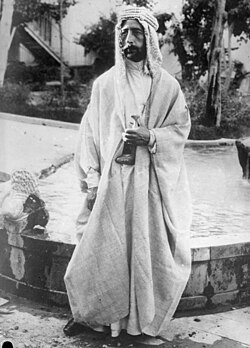
Faisal I was a pivotal Hejazi statesman whose leadership spanned two kingdoms and a global conflict. A member of the prestigious Hashemite family, he emerged as a central figure in the early 20th-century struggle for Arab independence, serving as the King of Syria and later as the King of Iraq. His life was defined by a constant negotiation between the aspirations of pan-Arabism and the geopolitical realities imposed by European powers.
Born in Mecca in 1885, Faisal was the third son of Hussein bin Ali, the Grand Sharif of Mecca. His early education in Istanbul provided him with a deep understanding of Ottoman administration, which he later utilized during his political career. By 1913, he had already entered the political arena as a representative for Jeddah in the Ottoman parliament.
The Great Arab Revolt and World War I
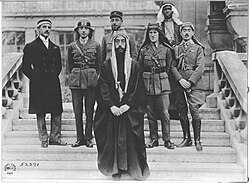
The trajectory of Faisal's life changed in October 1916 when he met Captain T. E. Lawrence, a British intelligence officer. Together, they coordinated the Northern Army of the Great Arab Revolt, a campaign aimed at liberating Arab lands from Ottoman rule. Faisal's military leadership was instrumental in the conquest of western Saudi Arabia, Jordan, and eventually Syria.
Despite his alliance with the British, Faisal's ambitions were complex. He briefly attempted to negotiate with the Ottomans to rule Syria and Mosul as a vassal, disillusioned by the secret Sykes–Picot Agreement between the Allies. However, after the Ottomans refused his terms, he remained loyal to his father's cause, eventually capturing Damascus in October 1918.
The Short-Lived Kingdom of Syria
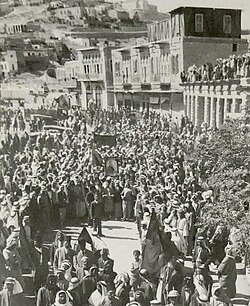
Following the capture of Damascus, Faisal helped establish an Arab government in Greater Syria under British protection. His diplomatic efforts culminated in his leadership of the Arab delegation at the 1919 Paris Peace Conference. In March 1920, the Syrian National Congress proclaimed him King of the Arab Kingdom of Syria, rejecting French claims to a mandate over the region.
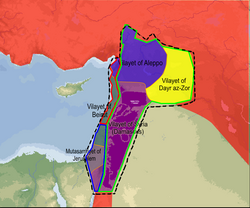
This defiance led to an immediate clash with France. The resulting Franco-Syrian War ended abruptly at the Battle of Maysalun on July 24, 1920. The French victory forced Faisal into exile and abolished the Syrian monarchy, ending his brief but significant reign in Damascus.
The Accession to the Iraqi Throne
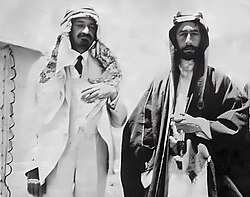
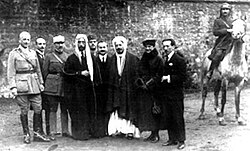
Faisal's political journey took a new turn in 1921. During the Cairo Conference, British officials—including Gertrude Bell and T. E. Lawrence—identified Faisal as an ideal candidate to lead the British Mandate of Iraq due to his conciliatory nature. Although initially unknown to many Iraqis, Faisal campaigned successfully to win the support of the Sunni minority.
His arrival in Basra in June 1921 was met with mixed reactions; while many welcomed him, some Shia leaders and southern tribes remained hostile. Despite this, a plebiscite showed 96% support for his leadership, and on August 23, 1921, he was officially crowned King of Iraq.
![The Coronation of Faisal as King of Iraq. Faisal seated, to his right are British High commissioner Percy Cox and Lieutenant Kinahan Cornwallis, to his left commander-in-chief of all British troops in the Mesopotamia Commander General Aylmer Haldane.[17]](/images/dc/7c/dc7c717da4f8bea983c2f4b83a96516914a1cc79eb8ea599d1af253ba90e27b1.jpg)
Governing Iraq and the Path to Independence
As King, Faisal faced the daunting task of creating a national identity for a country composed of three distinct Ottoman provinces (Mosul, Baghdad, and Basra). He worked tirelessly to foster unity between Sunni and Shia Muslims and promoted pan-Arabism, envisioning a larger state encompassing the Fertile Crescent.
His reign was marked by efforts to modernize the state. He recruited Syrian exiles, doctors, and teachers to improve the civil service and education system. However, this influx sometimes caused friction with native Iraqis, particularly when textbooks glorifying the Umayyad Caliphate offended the Shia community.
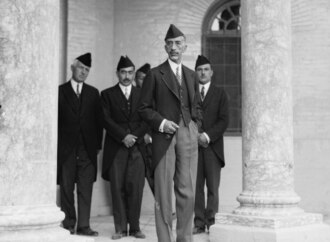
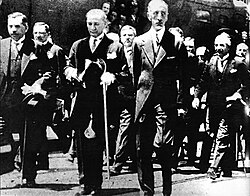
On the international stage, Faisal was a staunch supporter of Arab rights in Palestine, pressuring the British to limit Jewish immigration and land purchases. His diplomatic efforts reached a milestone in 1932 when the British Mandate ended, and Iraq gained full independence, joining the League of Nations on October 3, 1932.
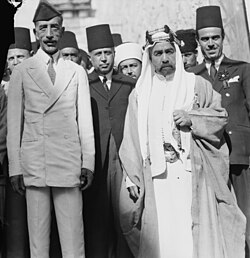
Death and Legacy
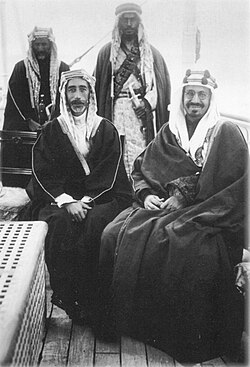
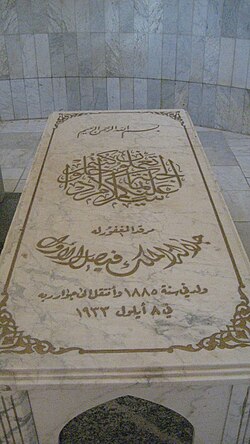
King Faisal I died of a heart attack on September 8, 1933, in Bern, Switzerland, at the age of 48. He was succeeded by his eldest son, Ghazi I. While official records cite natural causes, some historical accounts have questioned the circumstances of his death, mentioning symptoms of arsenic poisoning.
Key Facts
- Full Name: Faisal bin Hussein bin Ali Al-Hashemi.
- Reigns: King of Syria (March–July 1920) and King of Iraq (1921–1933).
- Key Alliance: Partnered with T. E. Lawrence during the Great Arab Revolt.
- Major Achievement: Led Iraq to independence from the British Mandate in 1932.
- Dynasty: Member of the Hashemite house, son of Hussein bin Ali.
- Death: Died in Bern, Switzerland, in 1933.
| Kingdom | Reign Period | Predecessor | Successor | Outcome |
|---|---|---|---|---|
| Arab Kingdom of Syria | March 8, 1920 – July 25, 1920 | Military occupation | Monarchy abolished | Expelled by French forces |
| Kingdom of Iraq | August 23, 1921 – September 8, 1933 | Military occupation | Ghazi I | Achieved independence (1932) |
Frequently Asked Questions
Why was Faisal I removed from the throne of Syria?
Faisal I was expelled by French forces following the Battle of Maysalun in July 1920. This occurred because the Syrian National Congress had proclaimed him king and rejected the French claim to a Mandate for Syria.
How did Faisal I come to be the King of Iraq?
Following the Cairo Conference in 1921, the British selected Faisal as a candidate for the Iraqi throne due to his diplomatic skills and the recommendation of T. E. Lawrence. He was formally made king after a plebiscite showed 96% support.
What was Faisal I's approach to religious unity in Iraq?
Faisal sought to bridge the gap between Sunni and Shia Muslims to create a common national loyalty. However, this was occasionally hindered by the influence of Syrian nationalists in the education system whose textbooks offended the Shia community.
What was the significance of 1932 for Faisal's reign?
1932 marked the end of the British Mandate over Iraq. Under Faisal's leadership, the Kingdom of Iraq became a fully independent state and officially joined the League of Nations.
Who succeeded Faisal I after his death?
Faisal I was succeeded by his eldest son, Ghazi I, following his death in Switzerland in 1933.