Mandatory PalestineBritish MandateLeague of NationsZionismArab revolt

Mandatory Palestine: The British Administration from 1920 to 1948

Mandatory Palestine: The British Administration from 1920 to 1948 Mandatory Palestine was a geopolitical entity administered by the United Kingdom between 1920 and 1948. Established as a ...

Mandatory Palestine: The British Administration from 1920 to 1948

Mandatory Palestine was a geopolitical entity administered by the United Kingdom between 1920 and 1948. Established as a Class A mandate under the League of Nations, this territory was managed by the British Colonial Office through a High Commissioner based in Jerusalem. The era was defined by complex demographic shifts, competing national aspirations, and a transition from Ottoman rule to the eventual establishment of new sovereign states.

The British officially assumed control on September 29, 1923, following the initial assignment of the mandate on April 25, 1920. During this period, the region served as a focal point for both Palestinian Arab national aspirations and the Zionist movement's goal of establishing a Jewish national home.
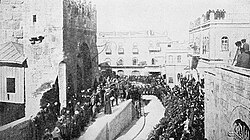
The formal transfer of Jerusalem to British rule, with a "native priest" reading the proclamation from the steps of the Tower of David

Key Facts

  • Duration: 1920 to May 14, 1948.
  • Administrative Status: Class A League of Nations mandate.
  • Capital: Jerusalem.
  • Official Languages: Arabic, English, and Hebrew.
  • First High Commissioner: Sir Herbert L. Samuel (1920–1925).
  • Last High Commissioner: Sir Alan Cunningham (1945–1948).
  • Currency: Egyptian pound (until 1927), followed by the Palestine pound.

Historical Progression and Conflict

The 1920s and 1930s

The early years of the mandate saw the arrival of key British officials and the establishment of administrative structures. However, tensions rose as Jewish immigration increased and land ownership patterns shifted. By the 1930s, these tensions culminated in the Arab revolt, an armed insurgency against British rule and Zionist settlement.
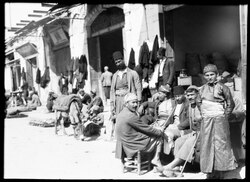
Palestinians in Jaffa in the 1920s

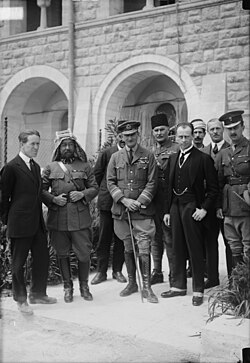
The arrival of Sir Herbert Samuel. From left to right: T. E. Lawrence, Emir Abdullah, Air Marshal Sir Geoffrey Salmond, Sir Wyndham Deedes and others

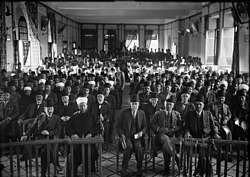
An Arab "protest gathering" in session, in the Rawdat el Maaref hall, 1929. From left to right : unknown – Amin al-Husayni – Musa al-Husayni – Raghib al-Nashashibi – unknown

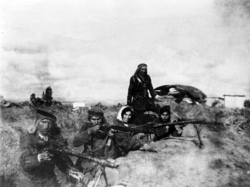
Arab revolt against the British

The Second World War Era

During World War II, the region was strategically vital. The British implemented immigration quotas, which became a point of contention during the Holocaust as Jewish refugees sought entry. This period also saw the rise of Zionist insurgency against British restrictions, particularly following the 1939 White Paper.
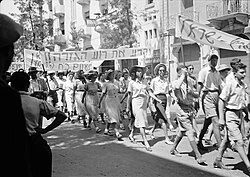
Jewish demonstration against White Paper in Jerusalem in 1939

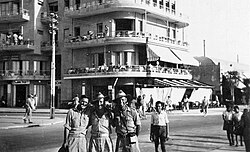
Australian soldiers in Tel Aviv in 1942

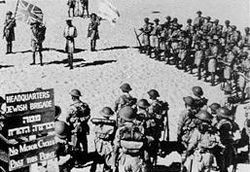
Jewish Brigade headquarters under the Union Flag and Jewish flag

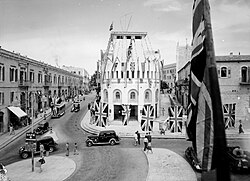
Jerusalem on VE Day, 8 May 1945

Termination of the Mandate

Following the war, the British government found the mandate increasingly ungovernable. The United Nations proposed a Partition Plan (Resolution 181) in November 1947 to divide the territory. The mandate officially ended on May 14, 1948, leading to the proclamation of the State of Israel and the subsequent Jordanian annexation of the West Bank.

Jewish State ship, one of several Haganah ships that carried Jewish immigrants from Europe, mostly illegal, at the Haifa Port, Mandatory Palestine, 1947[70]

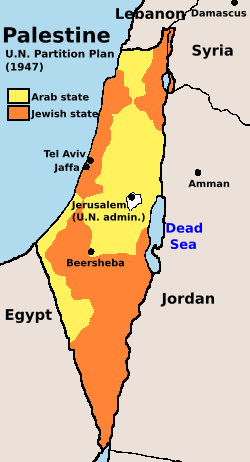
The UN Partition Plan

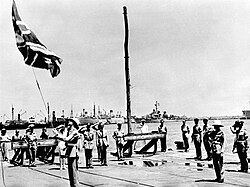
British troops leaving Haifa in 1948

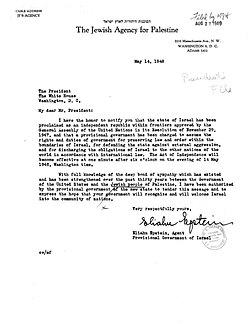
On the day of its proclamation, Eliahu Epstein wrote to Harry S. Truman that the state had been proclaimed "within the frontiers approved by the General Assembly of the United Nations in its Resolution of November 29, 1947".

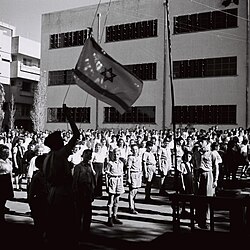
Hoisting of the Yishuv flag in Tel Aviv, 1 January 1948

Demographics and Land Ownership

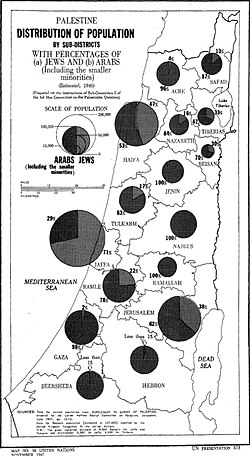
The population of Mandatory Palestine grew significantly between 1922 and 1945. While the Muslim community remained the largest group, the Jewish population experienced the highest growth rate due to immigration.
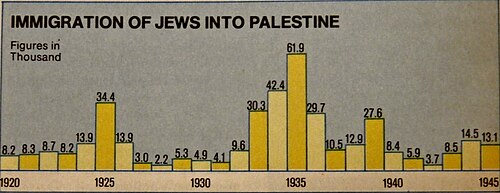
Jewish immigration to Mandatory Palestine from 1920 to 1945

Population distribution near the end of the Mandate

Population Statistics (1922–1945)

Population Growth by Community
Year Total Population Muslim Jewish Christian Other
1922 752,048 589,177 (78%) 83,790 (11%) 71,464 (10%) 7,617 (1%)
1931 1,036,339 761,922 (74%) 175,138 (17%) 89,134 (9%) 10,145 (1%)
1945 1,764,520 1,061,270 (60%) 553,600 (31%) 135,550 (8%) 14,100 (1%)

Land Distribution

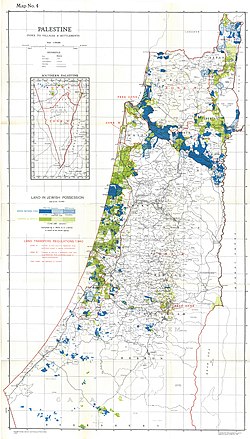
Land ownership was a central point of conflict. By 1945, ownership varied wildly by district. For example, in the Hebron and Ramallah sub-districts, Arab ownership was nearly 96-99%, while in Jaffa, Jewish ownership reached 39%.
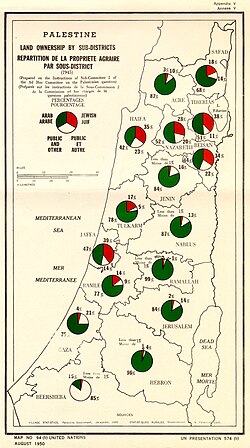
Map of Palestinian land ownership by sub-district (1945) originally published in the Village Statistics, 1945

Palestinian index of villages and settlements, showing land in Jewish possession as of 31 December 1944

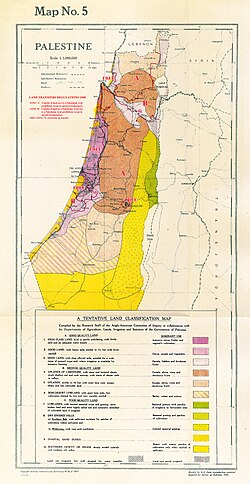
Land classification as prescribed in 1940

Governance and Society

The British administration utilized a mix of direct rule and community-based parliamentary bodies, such as the Supreme Muslim Council and the Assembly of Representatives for the Jewish community. The legal framework was supported by various ordinances, including the Land Transfer Ordinance of 1920 and the Land Settlement Ordinance of 1928.
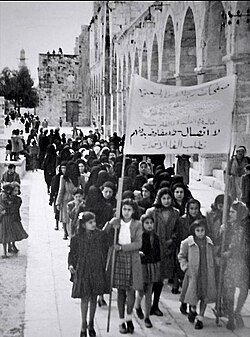
A 1930 protest in Jerusalem against the British Mandate by Arab women. The sign reads "No dialogue, no negotiations until termination of the Mandate."

The Palestinian Arab Christian-owned Falastin newspaper featuring a caricature on its 18 June 1936 edition showing Zionism as a crocodile under the protection of a British officer telling Palestinian Arabs: "don't be afraid!!! I will swallow you peacefully...."[141]

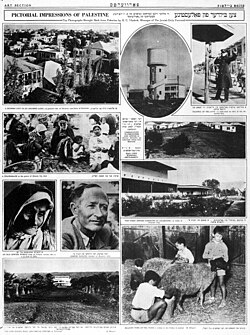
Scenes of Jewish life in Palestine, photographed by Zoltan Kluger and collected by Baruch Charney Vladeck, featured in The Jewish Daily Forward, 15 November 1936

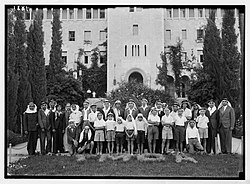
Arab Christian Palestinian boys at the Jerusalem YMCA, 1938

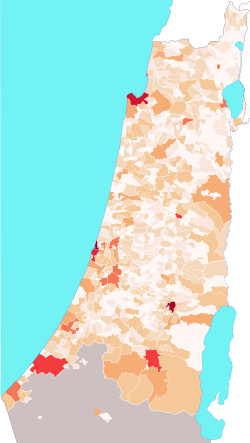
Map of the municipalities in Mandatory Palestine by population count (1945) 150,000 and more 100,000 50,000 20,000 10,000 5,000 2,000 1,000 500 less than 500 Nomadic regions in the Negev desert

Jerusalem City Hall, 1939

Street in As-Salt in the 1920s

Frequently Asked Questions

What was the purpose of the British Mandate for Palestine?

The mandate was a legal commission granted by the League of Nations to the United Kingdom to administer the territory, with the goal of managing the region's transition toward independence while facilitating the establishment of a Jewish national home.

Who were the primary administrative leaders?

The territory was led by a British High Commissioner. Sir Herbert Samuel was the first to hold the position (1920–1925), and Sir Alan Cunningham was the final High Commissioner (1945–1948).

How did the population change during the mandate?

The population grew from approximately 752,000 in 1922 to over 1.7 million by 1945. The Jewish population grew most rapidly, increasing from 11% of the population in 1922 to 31% by 1945.

What was the UN Partition Plan?

The UN Partition Plan, adopted via Resolution 181 in November 1947, proposed dividing Mandatory Palestine into independent Arab and Jewish states, with Jerusalem under an international regime.

When did the British Mandate officially end?

The British Mandate officially terminated on May 14, 1948, coinciding with the proclamation of the State of Israel.

References

  1. During its existence the territory was officially known simply as Palestine, but, in later years, a variety of other names and descriptors have been used, including Mandatory or Mandate Palestine, the British Mandate of Palestine and British Palestine (Arabic: فلسطين الانتدابية Filasṭīn al-Intidābiyah; Hebrew: פָּלֶשְׂתִּינָה (א״י) Pāleśtīnā (E.Y.), where "E.Y." indicates ’Eretz Yiśrā’ēl, the Land of Israel).
  2. Historian Nur Masalha describes the "British preoccupation with Palestine" and the large increase in European books, articles, travelogues and geographical publications during the 18th and 19th centuries.[15]
  3. From Himmler: The National Socialist movement of Greater Germany has, since its inception, inscribed upon its flag the fight against the world Jewry. It has therefore followed with particular sympathy the struggle of freedom-loving Arabs, especially in Palestine, against Jewish interlopers. In the recognition of this enemy and of the common struggle against it lies the firm foundation of the natural alliance that exists between the National Socialist Greater Germany and the freedom-loving Muslims of the whole world. In this spirit I am sending you on the anniversary of the infamous Balfour declaration my hearty greetings and wishes for the successful pursuit of your struggle until the final victory. From Ribbentrop: I am sending my greetings to your eminence and to the participants of the meeting held today in the Reich capital under your chairmanship. Germany is linked to the Arab nation by old ties of friendship, and today we are united more than ever before. The elimination of the socalled Jewish national home and the liberation of all Arab countries from the oppression and exploitation of the Western powers is an unchangeable part of the Great German Reich policy. Let the hour not be far off when the Arab nation will be able to build its future and find unity in full independence.
  4. For example, Radio Palestine broadcast the comments of an Egyptian writer who said, "The war is between the lofty and humane values represented by England and the forces of darkness represented by the Nazis."[67]
  5. A British recruiting poster in Arabic, published in the Falastin newspaper in January 1942, read: "She couldn't stop thinking about contribution and sacrifice, she felt ongoing pride and exaltation of spirit – when she did what she saw as her sacred duty for her nation and its sons. When your country is crying out to you and asking for your service, when your country makes it plain that our Arab men need your love and support, and when your country reminds you of how cruel the enemy is – when your country is calling you, can you stand by and do nothing?"[67]