Expo '74: The Environmental Transformation of Spokane
In the mid-20th century, the heart of Spokane, Washington, was a landscape defined by industrial grit and the roar of locomotives. However, a bold vision for urban renewal transformed this industrial hub into a global stage for environmental consciousness. Expo '74 was not just a world's fair; it was a catalyst that reclaimed the Spokane River for the people, marking a pivotal shift from industrial exploitation to ecological preservation.
The Industrial Era of Spokane Falls
Spokane was settled in the late 1800s specifically for the hydropower potential of the Spokane Falls. This natural resource fueled a rapid economic boom, leading to a dense concentration of flour mills, sawmills, and hydroelectric generators. By the early 20th century, the area became a critical nexus for rail transport.
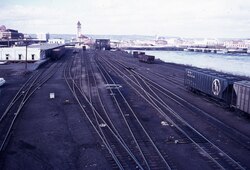
The city served as a hub for four transcontinental railroads: the Great Northern, Northern Pacific, Union Pacific, and the Chicago, Milwaukee, St. Paul and Pacific Railroad, alongside regional lines like the Oregon Railway. While economically successful, this development physically severed the city from its river. By 1914, the Union Pacific had constructed a station and elevated tracks that created a visual and physical barrier so imposing that locals compared it to the Great Wall of China.
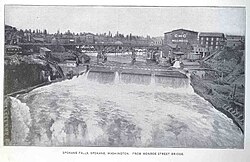
The environmental cost was high. The downtown core became noisy and congested due to frequent at-grade railroad crossings. As early as 1908, the Olmsted Brothers—renowned landscape architects—noted the industrial blight in their master plan for the city's parks, sarcastically remarking that the area had been "improved" and urging the city to eventually reclaim the falls for public use.
The Path to Urban Renewal
By the 1950s, suburbanization led to a decline in the downtown core. In response, local business leaders formed Spokane Unlimited in 1959 to revitalize the city. They commissioned Ebasco Services, a New York firm, to create a plan that called for the removal of downtown train tracks and the restoration of the Spokane River's beauty.
Initial attempts to fund this vision through bonds were defeated by voters. To build grassroots support, King Cole formed the Associations for a Better Community (ABC) during the 1960s, focusing on the beautification of the riverfront and the conversion of Havermale Island into a park.
By 1970, a feasibility study suggested that a simple centennial celebration for Spokane would not generate enough funding for such a massive undertaking. Instead, the study recommended hosting an international exposition to attract federal and state dollars, as well as global tourism. This led to the official planning of Expo '74.
Building the First Environmental World's Fair
Hosting a world's fair was a daunting task for Spokane, which was the smallest city to ever host a Bureau International des Expositions recognized event at that time. The project required intense negotiations to convince 16 different landowners, including the railroads, to vacate the site. Through a series of land swaps, the railroads were consolidated further south, clearing the way for construction.

Construction began on May 8, 1972. Despite protests from preservationists, the Great Northern depot on Havermale Island and the Union Pacific station on Spokane Falls Boulevard were demolished to make room for the new vision. The fair broke tradition by eschewing the futuristic, space-age themes common in previous expositions, opting instead for the slogan: "Celebrating Tomorrow's Fresh New Environment."
The Expo '74 Experience
The fair officially opened on May 4, 1974, with a ceremony presided over by President Richard Nixon. Despite the political tension of the Watergate scandal, the event drew 85,000 people on its opening day. To honor the environmental theme, the city released 1,000 pigeons and 1,974 rainbow trout into the Spokane River.
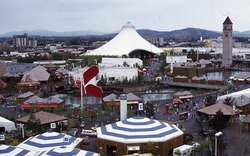
The exposition featured pavilions from nations including the USSR, Japan, West Germany, Canada, and Australia. The Australian Pavilion was particularly praised by critics for its design and its model of the Sydney Opera House. However, some observers, such as writer Calvin Trillin, noted that some exhibits seemed to highlight a lack of environmental care rather than a solution to it.
Technological Milestones
Expo '74 was a launchpad for several technological innovations:
- IMAX Cinema: The fair debuted the first IMAX movie theater inside the U.S. Pavilion. The screen measured 90 by 65 feet, showing the film "Man Belongs to the Earth," which was so immersive that motion sickness bags were provided to viewers.
- Kinoautomat: An interactive movie system that engaged audiences in new ways.
- Sustainable Architecture: The Pacific Northwest Bell pavilion utilized louvered roof panels to eliminate the need for air conditioning.
Key Facts
- Theme: The first World's Fair to focus on the environment ("Celebrating Tomorrow's Fresh New Environment").
- Scale: Smallest city to host a BIE-recognized World's Fair until 1982.
- Logo: A blue, green, and white Möbius strip symbolizing the continuity of life and the environment.
- Innovation: Site of the first IMAX movie theater.
- Legacy: Transformed a former industrial railyard into a public riverfront park.
| Category | Details |
|---|---|
| Opening Date | May 4, 1974 |
| Primary Theme | Environmentalism |
| Key Infrastructure Removed | Railroad tracks, trestles, and depots |
| Notable Technology | IMAX Theater, Kinoautomat, TTY equipment |
| Logo Designer | Lloyd L. Carlson |
Frequently Asked Questions
Why was the site of Expo '74 chosen?
The site was chosen because it was the heart of Spokane's industrial district. By removing the railroads and warehouses that blocked access to the Spokane Falls, the city could reclaim the riverfront for public use and urban beautification.
What did the colors in the Expo '74 logo represent?
The logo used three colors to symbolize the environment: blue for clean water, green for plants and trees, and white for fresh air.
How was the fair funded?
Funding came from a combination of local, state, and federal sources, including a business and occupation tax passed by the Spokane City Council in 1971.
What was the significance of the IMAX theater at the fair?
It was the first IMAX theater ever built. Its massive screen and immersive film, "Man Belongs to the Earth," provided a groundbreaking cinematic experience that emphasized the relationship between humanity and nature.
Which railroads were moved to make room for the fair?
The Great Northern, Northern Pacific, Union Pacific, and the Chicago, Milwaukee, St. Paul and Pacific Railroad all had a presence in the area; they were eventually consolidated onto Northern Pacific lines further south.