Executive Branch of Government: Functions, Structures, and Systems
The executive is the component of a government responsible for executing and enforcing laws and policies. Depending on the political framework of a nation, the executive may operate as a distinct branch of government—common in liberal democracies—or as an organ within a unified state apparatus, as seen in communist states.
The specific scope of executive power is typically defined by a country's constitution. While the executive often wields significant influence over national politics in democratic societies, this power is usually subject to various legal and systemic limitations to ensure stability and accountability.
Key Facts
- The executive's primary role is the enforcement of law and policy.
- In separation of powers systems, the executive is distinct from the legislature and judiciary.
- In fusion of powers systems, executive members are typically part of the legislature.
- The head of government manages state affairs, while the head of state may be a ceremonial figure.
- Executive power can include the creation of decrees, executive orders, or delegated legislation.
How Executive Power Functions
The organization of executive power varies based on how a state distributes its authority. In systems utilizing the separation of powers, authority is split between different branches to prevent any single person or group from gaining absolute control. This creates a system of checks and balances: the executive or legislature proposes laws, the legislature passes or blocks them, the executive enforces them, and the judiciary interprets them.
Beyond enforcement, the executive can generate specific types of law-derived rules. These include decrees, executive orders, or delegated legislation. For instance, the U.S. federal legislative branch often delegates the creation of specific regulations to the federal executive branch.
Conversely, some nations employ a fusion of powers, most notably in parliamentary systems like the United Kingdom. In these systems, the executive (often called "the government") consists of members from the political party that controls the legislature. Because the executive requires the legislature's ongoing support and approval, the two bodies are interdependent. Under the principle of parliamentary sovereignty, the executive's powers are granted by the legislature, though their actions may still be subject to judicial review.
Despite these constraints, the executive often maintains broad influence through the control of the government bureaucracy, particularly regarding foreign policy and national economic strategy.
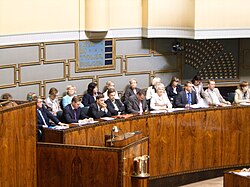
Political Creation and Leadership Structures
Parliamentary Systems
In a parliamentary system, the executive is accountable to the elected legislature. To remain in power, the executive must maintain the "confidence" of the legislature. If the legislature expresses a lack of confidence, it can trigger a change in the governing party or a general election.
These systems typically distinguish between two roles:
- Head of Government: The leader of the executive (often a Prime Minister) who manages the administration of state affairs.
- Head of State: A figure who remains constant through electoral changes, often serving a ceremonial role as a monarch or president.
In the Westminster model, the separation of powers is less entrenched; ministers are members of both the executive and the legislature, allowing them to participate in both writing and enforcing laws.
Presidential Systems
In a presidential system, the leader of the executive serves as both the head of state and the head of government. This leader is typically directly elected and is responsible for appointing ministers. In some variations, such as in South Korea, a Prime Minister exists to assist the President, though the President remains the primary head of government.
While most ministers are appointed, some systems allow for direct election. For example, in Switzerland, ministers can be directly elected by voters at the cantonal (state) level.
Internal Organization and Personnel
The executive branch is organized into various portfolios to manage the complexities of state governance. The following table outlines the typical leadership roles found within an executive branch:
| Role | Primary Responsibilities |
|---|---|
| Head of Government | Overseeing the general administration of all state affairs. |
| Defence Minister | Managing external safety, military policy, and the armed forces. |
| Interior Minister | Enforcing the law, managing internal control, and overseeing police forces. |
| Foreign Minister | Managing foreign relations, diplomatic services, and foreign policy. |
| Finance Minister | Managing the national budget, fiscal policy, and the treasury. |
| Justice Minister | Overseeing corrections, criminal prosecutions, and the enforcement of court orders. |
Frequently Asked Questions
What is the main difference between a head of state and a head of government?
The head of government is the official responsible for the day-to-day administration of the state and leading the executive. The head of state is the highest-ranking constitutional representative of the nation, who in parliamentary systems often performs ceremonial duties and remains in place regardless of changes in the governing party.
What is the "fusion of powers"?
Fusion of powers occurs when the executive and legislative branches are not independent but are instead intertwined. This is common in parliamentary systems where the executive members are also members of the legislature and rely on its confidence to remain in power.
How does the executive create laws?
While the legislature typically passes laws, the executive can create law-derived rules through executive orders, decrees, or delegated legislation, which are specific regulations created under the authority granted by the legislature.
What happens if a parliamentary executive loses the confidence of the legislature?
If the legislature expresses a lack of confidence in the executive, it typically results in either a change in the governing party or group of parties, or the calling of a general election.
Who appoints ministers in a presidential system?
In a presidential system, the directly elected head of government (the President) typically appoints the ministers.