European Union Common Security and Defence Policy: Overseas Missions and Operations
The European Union (EU) actively engages in global security through its Common Security and Defence Policy (CSDP), a framework that allows the union to deploy civilian and military assets to maintain peace and stability. These interventions span three continents—Europe, Africa, and Asia—and are designed to work in close coordination with EU delegations to address regional crises and security threats.
Since 2002, the EU has intervened abroad thirty times, utilizing a diverse array of capabilities to support rule of law, provide military training, and conduct maritime security operations.
![Since 2002, the European Union has intervened abroad thirty times in three different continents.[citation needed][clarification needed]](/images/0e/66/0e664fab40611f6ef07ebbb1d14d1b2fcaa70e04f72fb02003a86925ac0f00b3.webp)
Key Facts
- CSDP Scope: Covers both civilian and military interventions across Europe, Africa, and Asia.
- Decision Making: Deployment and management decisions are made by EU member states within the Foreign Affairs Council (FAC).
- Terminology: Civilian interventions are always called "missions," while military interventions are called "operations" if they have an executive mandate.
- Command Structure: Political direction is provided by the High Representative (HR/VP) and the Political and Security Committee (PSC).
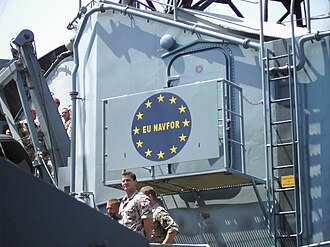
- Operational Reach: Includes high-profile efforts such as Operation Atalanta in Somalia and EULEX in Kosovo.
Classification of EU Interventions
The EU uses specific terminology to distinguish between the nature and authority of its overseas deployments.
Civilian Missions
All civilian CSDP interventions are classified as missions. These may have an executive mandate (such as EULEX Kosovo) or a non-executive mandate. Civilian missions employ uniformed personnel, including police and gendarmerie, but specifically exclude military personnel.
Military Interventions
Military deployments are categorized based on their mandate and command level:
- Operations: These possess an executive mandate (e.g., Operation Atalanta) and are commanded at a two-star level.
- Missions: These possess a non-executive mandate (e.g., EUTM Somalia) and are commanded at a one-star level.
Deployment and Command Structure
The process of deploying EU forces is strictly governed by political oversight. The Foreign Affairs Council (FAC) holds the ultimate authority for deployment and management. Military operations specifically undergo four distinct planning phases involving the Operation Commander, Military Staff (EUMS), Military Committee (EUMC), and the Political and Security Committee (PSC).
The Chain of Command
The command and control (C2) structure is directed by political bodies representing member states, generally requiring unanimous decisions. The High Representative (HR/VP) plays a central role, proposing and implementing CSDP decisions while chairing the FAC and potentially the PSC during crises.
At the strategic level, the EU Military Staff (EUMS) and the Civilian Planning and Conduct Capability (CPCC) provide the necessary infrastructure. Depending on the mission, the EU may use its own Military Planning and Conduct Capability (MPCC) as an Operational Headquarters (OHQ), or utilize a national OHQ provided by a member state or the NATO Command Structure (NCS).
Summary of EU CSDP Activities
| Name | Abbreviation | Type | Focus Area |
|---|---|---|---|
| EU Naval Force Operation Somalia | EU NAVFOR ATALANTA | Military Operation | Maritime Security |
| EU Rule of Law Mission in Kosovo | EULEX Kosovo | Civilian Mission | Rule of Law |
| EU Training Mission in Somalia | EUTM Somalia | Military Mission | Training |
| EU Military Assistance Mission Ukraine | EUMAM Ukraine | Military Mission | Military Assistance |
| EU Partnership Mission in Moldova | EUPM Moldova | Civilian Mission | Partnership/Resilience |
Frequently Asked Questions
What is the difference between a CSDP "mission" and an "operation"?
Civilian interventions are always called missions. Military interventions are called operations if they have an executive mandate (commanded at two-star level) and missions if they have a non-executive mandate (commanded at one-star level).
Who decides when the EU deploys forces abroad?
The decision to deploy, as well as the subsequent management of the intervention, is taken by the EU member states within the Foreign Affairs Council (FAC).
Can the EU use NATO infrastructure for its operations?
Yes. If the EU does not use its own Military Planning and Conduct Capability (MPCC) as the Operational Headquarters, it may use a national OHQ or the NATO Command Structure (NCS).
What role does the High Representative (HR/VP) play in CSDP?
The HR/VP proposes and implements CSDP decisions, chairs the Foreign Affairs Council, and may chair the Political and Security Committee during times of crisis.
Do civilian missions include military personnel?
No. Civilian missions may include uniformed personnel such as police and gendarmerie, but they do not include military personnel.