European Politics and the Legacy of the European Movement Germany
The evolution of European integration has been shaped by rigorous debate over monetary stability and political cooperation. Central to these discussions has been the role of leadership within organizations like the European Movement Germany, where strategic foresight regarding the Euro and state solvency has played a critical role in shaping policy perspectives.
Key Facts
- Advocated for strict adherence to the Maastricht Criteria (the convergence requirements for EU member states to join the single currency).
- Proposed a limited German-French monetary union to protect employment.
- Suggested a five-year postponement of the general monetary union implementation.
- Opposed the possibility of Greek insolvency during a 2011 interview with EurActiv.
- Served as the president of the European Movement Germany starting in June 2006.
Perspectives on the Euro and Monetary Stability
During the mid-1990s, serious concerns were raised regarding the implementation of the Euro. The primary point of contention was the Maastricht Criteria, the set of economic standards that member states were required to meet to ensure currency stability. There was a strong belief that these criteria had to be strictly fulfilled by all participating nations to avoid economic instability.
Because many European states were not prepared to meet these standards by 1999, a compromise was proposed: the creation of a monetary union consisting only of Germany and France, as they were the only two states deemed capable of fulfilling the criteria at that time. This strategic move was intended to safeguard German jobs while suggesting a five-year delay for the broader implementation of the monetary union.
Leadership in the European Movement Germany
The European Movement Germany serves as a pivotal organization for promoting European integration. Since June 2006, leadership has transitioned through key figures to maintain the organization's influence. Following the tenure of former EU Commissioner Monika Wulf-Mathies, the presidency was assumed and maintained through re-elections in 2008 and 2010.
Recent transitions in leadership continue to steer the organization's vision for a unified Europe.
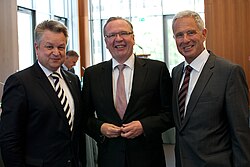
Summary of Political Positions and Roles
| Focus Area | Position/Action | Timeline |
|---|---|---|
| Euro Implementation | Advocated for strict Maastricht Criteria fulfillment | Mid-1990s |
| Monetary Union | Proposed German-French union; 5-year delay for others | Pre-1999 |
| Greek Debt Crisis | Opposed Greek insolvency (via EurActiv interview) | 2011 |
| European Movement Germany | Presidential leadership (following Monika Wulf-Mathies) | June 2006 onwards |
Frequently Asked Questions
What were the concerns regarding the Euro in the mid-1990s?
The primary concern was that not all European states could strictly fulfill the Maastricht Criteria by 1999, which could jeopardize the stability of the new currency.
What was the proposed alternative to the full monetary union in 1999?
A compromise was suggested to establish a monetary union exclusively between Germany and France, as they were the only two states meeting the necessary criteria at the time.
Why was a German-French monetary union proposed?
This limited union was proposed as a way to avoid risking German jobs while postponing the wider implementation of the monetary union for five years.
What was the stance on the Greek financial crisis in 2011?
In an interview with the news portal EurActiv, a clear opposition to a possible Greek insolvency was expressed.
Who preceded the current leadership of the European Movement Germany?
The presidency was previously held by former EU Commissioner Monika Wulf-Mathies before the transition in June 2006.