Eugene McCarthy: The Anti-War Senator Who Challenged a President
Eugene Joseph McCarthy was a multifaceted American figure—a politician, writer, and academic who left an indelible mark on the United States political landscape. Representing Minnesota in both houses of Congress for over two decades, McCarthy is most remembered as the catalyst for the anti-Vietnam War movement within the Democratic Party during the late 1960s.
A member of the Minnesota Democratic–Farmer–Labor Party (DFL), McCarthy's career spanned from the halls of the U.S. House of Representatives to the U.S. Senate, and eventually to several bids for the presidency. His willingness to challenge the status quo, particularly regarding foreign policy, made him a symbol of dissent during one of the most turbulent eras in American history.
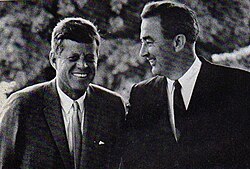
Key Facts
- Congressional Tenure: Served in the U.S. House (1949–1959) and the U.S. Senate (1959–1971).
- 1968 Campaign: Challenged incumbent President Lyndon B. Johnson on an anti-Vietnam War platform.
- Academic Background: Former professor of economics and education at St. John's.
- Military Service: Served as a code breaker for the U.S. Department of War during World War II.
- Literary Work: Published numerous books and a collection of poetry in 1997.
Early Life, Education, and Military Service
Born on March 29, 1916, in Watkins, Minnesota, McCarthy was deeply influenced by the intellectual environment of St. John's Abbey and University. He graduated from Saint John's Preparatory School in 1932 and earned his bachelor's degree from Saint John's University in 1935, followed by a master's degree from the University of Minnesota in 1939.
Before entering politics, McCarthy balanced academia and national service. He taught in public schools across Minnesota and North Dakota and served as a professor of economics and education at St. John's from 1940 to 1943. During World War II, he contributed to the war effort as a code breaker for the United States Department of War.
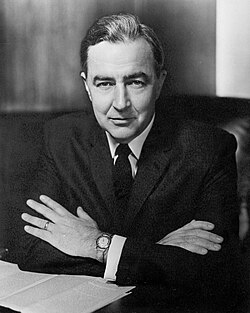
Congressional Career and Legislative Record
McCarthy's political ascent began in 1948 when he was elected to the U.S. House of Representatives for Minnesota's 4th district. He served there for ten years before transitioning to the U.S. Senate in 1959, where he served until 1971.
During his time in the Senate, McCarthy was a supporter of several landmark pieces of legislation. He voted in favor of the Civil Rights Act of 1960, the Civil Rights Act of 1964, the Voting Rights Act of 1965, and the creation of the Medicare program. He also co-sponsored the Immigration and Nationality Act of 1965, though he later expressed regret over its long-term impact, eventually joining the Federation for American Immigration Reform.
The 1968 Presidential Challenge
By the late 1960s, McCarthy became a leading critic of President Lyndon B. Johnson's management of the Vietnam War. In December 1967, he publicly accused the administration of bungling opportunities to end the conflict. This stance positioned him as the primary alternative for anti-war Democrats.
Despite initial fundraising struggles and low expectations, McCarthy's campaign gained momentum through grassroots efforts and media attention. The Tet Offensive—a major North Vietnamese offensive in early 1968—galvanized public opposition to the war, propelling McCarthy to a strong second-place finish in the New Hampshire primary.
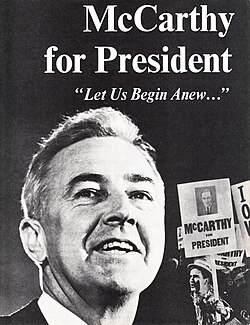
The Battle for the Nomination
The race grew more complex when Robert F. Kennedy entered the contest, leading President Johnson to announce he would not seek reelection. While McCarthy won a plurality of the popular vote and delegates in the primaries, the delegate-selection rules of the time were not binding. Following Kennedy's assassination in June 1968, many of his delegates shifted their support to Vice President Hubert Humphrey.
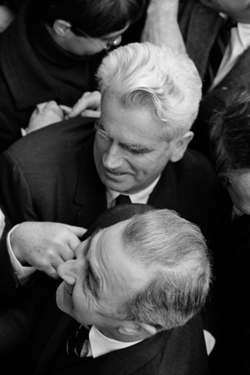
Humphrey, the preferred candidate of President Johnson, ultimately secured the Democratic nomination at the 1968 National Convention. Although McCarthy did not win the nomination, his campaign had successfully shifted the national conversation regarding the war.
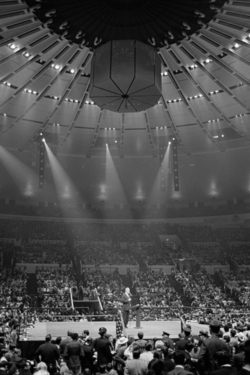
Later Political Life and Activism
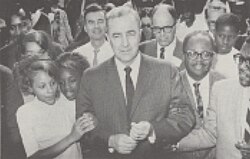
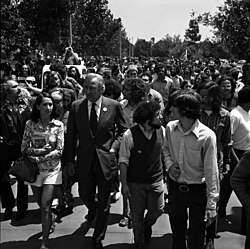
McCarthy did not seek reelection to the Senate in 1970. He continued to pursue the presidency in subsequent cycles, including a 1972 Democratic primary bid and a 1976 run as an Independent, where he earned 0.91% of the popular vote. He also ran as a Consumer Party candidate in 1988.
Beyond the ballot, McCarthy remained active in legal and political spheres. He was a plaintiff in the significant campaign finance case Buckley v. Valeo and, in a shift of political alignment, supported Ronald Reagan for president in 1980.
Literary Pursuits and Final Years
After leaving the Senate, McCarthy transitioned into the world of publishing as a senior editor at Harcourt Brace Jovanovich and a syndicated columnist. He was also a prolific author, writing on democracy, power, and economics. His passion for poetry culminated in the 1997 publication of Cool Reflections: Poetry For The Who, What, When, Where and Especially Why of It All.
McCarthy passed away on December 10, 2005, at the age of 89, due to complications from Parkinson's disease in Georgetown, Washington, D.C.
| Election Year | Party Affiliation | Votes Received | Percentage |
|---|---|---|---|
| 1968 (Primary) | Democratic | 2,914,933 | 38.7% |
| 1972 (Primary) | Democratic | 553,352 | 1.7% |
| 1976 | Independent | 740,460 | 0.91% |
| 1988 | Consumer | 30,905 | 0.03% |
Frequently Asked Questions
Why is Eugene McCarthy significant in American history?
He is primarily significant for challenging President Lyndon B. Johnson in 1968, which brought the anti-Vietnam War movement into the mainstream of the Democratic Party and contributed to Johnson's decision not to seek reelection.
What was McCarthy's legislative record in the Senate?
McCarthy supported major civil rights legislation, including the Civil Rights Acts of 1960 and 1964, the Voting Rights Act of 1965, and the Medicare program.
Did Eugene McCarthy ever win the presidency?
No, he never won the presidency. Despite a strong showing in the 1968 primaries, he lost the nomination to Hubert Humphrey and was unsuccessful in subsequent bids in 1972, 1976, and 1988.
What happened to McCarthy after his political career?
He became a senior editor at a publishing house, a syndicated columnist, and a published poet and author of numerous books on politics and economics.
How did the 2008 Democratic National Convention memorialize him?
The convention included a tribute with his photograph, though it mistakenly labeled him as "Senator Joseph McCarthy," confusing him with the Republican Senator from Wisconsin known for anti-Communist campaigns.