Epistolary Novels: A History of Storytelling Through Documents
The epistolary novel is a literary form where the narrative is told through a series of documents. While most commonly associated with letters, this versatile style encompasses diaries, newspaper clippings, emails, and even transcripts. By presenting the story as a collection of records, authors can create a sense of intimacy and authenticity, allowing readers to feel as though they are uncovering a private history.
Key Facts
- Definition: A novel written as a series of documents, typically letters, but also including journals and digital records.
- Origins: Gained significant popularity in the 18th century with authors like Samuel Richardson.
- Evolution: Has transitioned from handwritten correspondence to modern formats like emails, PowerPoint presentations, and classified documents.
- Purpose: Often used to provide deep psychological insight into characters or to construct complex, multi-layered mysteries.
The Rise of the Form in the Eighteenth Century
The 18th century marked a golden age for the epistolary form. Early works like Montesquieu's Lettres persanes (1721) set the stage for a surge in artistic interest. Samuel Richardson became a pivotal figure in this movement; his 1740 bestseller Pamela; or, Virtue Rewarded sparked widespread interest in the format, followed by his masterpiece Clarissa (1748), which remains a milestone in the genre.
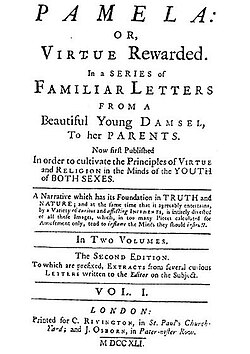
Other influential works of this era include Jean-Jacques Rousseau's Julie; or, The New Heloise (1761), Johann Wolfgang Goethe's The Sorrows of Young Werther (1774), and Frances Burney's Evelina (1778). The century closed with complex narratives like Pierre Choderlos de Laclos's Les Liaisons dangereuses (1782), which used letters to depict the manipulation and corruption of the French nobility, and José Cadalso's Cartas marruecas (1789).
Nineteenth Century Innovations
In the 1800s, writers began integrating the epistolary style into broader narrative structures, often using it as a frame story—a literary technique where an introductory narrative sets the stage for a secondary story.
Mary Shelley's Frankenstein (1818) utilizes this approach, framing the main account within letters. Similarly, Anne Brontë's The Tenant of Wildfell Hall (1848) blends letters and diary entries. Fyodor Dostoevsky also employed the format for his debut novel, Poor Folk (1846), to highlight the struggles of impoverished citizens in Imperial Russia.
The late 19th century saw the form adapt to the detective and horror genres. Wilkie Collins used a collection of documents in The Woman in White (1859) and The Moonstone (1868) to build mystery. Bram Stoker's Dracula (1897) pushed the boundaries further by incorporating dictation cylinders and newspaper accounts alongside traditional diaries and letters.
Twentieth Century Diversification
As communication evolved, so did the epistolary novel. The 20th century saw a shift toward experimental formats and psychological exploration. C.S. Lewis used the form for theological and moral exploration in The Screwtape Letters (1942) and Letters to Malcolm (1964).
Authors began using non-traditional "letters" to tell their stories. Daniel Keyes's Flowers for Algernon (1959, 1966) uses lab progress reports to mirror the protagonist's changing intellectual capacity. Lawrence Sanders's The Anderson Tapes (1969, 1970) relied on tape recording transcripts, while Stephen King's Carrie (1974) blended newspaper clippings and book excerpts.
The era also produced poignant social commentaries, such as Alice Walker's The Color Purple (1982) and Kathrine Taylor's anti-Nazi novel Address Unknown (1938). Toward the end of the century, Mark Z. Danielewski's House of Leaves (2000) pushed the form into metafiction, using footnotes and film transcripts to create a layered, disorienting experience.
Twenty-First Century and Digital Evolution
In the modern era, the "letter" has evolved into the email, the text message, and the online post. Debbie Macomber's Between Friends (2001) tracks a friendship through letters that eventually become emails. The digital age is further explored in Dennis Cooper's The Sluts (2004), which consists of online posts and email correspondence.
Contemporary authors continue to experiment with constraints and formats. Mark Dunn's Ella Minnow Pea (2001) is a lipogrammatic novel, meaning certain letters are systematically omitted from the text, forcing the reader to interpret the meaning. Other modern examples include the oral history style of Max Brooks's World War Z (2006) and the diverse media mix in Paul Torday's Salmon Fishing in the Yemen (2007).
| Era | Notable Work | Primary Document Format |
|---|---|---|
| 18th Century | Pamela; or, Virtue Rewarded | Letters |
| 19th Century | Dracula | Diaries, Letters, Dictation Cylinders |
| 20th Century | Flowers for Algernon | Lab Progress Reports |
| 21st Century | World War Z | Interviews |
Frequently Asked Questions
What exactly is an epistolary novel?
An epistolary novel is a story told through a series of documents. While the term comes from "epistle" (meaning letter), modern versions include diaries, emails, transcripts, and other recorded communications.
Who are some of the most famous epistolary authors?
Samuel Richardson is one of the most influential early figures. Other notable authors include Mary Shelley, Bram Stoker, and more recently, Margaret Atwood and Alice Walker.
How does the epistolary form differ from a standard first-person narrative?
Unlike a standard narrative, the epistolary form presents the story as a collection of "found" documents. This often creates a sense of immediacy and allows the author to show a character's internal state through their private writing.
Can a book be epistolary if it only uses letters for part of the story?
Yes. Many novels use a hybrid approach. For example, Frankenstein uses letters as a frame for the main story, and Pepita Jiménez alternates between letters and a third-person narrator.
What are some modern examples of the epistolary style?
Modern examples include The White Tiger (letters to a political leader), World War Z (survivor interviews), and Illuminae (classified documents and censored emails).