Eels: Biology, Classification, and Global Significance of Anguilliformes
Eels are specialized ray-finned fish belonging to the order Anguilliformes. Characterized by their elongated bodies and serpentine movement, these predators are found in diverse aquatic environments across the globe. From the shallow sands of coastal oceans to the depths of the continental slopes, eels have evolved a variety of forms and behaviors to thrive in their respective niches.
The order Anguilliformes is vast, comprising eight suborders, 20 families, 164 genera, and approximately 1,000 species. Their evolutionary history is long, with a temporal range extending from the Cenomanian period to the present day.
Key Facts
- Physical Range: Lengths vary from 5 cm (one-jawed eel) to 4 m (slender giant moray).
- Weight Extremes: Adults range from 30 g to over 25 kg, with the European conger being the heaviest true eel.
- Locomotion: They swim using propulsive waves along their bodies and can swim backward by reversing these waves.
- Habitat: Most are nocturnal marine dwellers, though the genus Anguilla regularly inhabits fresh water.
- Conservation: Several key species, including the European and Japanese eels, are listed as endangered or critically endangered.
Physical Characteristics and Habitat
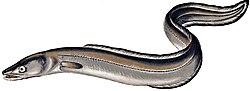
Eels are defined by their elongated shape and a lack of pelvic fins; many species also lack pectoral fins. Their dorsal and anal fins are fused with the caudal (tail) fin, creating a single continuous ribbon that runs along much of their body. This anatomy allows them to navigate tight spaces and move efficiently through water.
While most eels are nocturnal and prefer burrowing into mud, sand, or rocks in shallow ocean waters, some are adapted for the deep sea. Certain species inhabit continental shelves and slopes at depths reaching 4,000 meters (13,000 ft).
The Complex Life Cycle
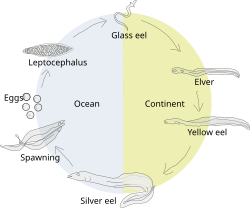
Many eels exhibit a catadromous life cycle, meaning they spend most of their adult lives in fresh water but migrate to the ocean to breed. This transition involves several distinct developmental stages:
- Larval Stage: Eels begin their lives in the ocean.
- Glass Eels: As they transition from the ocean toward fresh water, they become transparent "glass eels."
- Elvers: Once in fresh water, they are known as elvers and work their way upstream.
- Silver Stage: Upon reaching maturity, they enter the silver stage and migrate back to the ocean to mate.
Taxonomy and Evolution
The classification of eels is complex, with different systems (such as FishBase, ITIS, and Systema Naturae 2000) offering varying family counts. The order is divided into several suborders, including Anguilloidei (freshwater eels and snipe eels), Muraenoidei (moray eels), and Congroidei (conger and snake eels).
Paleontological records show that eels have existed for millions of years. Early ancestors and extinct relatives provide insight into their evolution.


Commercial Importance and Human Use
Eels are highly valued in global gastronomy, particularly in Asia and Europe. In Japan, freshwater eels (unagi) and marine eels (anago) are staples of the cuisine, appearing in dishes like unadon and unajū. In China, they are prepared in numerous ways and can command very high market prices.
European traditions include jellied eels in East London and the Spanish delicacy angulas, which consists of sautéed elvers. In Northern Europe, smoked eel is a prized delicacy. However, this high demand has led to significant population declines.
| Common Name | Scientific Name | Max Length | Max Weight | IUCN Status |
|---|---|---|---|---|
| American eel | Anguilla rostrata | 152 cm | 7.33 kg | Endangered |
| European eel | Anguilla anguilla | 150 cm | 6.6 kg | Critically Endangered |
| Japanese eel | Anguilla japonica | 150 cm | 1.89 kg | Endangered |
| Short-finned eel | Anguilla australis | 130 cm | 7.48 kg | Near Threatened |
Sustainability and Conservation
The sustainability of eel populations is a critical concern. Overfishing and habitat loss have pushed several species toward extinction. In 2010, Greenpeace International added the American, European, and Japanese eels to its seafood red list. Japan is a primary driver of this demand, consuming more than 70% of the global eel catch.
Frequently Asked Questions
Can eels swim backward?
Yes, eels are capable of swimming backward by reversing the direction of the propulsive waves that travel along their bodies.
What is a catadromous fish?
A catadromous fish is one that lives in fresh water for most of its adult life but migrates to the salt water of the ocean to spawn.
Which eel is the heaviest?
The European conger is recognized as the heaviest of all true eels.
Why are some eel species endangered?
High global consumption, particularly for luxury food markets in Asia and Europe, combined with environmental pressures, has led to a collapse in population numbers for species like the European eel.
What are elvers?
Elvers are young eels that have transitioned from the glass eel stage and are migrating upstream into fresh water.