Edwardsville Amazon Warehouse Tornado: Timeline and Impact
In December 2021, a devastating tornado struck a delivery station operated by Amazon in Edwardsville, Illinois. The event highlighted the intersection of rapid industrial growth and the volatility of severe Midwestern weather. To understand the tragedy, one must look at the development of the site and the meteorological conditions that led to the disaster.
The Development of Amazon's Edwardsville Hub
Beginning in 2016, Amazon expanded its logistics footprint in Edwardsville, Illinois, located 16 miles east of downtown St. Louis. The company established two massive e-commerce fulfillment facilities—warehouses where customer orders are processed and packaged—each spanning 700,000 square feet. These were designated as STL4, which handled larger items, and STL6, which focused on smaller items.
By August 2018, the site's capacity had already exceeded initial projections, employing over 2,000 people. To further streamline the logistics chain, Amazon added a delivery station known as DLI4. Unlike fulfillment centers, delivery stations are smaller hubs where packages are sorted and loaded onto trucks for final delivery. Completed in September 2020, DLI4 covered 594,000 square feet, including 15,000 square feet of office space.
By December 2021, DLI4 operated with approximately 190 employees across all shifts. The workforce consisted primarily of contracted delivery drivers, a result of a company-wide initiative started in 2018 to reduce reliance on external carrier services. At the time the tornado struck, only seven full-time employees were present at the DLI4 facility.
Severe Weather Forecasts and Warnings
The events of December 10, 2021, were preceded by detailed warnings from meteorological agencies. The National Weather Service (NWS) in St. Louis identified a low-pressure system moving from the Rocky Mountains that would bring anomalously high temperatures and dew points to the region, potentially exceeding 70°F.
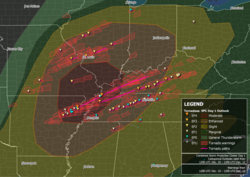
The Storm Prediction Center (SPC) in Norman, Oklahoma, issued an enhanced risk—the third-highest risk level—for the middle Mississippi River valley. Forecasters warned of damaging winds, large hail, and tornadoes. While initial models suggested a squall line (a long line of thunderstorms) might limit the threat of supercells, later updates increased the risk level to moderate for parts of the Ohio and Mississippi River valleys, signaling a high confidence in the potential for strong tornadoes.
The Onset of the Outbreak
At 5:20 p.m. on December 10, a tornado watch was issued for Madison County, Illinois, and much of Missouri. By 7:02 p.m., a line of storms moved across central Missouri, with some developing into supercells—highly organized thunderstorms characterized by a rotating updraft that can produce violent tornadoes.
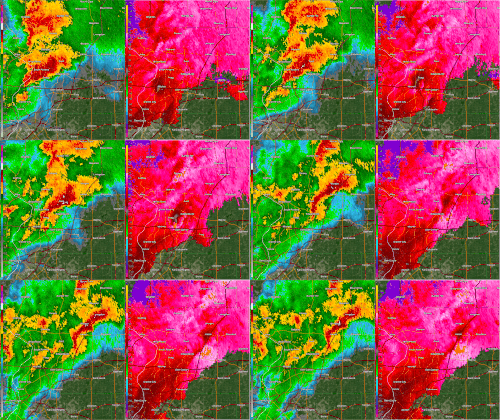
One particular supercell became the primary threat. It first produced an EF3 tornado that struck Defiance, Missouri, at 7:35 p.m., resulting in one death and two injuries before lifting at 8:01 p.m. Just five minutes later, at 8:06 p.m., a tornado warning was issued for the Edwardsville area as the storm continued its path.
The Strike at DLI4
As the storm approached, communication at the DLI4 site became critical. Some delivery drivers were told to return home, while others were instructed to return to the facility. At 8:06 p.m. and 8:16 p.m., the Amazon facilities received imminent severe weather alerts via a web application.
Management attempted to move workers to the designated shelter—the northern bathroom of the warehouse. However, the process was marred by confusion. A later investigation revealed that a megaphone intended for emergency coordination was locked in a cage and inaccessible. Furthermore, employees were confused about whether to seek shelter in the northern or southern bathroom; OSHA later determined that 10 employees mistakenly took shelter in the southern bathroom.
The tornado, spawned by the same supercell that hit Defiance, touched down west of the I-270/I-255 interchange at 8:27 p.m., heading directly toward the DLI4 warehouse.
Key Facts
- Facility Scale: STL4 and STL6 each covered 700,000 sq ft; DLI4 covered 594,000 sq ft.
- Workforce: DLI4 had ~190 employees in December 2021, mostly contracted drivers.
- Meteorological Risk: The SPC issued a "moderate risk" for the region, the second-highest possible level.
- The Storm: A single supercell produced both the EF3 tornado in Defiance, MO, and the tornado that hit Edwardsville.
- Safety Failures: A critical megaphone was locked away, and workers were confused about the designated shelter location.
| Facility ID | Type | Primary Function | Size (Sq Ft) |
|---|---|---|---|
| STL4 | Fulfillment Center | Large items | 700,000 |
| STL6 | Fulfillment Center | Small items | 700,000 |
| DLI4 | Delivery Station | Sorting and loading | 594,000 |
Frequently Asked Questions
What is the difference between a fulfillment center and a delivery station?
Fulfillment centers (like STL4 and STL6) are large warehouses where items are stored, picked, and packaged. Delivery stations (like DLI4) are smaller facilities where those packages are sorted and loaded onto trucks for final delivery to customers.
What is a supercell thunderstorm?
A supercell is a highly organized thunderstorm with a rotating updraft. These storms are particularly dangerous because they are more likely to produce strong, long-lived tornadoes than standard thunderstorms.
How did the National Weather Service warn the area?
The NWS and the Storm Prediction Center issued a series of alerts, including a tornado watch for Madison County and specific tornado warnings for Edwardsville and surrounding areas starting at 8:06 p.m.
What safety issues were identified at the DLI4 facility?
Investigations found that the megaphone used for emergency communication was locked in a cage and unavailable. Additionally, there was confusion among staff regarding which bathroom served as the designated severe weather shelter.
Who was affected by the supercell before it hit Edwardsville?
The same supercell produced an EF3 tornado that struck Defiance, Missouri, at 7:35 p.m., causing one death and two injuries before moving toward Illinois.