Edsel and A&W: Lessons in Marketing and Consumer Psychology
In the world of business, success is often determined by more than just the quality of a product. Even with significant investment and superior specifications, a brand can fail due to timing, perception, or a fundamental misunderstanding of the target audience. Two of the most vivid examples of this phenomenon are the Edsel automobile and A&W's Third-Pound Burger.
The Rise and Fall of the Edsel
Launched by the Ford Motor Company for the 1958 to 1960 model years, the Edsel was designed to be a strategic expansion. Named after Edsel Ford, the son of founder Henry Ford, the brand was created to give Ford a fourth brand to capture more market share from competitors like General Motors and Chrysler.
The Edsel was established as part of the Mercury–Edsel–Lincoln Division. It shared its price range with Mercury and utilized bodies shared with both Ford and Mercury. Positioned to compete against brands such as Buick, Oldsmobile, Pontiac, Dodge, and DeSoto, the Edsel represented the first new brand from an American automaker since the launch of Mercury in 1939 and Continental in 1956.
To ensure a successful launch, Ford invested heavily in an advertising campaign that marketed the Edsel as the "car of the future."
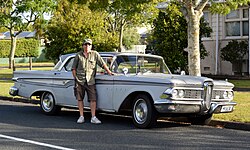
A Symbolic Commercial Failure
Despite introducing several advanced features for its price segment, the Edsel became a symbol of commercial failure. Several factors contributed to its downfall:
- Economic Timing: The car was introduced during a recession that severely impacted the sales of medium-priced vehicles.
- Design Criticism: The vertical grille was widely disliked and frequently compared to a horse collar.
- Perception: The brand was viewed as overhyped and suffered from perceived low quality.
The financial toll was staggering. Ford lost over $250 million (approximately 2.72 billion in 2025 dollars) on the development, manufacturing, and marketing of the line. Consequently, Ford quietly discontinued the brand before 1960.
A&W and the Third-Pound Burger Paradox
While the Edsel failed due to design and timing, A&W's struggle in the 1980s provides a fascinating look at consumer arithmetic failure—the inability of customers to correctly process mathematical values during a purchase decision.
Under the ownership of A. Alfred Taubman, A&W attempted to challenge the dominance of McDonald's Quarter Pounder. They introduced a larger, higher-quality hamburger and launched the "Third is the Word" campaign. The goal was simple: offer a third-pound burger as a better value for the same price as the competitor's quarter-pound burger.
The Psychology of Fractions
Despite aggressive TV and radio promotion, sales remained lackluster. To understand why, Taubman hired a market research firm to conduct focus groups. The results revealed a surprising psychological barrier: many consumers believed that one-third (1/3) of a pound was smaller than one-fourth (1/4) of a pound.
Participants focused on the denominators—the numbers "3" and "4"—and concluded that because 4 is larger than 3, a quarter-pounder must be larger than a third-pounder. This led customers to believe they were being overcharged for a smaller burger, despite the fact that a third of a pound is mathematically larger than a quarter of a pound.
This failure was further highlighted by a CBC report, which found that more than half of surveyed consumers avoided the burger for this reason. Even though taste tests showed customers preferred the A&W burger and it was less expensive, the mathematical confusion proved insurmountable.
Key Facts
- Edsel Investment: Ford lost over $250 million (approx. $2.72 billion in 2025 dollars) on the Edsel brand.
- Edsel Timeline: Produced between the 1958 and 1960 model years.
- A&W Strategy: The "Third is the Word" campaign offered more meat for the same price as a Quarter Pounder.
- Consumer Error: Many A&W customers mistakenly believed 1/3 was smaller than 1/4.
- Market Positioning: Edsel competed with mid-tier brands like Buick, Oldsmobile, and Pontiac.
| Feature | Edsel (Ford) | Third-Pound Burger (A&W) |
|---|---|---|
| Primary Cause of Failure | Recession, design, and overhyping | Consumer mathematical misunderstanding |
| Competitive Target | Buick, Oldsmobile, Pontiac, etc. | McDonald's Quarter Pounder |
| Key Misstep | Poor timing and unattractive styling | Confusing fractional naming |
| Outcome | Brand discontinued by 1960 | Lackluster sales despite better taste/value |
Frequently Asked Questions
Why did the Edsel fail so spectacularly?
The Edsel failed due to a combination of a recession affecting medium-priced cars, a widely disliked vertical grille design, and a marketing campaign that overhyped the product, leading to a gap between expectation and reality.
How much money did Ford lose on the Edsel?
Ford lost over $250 million on development, manufacturing, and marketing, which is equivalent to approximately 2.72 billion dollars in 2025.
Why did consumers think a third-pound burger was smaller than a quarter-pounder?
Consumers focused on the numbers 3 and 4 in the fractions. Because 4 is a larger number than 3, they incorrectly concluded that 1/4 was a larger portion of meat than 1/3.
Did customers actually like the A&W Third-Pound Burger?
Yes, taste tests indicated that customers actually preferred the A&W third-pound burger over the McDonald's Quarter Pounder, and it was priced more competitively.
Who was the Edsel named after?
The brand was named after Edsel Ford, the son of Ford Motor Company founder Henry Ford.