Earthlight and Earthshine: The Lunar Illumination Phenomenon
While we often think of the Moon as a cold, dark rock reflecting the Sun's rays, there is a subtle and fascinating interplay of light between our planet and its satellite. This phenomenon, known as Earthshine when viewed from Earth and Earthlight when viewed from the Moon, allows us to see parts of the lunar surface that are not directly touched by sunlight.
At its core, this process involves sunlight hitting the Earth, reflecting off our atmosphere and oceans, and then bouncing toward the Moon. This reflected light illuminates the lunar night, creating a ghostly glow that reveals the "dark side" of the lunar disk during specific phases.
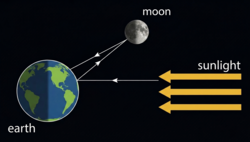
Key Facts
- Maximum Apparent Magnitude: -17.7 as viewed from the Moon; -3.69 as viewed from Earth.
- Radiance: Earthlight provides approximately 0.15 W m at the lunar surface, which is 0.01% of direct sunlight.
- Visibility: Most prominent during thin crescent moon phases.
- Intensity: Lunar night illumination is 43 to 55 times brighter than a full moon night on Earth.
- Unique Effect: Earthlight can illuminate areas of the lunar near side that the Sun never reaches.
Observing Earthshine from Earth
For observers on Earth, this phenomenon is most visible during astronomical twilight (the period when the sun is far enough below the horizon that the sky is dark) a few days before or after a new moon. When the Moon appears as a thin crescent, the entire lunar disk becomes visible—the crescent is lit by the Sun, while the rest of the disk is faintly lit by Earthshine.
The best times to spot this are after dusk during the waxing crescent (visible in the western sky) and before dawn during the waning crescent (visible in the eastern sky). Additionally, high-contrast photography can capture the night side of the Moon illuminated by Earthlight during a solar eclipse.
Beyond visible light, the Moon also reflects radio frequency transmissions, a principle utilized in Earth–Moon–Earth communication.
The Experience of Earthlight on the Moon
From the perspective of an astronaut or an observer on the lunar surface, the phenomenon is called Earthlight. Because the Earth is much larger and more reflective than the Moon, the light it casts is significantly more intense.
During the Apollo 11 mission on July 19, 1969, astronaut Michael Collins noted that the Earthshine entering the spacecraft window at a distance of 19,000 kilometers was bright enough to read a book by. While no human has yet stood on the lunar surface during the lunar night, calculations show that Earthshine makes the lunar night 43 to 55 times brighter than a night on Earth lit by a full moon.
The Absolute Darkness of the Far Side
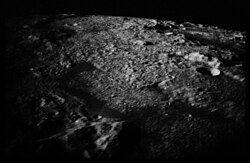
It is important to note that not all parts of the Moon experience this glow. The far side of the Moon, and the near side during lunar eclipses, remain in total darkness—darker than a moonless night on Earth.
This profound darkness was first experienced by the Apollo 8 crew on December 24, 1968. As they flew into the shadow behind the Moon, the lunar surface became completely invisible. Astronaut Bill Anders described the experience as a "big black void," where the Moon was only detectable as a black circular silhouette blocking a dazzling tapestry of stars.
Scientific Applications and Impact
Earthlight is more than a visual curiosity; it is a tool for scientific research. By studying the amount of Earthlight produced, researchers can analyze Earth's own environment from a distance. Furthermore, Earthlight enables the remote study of the Moon and provides illumination to specific regions of the lunar near side that are permanently shielded from direct sunlight.
| Perspective | Term | Max Apparent Magnitude | Relative Intensity |
|---|---|---|---|
| From Earth | Earthshine | -3.69 | Faint glow on crescent moon |
| From Moon | Earthlight | -17.7 | 43–55x brighter than Earth's full moon |
| Lunar Surface | Direct Sunlight | N/A | 10,000x brighter than Earthlight |
Frequently Asked Questions
What is the difference between Earthshine and Earthlight?
The terms describe the same physical phenomenon: sunlight reflecting off Earth to the Moon. "Earthshine" is used when the effect is observed from Earth, while "Earthlight" is used when observed from the Moon or a spacecraft.
When is the best time to see Earthshine in the night sky?
It is most visible a few days before or after a new moon during the thin crescent phases. Look in the western sky after dusk during a waxing crescent or the eastern sky before dawn during a waning crescent.
Is the lunar night completely dark?
On the near side, no; it is illuminated by Earthlight and is significantly brighter than a moonless night on Earth. However, the far side of the Moon and the near side during a lunar eclipse experience absolute darkness.
How bright is Earthlight compared to the Sun?
Earthlight is very dim compared to direct sunlight, providing only about 0.01% of the radiance that the Sun delivers to the lunar surface.
Can Earthlight be used for scientific research?
Yes. Scientists use Earthlight to study the Earth's environment by measuring the light the planet reflects, and it allows for the observation of lunar areas that never receive direct sunlight.