Drake Passage: The Powerful Gateway Between the Atlantic and Pacific
The Drake Passage, also known as the Mar de Hoces (Sea of Hoces), is a formidable body of water separating Cape Horn at the southern tip of South America from the South Shetland Islands of Antarctica. Serving as the critical link between the southwestern Atlantic Ocean (Scotia Sea) and the southeastern Pacific Ocean, this passage is named after the 16th-century English explorer Sir Francis Drake.
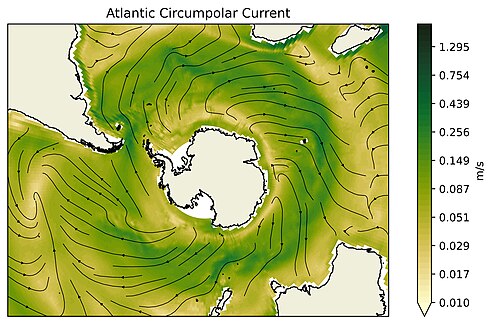
Renowned as one of the most treacherous maritime routes in the world, the passage is the site of the Antarctic Circumpolar Current (ACC). Because this current meets no landmass resistance, it can produce waves exceeding 40 feet (12 meters), earning the region a reputation as the most powerful convergence of seas on Earth.
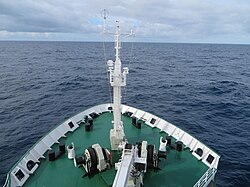
Key Facts
- Location: Between Cape Horn, Chile, and the South Shetland Islands, Antarctica.
- Primary Current: The Antarctic Circumpolar Current (ACC), the strongest oceanic current globally.
- Width: Approximately 800 kilometers (500 miles) at its shortest crossing.
- Climate Role: Acts as a choke point that influences global oceanic circulation and temperature.
- Wildlife: A rich habitat for whales, dolphins, and numerous species of albatrosses and penguins.
History of Discovery and Exploration
The history of the Drake Passage is marked by early Spanish and English voyages. In 1525, Spanish navigator Francisco de Hoces is believed to have discovered the passage after being blown south while seeking the Strait of Magellan. Although his fate remains unknown, Spanish sources often refer to the area as the Mar de Hoces.
The English name was established by Sir Francis Drake during his circumnavigation in 1578. After a tempest blew his fleet south, only his flagship, the Golden Hind, entered the passage, proving to the English that open water existed south of South America.
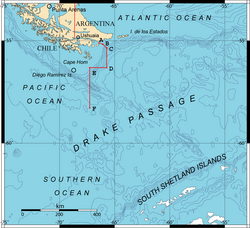
Later milestones include the 1616 voyage of Dutch navigator Willem Schouten, the first to sail around Cape Horn. More recently, in December 2019, a crew of six explorers became the first in history to successfully row across the passage, a feat documented in the film The Impossible Row.
Geography and Geological Origins
The Drake Passage was formed by plate tectonics as Antarctica separated from South America. While the exact timing is debated, estimates suggest this occurred between 49 and 17 million years ago. This geological event created the Shackleton fracture zone beneath the seabed.
The opening of the passage fundamentally altered the Earth's climate. By allowing the ACC to encircle Antarctica, the continent was thermally isolated from warmer northern waters, which likely triggered the rapid expansion of Antarctic ice sheets and global cooling during the Eocene epoch.
While the Strait of Magellan and the Beagle Channel offer alternative routes around South America, they are plagued by narrow channels and unpredictable tides. Consequently, most sailing ships prefer the open waters of the Drake Passage.
Physical Oceanography and Global Climate
The Drake Passage is a vital choke point—a narrow passage that restricts flow—connecting the Atlantic, Pacific, and Southern Ocean basins. The ACC transports an estimated 100–150 Sverdrups (Sv), where one Sverdrup equals one million cubic meters of water per second.
The Global Conveyor Belt
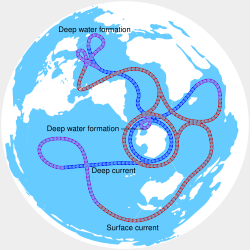
The passage is essential for the thermohaline circulation, the global "conveyor belt" driven by differences in temperature and salinity. Research indicates that the global thermohaline circulation, including the North Atlantic Deep Water (NADW) cell, only exists if the Drake Passage is open and subject to wind forcing.
Temperature and Mass Balance
The interaction of the ACC with the "Roaring Forties" and "Furious Fifties" winds leads to Ekman Transport, where water is pushed northward. Approximately 23 Sv of water is transported from the Drake Passage toward the equator, contributing to the global mass balance and the Atlantic meridional overturning circulation (AMOC).
![The Drake Passage influences the global surface temperature and Atlantic circulation.[15]](/images/5b/46/5b465f2f200c9fc4d3384bf103ef7fce94486068364c43faae4e3ac2f9289714.jpg)
Turbulence and Internal Mixing
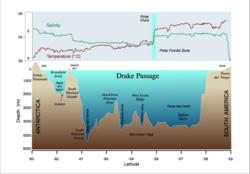
The rough bathymetry (underwater topography) of the Drake Passage facilitates diapycnal mixing—the process where different layers of stratified fluid mix. In a stable ocean, colder, denser water stays below warmer water. Internal mixing is required to push this colder water upward to maintain global circulation.
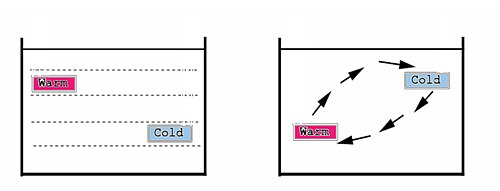
The breaking of internal waves (Lee waves) against the passage's coarse topography creates mixing that is estimated to be 20 times stronger than in the Pacific sector of the ACC. Without this intense mixing, the global oceanic circulation would be significantly weakened.
Marine Fauna
The nutrient-rich waters of the passage support a diverse array of wildlife, particularly seabirds and cetaceans.
| Category | Notable Species |
|---|---|
| Cetaceans | Blue whale, Fin whale, Humpback whale, Sperm whale, Hourglass dolphin, Long-finned pilot whale |
| Albatrosses | Wandering, Royal (Northern and Southern), Black-browed, Grey-headed, Light-mantled |
| Other Birds | Giant petrels, Southern fulmar, Cape petrel, Antarctic prion, various Storm petrels |
Frequently Asked Questions
Why is the Drake Passage so rough?
The roughness is primarily caused by the Antarctic Circumpolar Current (ACC), which flows unimpeded by any landmasses. This, combined with powerful winds from the Roaring Forties and Furious Fifties, creates massive waves and treacherous conditions.
How does the Drake Passage affect global temperature?
By allowing the ACC to form, the passage thermally isolates Antarctica from warmer northern waters, cooling the Southern Ocean. Simultaneously, it helps distribute heat to the high latitudes of the Northern Hemisphere through the global thermohaline circulation.
What is a Sverdrup (Sv)?
A Sverdrup is a unit of volume transport used in oceanography, equal to one million cubic meters of water flowing past a given point per second.
Who was the first person to row across the Drake Passage?
A crew of six explorers achieved this historic first on December 25, 2019, an accomplishment later featured in the documentary The Impossible Row.
What is diapycnal mixing?
Diapycnal mixing is the process by which water layers of different densities mix. In the Drake Passage, this is driven by internal waves breaking against the rough seafloor, which is essential for driving the global ocean conveyor belt.