Doppler Sodar: Technology and Application in Wind Measurement
Measuring upper-air wind conditions is critical for various meteorological and industrial applications. One of the most effective tools for this task is Doppler sodar (Sonic Detection and Ranging), a system that uses acoustic signals to determine wind velocity and direction at various altitudes.
At its core, a sodar system transmits sound waves into the atmosphere. These waves are scattered by atmospheric irregularities and reflected back to the system. By analyzing the Doppler shift—the change in frequency of a wave in relation to an observer moving relative to the wave source—the system can calculate the speed and direction of the wind.
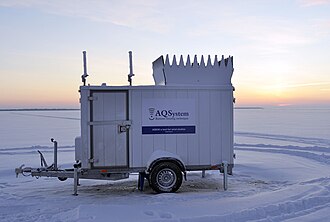
Key Facts
- Operational Range: Typically measures vertical ranges from 0.2 to 2 kilometers.
- Frequency Range: Operates between less than 1,000 Hz and over 4,000 Hz.
- Power Output: Can reach several hundred watts to ensure signal penetration.
- Measurement Basis: Uses acoustic scattering caused by temperature and wind velocity fluctuations.
- Beam Angles: Horizontal beams are usually tilted at a zenith angle of 15 to 30 degrees.
Antenna System Configurations
Commercial sodars are categorized by how they transmit and receive acoustic signals. The choice of antenna configuration determines what atmospheric factors cause the signal to scatter.
Mono-static vs. Bi-static Systems
A mono-static system utilizes the same antenna for both transmitting and receiving signals. In these systems, atmospheric scattering is primarily caused by temperature fluctuations. Conversely, a bi-static system employs separate antennas for transmission and reception, allowing it to detect scattering caused by both temperature and wind velocity fluctuations.
Mono-static Antenna Types
Mono-static systems are further divided into two primary designs:
- Multiple-Axis Individual Antennas: These systems typically use three independent antennas. One is aimed vertically, while the other two are tilted at orthogonal angles. These may use a single transducer with a parabolic reflector (forming a parabolic loudspeaker) or an array of speaker drivers and horns. While three axes are sufficient to retrieve wind speed components, additional axes can be added to increase robustness against noise using a least-squares approach.
- Phased-Array Antenna Systems: These use a single array of transducers. Instead of physical movement, the beams are electronically steered by adjusting the phasing of the transducers.
Calculating Wind Velocity
To determine horizontal wind components, the system analyzes the radial Doppler shifts and the zenith angle (the tilt angle from the vertical). These horizontal beams are generally oriented at right angles to each other.
Because the radial components along tilted beams are influenced by both horizontal and vertical wind movements, corrections are necessary in specific scenarios. A vertical velocity correction is required if the zenith angle is less than 20 degrees, or if the local vertical velocities exceed approximately 0.2 m/s, regardless of the angle.
Performance Factors and Range
The effective vertical range of a sodar (0.2 to 2 km) is not fixed; it depends on several environmental and technical variables. Atmospheric stability, turbulence, and the surrounding noise environment play significant roles in signal clarity.
Technical specifications also impact coverage. Due to atmospheric attenuation, systems with lower frequencies and higher power outputs generally achieve greater height coverage. Additionally, some sodars offer different operating modes that allow users to balance pulse length against maximum altitude to optimize vertical resolution for a specific application.
| Parameter | Typical Value/Range | Impact/Note |
|---|---|---|
| Vertical Range | 0.2 to 2 km | Affected by noise and stability |
| Operating Frequency | <1,000 Hz to >4,000 Hz | Lower frequencies increase height coverage |
| Power Output | Up to several hundred watts | Higher power improves range |
| Zenith Angle | 15 to 30 degrees | Determines horizontal wind calculation |
Frequently Asked Questions
What is the difference between mono-static and bi-static sodars?
Mono-static sodars use one antenna for both sending and receiving signals and detect scattering from temperature fluctuations. Bi-static sodars use separate antennas and can detect scattering from both temperature and wind velocity fluctuations.
How does a phased-array antenna differ from a multiple-axis system?
A multiple-axis system uses physically separate antennas aimed in fixed directions. A phased-array system uses a single array of transducers and steers the acoustic beams electronically through phasing.
When is a vertical velocity correction necessary?
Corrections are required if the system's zenith angle is less than 20 degrees or if the vertical wind velocity in the area exceeds 0.2 m/s.
What factors limit the maximum height a sodar can measure?
The vertical range is primarily limited by the noise environment, atmospheric stability, turbulence, the system's power output, and the operating frequency.
How can a sodar be optimized for different applications?
Some systems allow for different operating modes that adjust the relationship between pulse length and maximum altitude, allowing the user to choose between better vertical resolution or greater range.