DNA Barcoding: A Molecular Tool for Species Identification
In the vast complexity of the natural world, identifying a species accurately can be a daunting task. Traditional taxonomy relies on morphological characteristics—the physical traits of an organism—which can be misleading or impossible to determine from a small tissue sample or a larval stage. DNA barcoding offers a revolutionary alternative, using a short, standardized section of DNA from a specific gene to uniquely identify an organism.
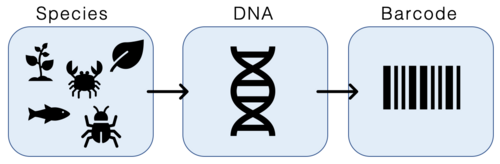
The concept is analogous to the Universal Product Code (UPC) barcodes used in supermarkets. Just as a scanner reads a series of black stripes to identify a product against a store's database, scientists sequence a specific genetic region and compare it to a reference library to determine the species of a biological sample.
Key Facts
- Purpose: Rapid species identification and cataloging of taxa.
- Mechanism: Comparison of a short DNA sequence against a known reference library.
- The Barcoding Gap: The principle that genetic variation between species is greater than variation within a single species.
- Common Markers: COI for animals, ITS for fungi, and RuBisCO for plants.
- Metabarcoding: An extension of barcoding used to identify entire communities from a single bulk sample.
How DNA Barcoding Works
The success of DNA barcoding depends on selecting the right genetic marker. A suitable marker must have low intraspecific variation (differences between individuals of the same species) and high interspecific variation (differences between different species). This disparity is known as the "Barcoding Gap," which allows researchers to draw a clear line between distinct species.
Target Gene Regions by Organism
Different groups of organisms require different genetic markers to ensure accuracy:
- Animals and some Protists: The cytochrome c oxidase I (COI, CO1, or COX1) gene found in mitochondrial DNA is the primary standard.
- Fungi: The internal transcribed spacer (ITS) rRNA region is most commonly used.
- Plants: The RuBisCO gene is a frequent choice for identification.
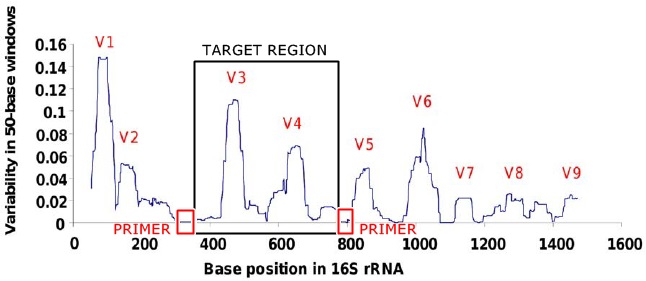
- Prokaryotes: The 16S rRNA gene is the gold standard for bacteria and archaea.
- Microbial Eukaryotes: The 18S rRNA gene is typically employed.
The Technical Process
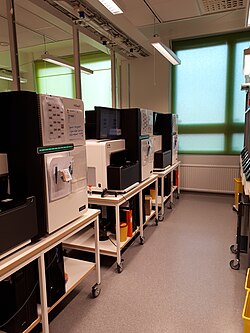
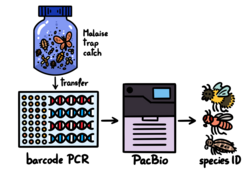
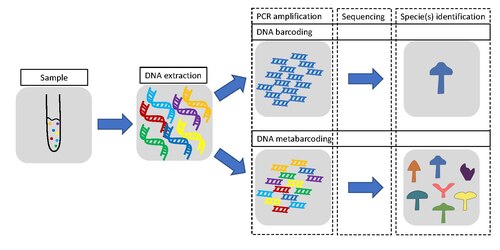
The workflow begins with sampling, which can involve individual tissue samples, bulk samples, or environmental DNA (eDNA)—genetic material collected directly from environmental sources like water or soil. Once the DNA is extracted, specific primers are used to amplify the target region via PCR (Polymerase Chain Reaction) before the sequence is read by a sequencer.
Reference Libraries and Data Systems
A DNA sequence is only useful if it can be compared to a known standard. This is where reference libraries come into play. These databases store verified sequences linked to taxonomically identified specimens.
| Library/System | Primary Focus | Description |
|---|---|---|
| BOLD | Animals/General | The Barcode of Life Data System; a global hub for animal barcodes. |
| UNITE | Fungi | A specialized database for fungal ITS sequences. |
| Diat.barcode | Diatoms | A dedicated resource for diatom identification. |
Practical Applications
DNA barcoding is more than a laboratory exercise; it has critical real-world applications across various sectors.
Biodiversity and Ecology
- Species Identification: Cataloging unknown taxa and discovering cryptic species (species that look identical but are genetically distinct).
- Invasive Species: Rapidly detecting non-indigenous species to prevent ecological collapse.
- Biomonitoring: Assessing the health of ecosystems by analyzing the diversity of species present.
Food Safety and Forensics
Barcoding is a powerful tool for vouching for food quality. It can detect fraudulent labeling (e.g., substituting a cheap fish for an expensive one) and ensure food safety by identifying the exact species of ingredients.
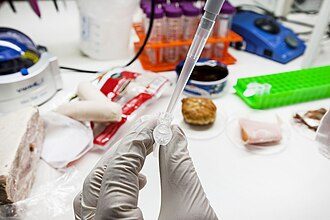
In forensic science, DNA barcoding can be used to identify illegal wildlife products or link suspects to a crime scene through environmental plant DNA found on clothing or equipment.
From Barcoding to Metabarcoding
While standard DNA barcoding identifies a single specimen, metabarcoding (or megabarcoding) analyzes a mixture of DNA from an entire community. This allows scientists to determine the diet of an animal by sequencing the DNA in its stomach contents or to survey all the fish in a lake from a single liter of water.
Potentials and Shortcomings
Despite its efficiency, the method is not without challenges. The primary advantages include reduced time and cost compared to traditional morphological expertise and the ability to identify organisms from fragmented samples.
However, shortcomings include technological bias during the amplification process and a lack of universal standardization. Furthermore, mismatches can occur between barcode-based identification and conventional morphology, and the method may struggle with haplogroup resolution or providing precise estimates of species abundance.
Frequently Asked Questions
What is the difference between DNA barcoding and DNA profiling?
DNA barcoding identifies the species of an organism by looking at a conserved gene region shared by all members of that species. DNA profiling (or fingerprinting) identifies a specific individual by looking at highly variable regions of the genome.
Can DNA barcoding identify a brand new species?
Yes. If a sequence is generated that does not match any existing entry in a reference library and shows a significant genetic distance from known species, it may indicate the discovery of a new or cryptic species.
What is eDNA?
Environmental DNA (eDNA) is genetic material shed by organisms into their environment—such as skin cells, mucus, or waste—which can be collected from water, soil, or air to detect species without needing to capture the organism itself.
Why is the COI gene used for animals?
The cytochrome c oxidase I (COI) gene is used because it is present in the mitochondria of almost all animals, evolves at a rate that creates a clear "barcoding gap" between species, and is easier to amplify than nuclear DNA.