Dirges: The History and Evolution of Mourning Songs
A dirge is a somber song or lament designed to express grief and mourning. Typically performed at funerals, these compositions often take the form of brief hymns. While they share similarities with elegies, dirges are generally shorter, less meditative, and characterized by a slow tempo reminiscent of a funeral march. Whether written as poetry dedicated to a specific person or as a general meditation on death, the dirge serves as a powerful auditory expression of loss.
The term originates from the Latin phrase Dirige, Domine, Deus meus, in conspectu tuo viam meam ("Direct my way in your sight, O Lord my God"). These are the opening words of the first antiphon—a short chant used in Christian liturgy—within the Matins of the Office for the Dead, based on Psalm 5.
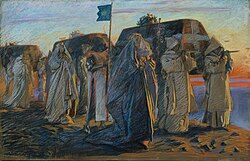
Key Facts
- Definition: A slow, somber song or hymn expressing mourning, often resembling a funeral march.
- Etymology: Derived from the Latin Dirige, the opening words of a chant in the Office for the Dead.
- Distinction: Shorter and less meditative than an elegy.
- Liturgical Roots: Originally referred to the morning prayers (Matins and Lauds) for the deceased.
- Cultural Example: The "Lyke-Wake Dirge" is a famous non-scriptural funeral lament from North-east Yorkshire.
The Liturgical Origins of the Dirge
During the late Medieval period, it was common for the Western Christian laity to attend the celebration of the Divine Office (canonical hours) alongside monastic communities. Because the official breviaries—books containing the service order—were too complex for private use, simplified versions called primers were created for the public.
One of the most enduring sections of these primers was the Office of the Dead. This set of prayers was divided into two daily recitations:
- Dirige: The morning service, equivalent to Matins and Lauds.
- Placebo: The evening service, equivalent to Vespers or Evensong.
Over time, the term "Dirige" expanded to encompass the entire Office of the Dead, including the Psalms of Commendation (Psalms 119 and 139). This collective usage was formally codified in the standardized primer issued under Elizabeth I in 1559.
Evolution from Ritual to Art
Before the English Reformation, translated portions of the Dirige were among the most widely circulated vernacular Bible texts in England, as they were frequently recited at gravesites. While formal liturgical performances remained in Latin through the early 16th century, the practice eventually shifted toward the variety of funeral hymns we recognize today.
The Lyke-Wake Dirge and Folk Tradition
One of the earliest examples of a non-liturgical lament is the "Lyke-Wake Dirge" from the Cleveland area of north-east Yorkshire. Unlike church chants, its lyrics focus on salvation through Christ via alms-giving. This tradition is linked to the "Lyke Wake Walk," a 40-mile challenge across Yorkshire moorlands. The dirge saw a modern resurgence in the 1960s through folk bands such as Pentangle and The Young Tradition.
Dirges in Literature and Music
As the form moved away from strict religious usage, composers and poets began utilizing the dirge for artistic expression. Some were written specifically for music, while others, like the "Dirge for Fidele" from William Shakespeare's play Cymbeline, were written as dramatic text and later set to music by composers such as Gerald Finzi and Ralph Vaughan Williams.
Summary of Dirge Characteristics
| Type | Origin/Context | Primary Characteristic |
|---|---|---|
| Liturgical Dirige | Christian Office for the Dead | Formal Latin chants based on Psalm 5 |
| Folk Dirge | Regional traditions (e.g., Yorkshire) | Vernacular laments, often non-scriptural |
| Literary Dirge | Poetry and Drama | Thematic focus on death or specific individuals |
Notable Examples of Dirges
- "A Dirge" by Christina Rossetti
- "A Dirge" by Percy Bysshe Shelley
- "Dirge for Fidele" by William Shakespeare (set to music by various composers)
- "Lyke-Wake Dirge" (Traditional English folk)
- "Ring Out Your Bells" by Sir Philip Sidney
Frequently Asked Questions
What is the difference between a dirge and an elegy?
While both express grief, a dirge is typically a shorter, slower song intended for performance at a funeral, often resembling a march. An elegy is generally a longer, more meditative poem or song.
Where does the word "dirge" come from?
It comes from the Latin word Dirige, which is the first word of an antiphon in the Christian Office for the Dead, meaning "Direct [my way], O Lord my God."
What is the Lyke-Wake Dirge?
It is a pre-Reformation funeral lament from north-east Yorkshire, England. It focuses on salvation through alms-giving rather than strict liturgy and was repopularized by folk musicians in the 1960s.
Was the dirge always a musical composition?
Not exclusively. While many are set to music, dirges can also exist as poetic forms dedicated to the deceased or as spoken liturgical prayers.
How did the English Reformation affect the dirge?
The Reformation led to a curtailment of public liturgical devotions. While the Dirige remained in the Elizabethan primer, there was significant Protestant objection to prayers for the dead, and some church officials disapproved of "dirge-like" singing in parishes.