Dieter Hecking: A Comprehensive Timeline of a German Managerial Career
Dieter Hecking has established himself as a mainstay in German football management, navigating the complexities of the Bundesliga (Germany's top professional league) and the 2. Bundesliga over more than two decades. From early struggles in the regional leagues to lifting major silverware, Hecking's career is a study in resilience, tactical adaptation, and the volatile nature of professional coaching.
Key Facts
- Major Trophy: Won the DFB-Pokal (German Cup) with VfL Wolfsburg in 2015.
- Individual Honor: Named Football Manager of the Year in 2015.
- Historic Achievement: Led Alemannia Aachen to become the first 2. Bundesliga team to reach the UEFA Cup third round.
- Versatility: Has served as both a head coach and a sporting director.
- Career Span: Active in management from 2000 through 2026.
Early Career and the Rise through Regionalliga (2000–2004)
Hecking began his managerial journey on July 1, 2000, with SC Verl in the Regionalliga Nord. His start was turbulent; after just 20 games, he was dismissed on January 31, 2001, following tensions regarding his desire to seek new opportunities. Despite the abrupt end, he left Verl in seventh place.
His fortunes shifted when he joined VfB Lübeck on March 27, 2001. Hecking successfully guided the team to a third-place finish in his first partial season and secured the league title the following year, earning promotion to the 2. Bundesliga. After maintaining an 11th-place finish in 2002–03, Hecking led the club to the DFB-Pokal semi-finals in 2004, though the season ended in relegation. He departed the club on May 25, 2004.
Establishing a Reputation: Alemannia Aachen and Hannover 96 (2004–2009)
In June 2004, Hecking took over at Alemannia Aachen. He made an immediate impact on the European stage, leading the club to the third round of the UEFA Cup—a first for any 2. Bundesliga side. After a sixth-place league finish in his first year, he secured promotion to the Bundesliga in the 2005–06 season, ending a 36-year absence from the top flight.
Hecking's success at Aachen caught the attention of Hannover 96. On September 7, 2006, he moved to Hannover for a compensation fee of nearly one million euros. He inherited a team at the bottom of the table and steered them to an 11th-place finish and a cup quarter-final. The following season, he achieved an eighth-place finish, the club's best in 43 years. However, after a disappointing 2008–09 campaign and a slow start to the next season, he resigned on August 19, 2009.
Stability and Success: 1. FC Nürnberg and VfL Wolfsburg (2009–2016)
Hecking joined 1. FC Nürnberg on December 22, 2009. He successfully navigated a relegation playoff against Augsburg to keep the club in the top flight and later led them to a sixth-place finish in 2011. He eventually left the club in December 2012 via a contract clause, leaving behind a record of 42 wins, 23 draws, and 47 losses.
His appointment at VfL Wolfsburg on December 22, 2012, marked the most successful period of his career. After stabilizing the team in 11th place during his first season, he led them to a fifth-place finish and Europa League qualification in 2014.
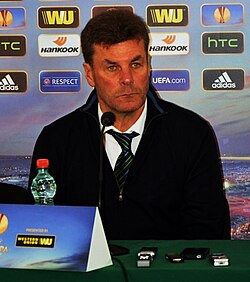
The 2014–15 season was a landmark year. Wolfsburg finished second in the Bundesliga, qualifying for the Champions League, and defeated Borussia Dortmund 3–1 to win the DFB-Pokal. Hecking was credited with the development of key players like Kevin De Bruyne, Bas Dost, and Ricardo Rodriguez. Despite a strong Champions League run to the quarter-finals in 2016, a poor domestic away record led to his sacking on October 17, 2016.
Later Years and Transition to Administration (2016–2026)
From 2016 to 2019, Hecking managed Borussia Mönchengladbach, where he focused on Bundesliga survival and achieved two consecutive ninth-place finishes. He then moved to Hamburger SV in May 2019, but departed by mutual consent in July 2020 after failing to secure promotion to the Bundesliga.
Hecking returned to 1. FC Nürnberg in a different capacity as sporting director, though he stepped in as interim head coach in February 2023 to ensure the club's survival in the 2. Bundesliga. A brief stint at VfL Bochum (2024–2025) ended in relegation and his subsequent dismissal.
In March 2026, Hecking returned to VfL Wolfsburg as head coach. Following a relegation playoff defeat to Paderborn, he retired from active coaching to transition into the role of managing director of sport.
Managerial Summary
| Club | Period | Key Achievement |
|---|---|---|
| VfB Lübeck | 2001–2004 | Regionalliga Nord Title & Promotion |
| Alemannia Aachen | 2004–2006 | Promotion to Bundesliga |
| Hannover 96 | 2006–2009 | 8th place finish (best in 43 years) |
| 1. FC Nürnberg | 2009–2012 | Avoided relegation via playoffs |
| VfL Wolfsburg | 2012–2016 | DFB-Pokal Winner (2015) |
| B. Mönchengladbach | 2016–2019 | Consistent top-half finishes |
| Hamburger SV | 2019–2020 | Managed in 2. Bundesliga |
Frequently Asked Questions
What is Dieter Hecking's greatest achievement as a manager?
His greatest achievement was leading VfL Wolfsburg to victory in the 2015 DFB-Pokal final, where they defeated Borussia Dortmund 3–1.
Which players did Hecking help develop at Wolfsburg?
Hecking was highly praised for the development of star midfielder Kevin De Bruyne, as well as key players Bas Dost and Ricardo Rodriguez.
Did Hecking ever manage in European competitions?
Yes, he led Alemannia Aachen to the third round of the UEFA Cup and guided VfL Wolfsburg to the Champions League quarter-finals.
Has Dieter Hecking held roles other than head coach?
Yes, he has served as a sporting director, most notably during his return to 1. FC Nürnberg and his final transition to managing director of sport at VfL Wolfsburg.
How did Hecking's time at Alemannia Aachen end?
After securing promotion to the Bundesliga, Hecking left the club in September 2006 to join Hannover 96.