Der Bannerträger: The Propaganda Art of Hubert Lanzinger
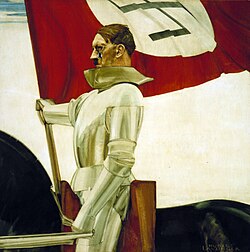
Art has often been used as a tool for political messaging, but few examples are as stark as Der Bannerträger (The Standard Bearer). Painted by Austrian artist Hubert Lanzinger, this work serves as a primary example of how the Nazi regime utilized stylized imagery to cultivate a messianic image of its leader, Adolf Hitler.
The painting depicts Hitler not as a modern politician, but as a figure from a bygone era. He is portrayed sitting atop a black horse, clad in armor reminiscent of a 15th-century knight. In his hand, he carries a Nazi flag that billows behind him, while his gaze is directed symbolically toward a perceived greater future for Germany. Some interpretations suggest the portrayal evokes the figure of Lohengrin, a mythical knight of the Grail.
Key Facts
- Artist: Hubert Lanzinger (Austrian).
- Subject: A stylized depiction of Adolf Hitler as a medieval knight.
- Medium: Oil painting on wood.
- Creation Date: Completed between 1934 and 1936.
- Current Location: United States Army Center of Military History, Washington, DC.
Public Display and Distribution
The painting first entered the public eye at the Great German Art Exhibition in Munich in 1937. To ensure the image reached a wider audience, Heinrich Hoffmann produced the work as a postcard in 1938, further disseminating the regime's idealized vision of the Führer.
Post-War Recovery and Denazification
Following World War II, the United States Army seized approximately 10,000 works of German military art and Nazi propaganda as part of denazification—the systematic effort to remove Nazi influence from German society and culture. Der Bannerträger was among these seized assets.
The painting bears the physical scars of the conflict; after the war, an American soldier damaged the piece by piercing it with a bayonet. It eventually became part of the collection at the United States Army Center of Military History.
Exhibition History and Critical Reception
In the decades following the war, the painting has been used as an educational tool to illustrate the mechanics of propaganda. It was featured in the United States Holocaust Memorial Museum's traveling exhibition, State of Deception: Power of Nazi Propaganda, and was displayed in 1999 at the Altes Museum in Berlin as part of the German Art of the Twentieth Century exhibition.
Modern historians and critics have viewed the work with disdain. In his 2019 book Culture in Nazi Germany, Michael H. Kater described the painting as an example of the "ludicrous nature" of original Nazi German art, noting that it transcends common definitions of kitsch (art considered to be in poor taste because of excessive sentimentality) to reveal the "depth of evil" behind it.
| Attribute | Details |
|---|---|
| Artist | Hubert Lanzinger |
| Date of Completion | 1934–1936 |
| Material | Oil on wood |
| First Public Appearance | 1937 (Munich) |
| Current Owner | US Army Center of Military History |
Frequently Asked Questions
What is the symbolism behind the armor in Der Bannerträger?
The 15th-century knight's armor is used to portray Hitler as a messianic or heroic figure, linking the Nazi leadership to a romanticized medieval past and suggesting a sense of timeless authority.
Where is the painting located today?
The painting is currently held in the collection of the United States Army Center of Military History in Washington, DC.
How was the painting damaged?
After World War II, the painting was pierced with a bayonet by an American soldier.
What was the purpose of the Great German Art Exhibition?
The painting was first displayed there in 1937, serving as a venue to showcase art that aligned with the ideological goals of the Nazi Party.
How did the painting reach a mass audience?
Beyond its exhibition in Munich, the image was mass-produced as a postcard by Heinrich Hoffmann in 1938.