Decentralized Systems in Nature and Human Society
Decentralized systems are structures where control is distributed rather than concentrated in a single authority. While these systems are often discussed in technical contexts, they are prevalent in the natural world and the foundational structures of human society, allowing complex global behaviors to emerge from simple, local interactions.
Decentralized Control in Insect Colonies
Certain insect colonies serve as primary examples of natural decentralized systems. In these environments, control is distributed among homogeneous biological agents—individuals of the same type—who rely on local information and interactions to achieve complex goals. These agents do not follow a master plan; instead, they use dynamical mechanisms, such as non-explicit communication and closely coupled action and perception systems, to manage the colony's needs.
Without a central controller, these colonies can feed their population, raise the brood, and respond to environmental changes by adjusting the number of workers assigned to specific tasks. For instance, ant colonies manage foraging, patrolling, and nest maintenance through a shifting web of spatio-temporal interactions based on olfactory sensing and the rate of antennal contact.
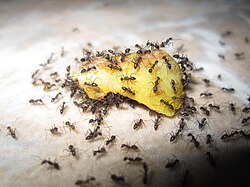
The Case of Red Harvester Ants
The red harvester ant (Pogonomyrmex barbatus) demonstrates a highly flexible task-allocation system. Rather than being directed by a leader, these ants use a division of labor based on chemical gradients and physical encounters. Specifically, they utilize cuticular hydrocarbon scents (waxy chemicals on the exoskeleton) and the rate of interaction to determine food availability.
The decision to switch to foraging behavior is driven by two local factors:
- Return Rate: A faster rate of foragers returning with seeds indicates high food availability.
- Interaction Rate: Fewer interactions suggest a greater need for more foragers to leave the nest.
This process is regulated by positive feedback: as outgoing foragers encounter more ants returning with seeds, more ants are triggered to forage. Once in the field, ants use their olfactory senses to follow pheromone trails—chemical paths left by others—following a descending gradient to locate the food source.
Limits and Failures of Decentralization
Decentralization is not universal among insects. For example, the foraging behavior of wasps is centrally regulated and controlled by the queen. Furthermore, decentralized systems can fail when the simple rules governing individual agents cannot handle specific scenarios, a phenomenon seen in the "ant mill," where ants follow each other in a continuous, fatal loop.
Decentralized Systems in Human Economics
Beyond biology, the market economy functions as a decentralized economic system. Unlike a planned economy, where a governmental body dictates production and investment, a market economy relies on distributed, local interactions, such as individual investments and trades.
While the degree of government regulation varies across different market economies, the overall economic behavior emerges from these local interactions rather than a central set of instructions. The allocation of producer goods and investment decisions are the result of collective market activity rather than a singular central plan.
Key Facts
- Distributed Control: In decentralized insect colonies, no single agent dictates the behavior of others.
- Local Cues: Red harvester ants use antennal contact and cuticular hydrocarbons to coordinate foraging.
- Positive Feedback: Increased encounters between returning foragers and nest-bound ants accelerate foraging activity.
- Biological Variation: Not all insects are decentralized; wasp foraging is controlled by the queen.
- Economic Parallel: Market economies are decentralized because they rely on local market interactions rather than a central production plan.
| System Type | Example | Primary Driver of Behavior | Control Mechanism |
|---|---|---|---|
| Biological | Red Harvester Ants | Pheromones & Antennal Contact | Local interactions/Feedback loops |
| Economic | Market Economy | Individual Investments/Trades | Distributed market interactions |
Frequently Asked Questions
How do red harvester ants decide when to forage?
They base this decision on local information: the rate at which other foragers return with seeds and the frequency of antennal interactions with other ants.
Do all insect colonies operate without a leader?
No. While many ants are decentralized, other insects, such as wasps, have foraging behaviors that are regulated and controlled by the queen.
What is an "ant mill"?
An ant mill is an example of a decentralized system failure, occurring when the simple rules followed by individual ants lead them into a circular loop they cannot escape.
Why is a market economy considered decentralized?
It is considered decentralized because investment and production decisions are made through distributed local interactions in the market rather than through a central governmental production plan.
What role do pheromones play in ant decentralization?
Pheromones act as chemical gradients that ants follow using their olfactory senses, allowing them to find food sources without needing direct instructions from another ant.