Daphnia: The Remarkable Biology of the Water Flea
Commonly known as water fleas due to their saltatory (jumping) swimming style, Daphnia are small, planktonic crustaceans that play a vital role in aquatic ecosystems. These tiny organisms, ranging from 0.2 to 6.0 mm in length, inhabit a diverse array of environments, from acidic swamps to freshwater lakes and ponds. Despite their diminutive size, they are complex biological marvels that serve as essential components of the food chain.
Key Facts
- Diversity: The genus contains over 200 species.
- Size: Typically between 0.2 mm and 6.0 mm.
- Reproduction: Utilizes cyclical parthenogenesis (alternating between asexual and sexual reproduction).
- Dietary Role: Acts as a primary food source for many fish and amphibians.
- Scientific Importance: Used as a model organism to study the effects of drugs and environmental toxins.
Physical Characteristics and Physiology
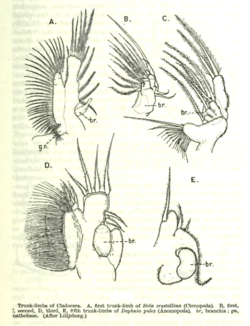
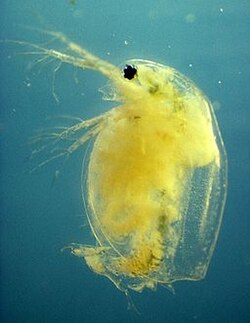
The body of a Daphnia is generally divided into segments, though these divisions are not always visible to the naked eye. Most species possess a carapace—a protective shell—that covers the body, leaving a ventral gap where several pairs of legs reside. Their most striking features include large compound eyes and prominent second antennae, which they use to power their characteristic jumping motion.
Because many species have a translucent carapace, they are exceptional subjects for microscopic study. Researchers can observe internal functions in real-time, such as the beating of the heart, the movement of blood cells, and even the development of immature young within the brood pouch. Under normal conditions, a Daphnia heart beats at an average rate of approximately 180 bpm.
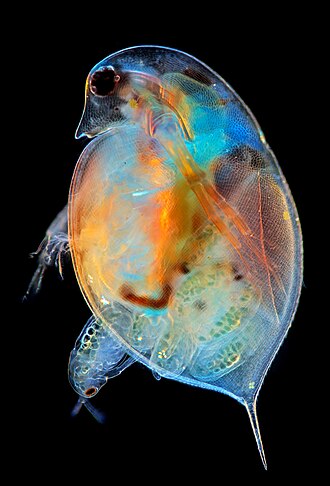
Due to their intermediate size, Daphnia employ both diffusion and circulatory methods for physiological processes. In low-oxygen environments, they are capable of producing hemoglobin to assist with oxygen transport. Their sensitivity to substances like caffeine, alcohol, nicotine, and adrenaline makes them invaluable in neurobiological research.
Systematics and Evolution
The genus Daphnia belongs to the family Daphniidae within the order Anomopoda. While the genus is subdivided into several subgenera—including Australodaphnia, Ctenodaphnia, and Daphnia—taxonomic boundaries remain a subject of ongoing scientific debate. This complexity is driven by factors such as phenotypic plasticity (the ability of an organism to change its phenotype in response to the environment), hybridization, and the existence of cryptic species.
Evolutionary evidence suggests that modern members of the Daphnia and Ctenodaphnia subgenera have existed since the Cretaceous period, though the genus likely originated even earlier.
Ecology and Behavioral Adaptations
Daphnia are typically r-selected species, meaning they prioritize early reproduction and often have relatively short lifespans. While they can live up to 13–14 months in cold, fish-free, oligotrophic (nutrient-poor) lakes, their lifecycle in typical conditions usually lasts only 5–6 months.
One of the most fascinating aspects of Daphnia biology is their ability to respond to kairomones—chemical signals released by predators. When they detect these signals, they can undergo morphological changes to increase their chances of survival. For instance, in the presence of Chaoborus (phantom midge) larvae, juveniles may hatch at a larger size and develop "neck-teeth" to discourage predation.
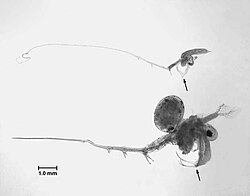
These adaptations are driven by complex genetic responses. Research has shown that different kairomones can trigger opposing genetic pathways; for example, fish kairomones may lead to a reduction in size at first reproduction, whereas Chaoborus kairomones may trigger an increase in size.
The Life Cycle: Cyclical Parthenogenesis
The reproductive strategy of Daphnia is known as cyclical parthenogenesis. For much of the growing season, females reproduce asexually, producing diploid eggs that hatch into typically female offspring. This allows for rapid population growth when conditions are favorable.
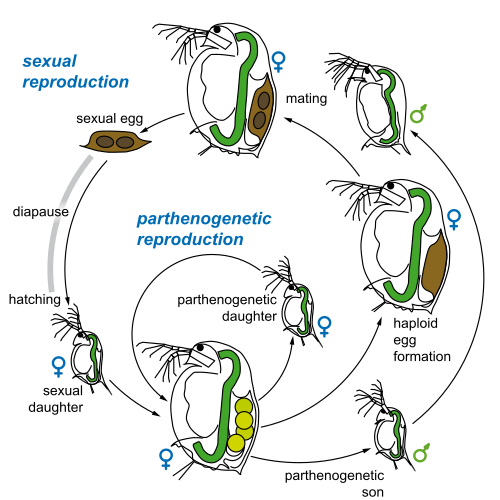
However, when environmental conditions change, they switch to sexual reproduction. This process results in the production of resting eggs, often housed in a protective structure called an ephippium, which can survive harsh conditions until favorable environments return.
Parasitism and Threats
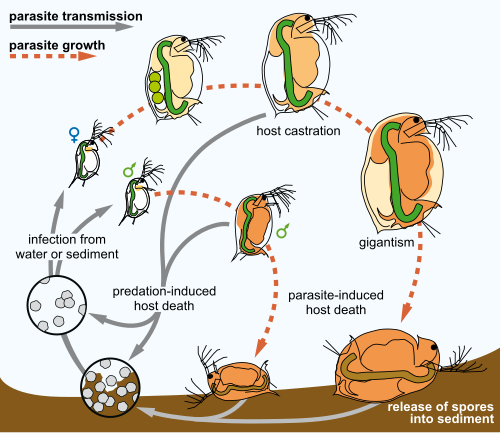
Daphnia are subject to various biological pressures, including bacterial parasites such as Pasteuria ramosa. This parasite infects the host's body cavity and muscle tissue, often resulting in sterility and gigantism before the host eventually dies and releases spores back into the environment.
Furthermore, the introduction of invasive species poses a significant threat. Certain non-native species, such as Daphnia lumholtzi, have developed permanent defenses like long spines and hooks. These can make them difficult for native predators to consume and can cause them to clog fishing lines, potentially disrupting local aquatic food webs.
Summary of Key Species and Characteristics
| Species/Group | Common Characteristics | Typical Size/Notes |
|---|---|---|
| D. pulex | Small and very common | Standard species |
| D. magna | Large species | Commonly used in research |
| D. pulicaria | Similar to D. pulex | Can produce hybrids with D. pulex |
| Moina | Related genus (Moinidae) | Roughly half the length of D. pulex |
| D. lumholtzi | Invasive characteristics | Possesses spines and hooks |
Frequently Asked Questions
Why are they called water fleas?
They are called water fleas because their method of swimming involves sudden, jumping movements that resemble the hopping motion of terrestrial fleas.
How do Daphnia reproduce?
They use a process called cyclical parthenogenesis, which means they alternate between asexual reproduction (producing female offspring) and sexual reproduction depending on environmental conditions.
Can Daphnia be used in scientific experiments?
Yes. Because they are translucent and have a visible circulatory system, they are excellent models for studying the effects of stimulants, depressants, and toxins on the nervous and cardiovascular systems.
Are all Daphnia species beneficial?
While most are vital parts of the food chain, some non-native species can become invasive, developing spines that make them difficult for native predators to eat, which may disrupt local ecosystems.
What are kairomones?
Kairomones are chemical signals released by predators. Daphnia can detect these chemicals and change their physical shape—such as growing "neck-teeth"—to better defend themselves.