Cyclamen hederifolium: The Hardy Ivy-Leaved Cyclamen
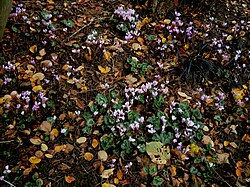
Cyclamen hederifolium, commonly known as sowbread or ivy-leaved cyclamen, is a resilient flowering plant belonging to the Primulaceae family. Native to the Mediterranean region—stretching from southern France to western Turkey and across various Mediterranean islands—this species thrives in woodlands, shrublands, and rocky terrains at altitudes reaching 1,200 metres. Due to its vigor, it has become naturalised in parts of northern Europe and Oregon.
Renowned among gardeners for being one of the hardiest and most vigorous cyclamen species in oceanic climates, it provides striking autumn color and intricate foliage that persists through the winter.
Key Facts
- Conservation Status: Least Concern (IUCN 3.1).
- Hardiness: Tolerates temperatures down to -18°C (Zone 6), and as low as -30°C with snow cover.
- Bloom Time: Late summer to autumn.
- Distinctive Feature: Leaves resemble ivy and appear after or during flowering.
- Recognition: Recipient of the Royal Horticultural Society's Award of Garden Merit.
Botanical Classification and Taxonomy
The scientific name Cyclamen hederifolium is derived from the Latin hedera (ivy) and folium (leaf), referencing the plant's characteristic foliage. It is also known by the synonym Cyclamen neapolitanum, referring to Naples.
Subspecies and Related Species
Botanists recognize two primary subspecies:
- Cyclamen hederifolium subsp. hederifolium: Found throughout the majority of the species' range.
- Cyclamen hederifolium subsp. crassifolium: Specifically located in southern Greece.
While previously categorized as a variety of C. hederifolium, the Cretan plant Cyclamen confusum is now classified as a separate species.
Physical Characteristics
This tuberous perennial grows up to 30 cm tall. Its life cycle is unique: it flowers and produces leaves in autumn, remains active through winter, and enters a period of aestivation (summer dormancy) after its seed capsules ripen.
The Tuber
The plant grows from a round-flattened tuber. Unlike some other species like Cyclamen persicum, where roots emerge from the bottom, C. hederifolium produces roots from the top and sides, leaving the base bare. As the plant ages, the tuber can expand to over 20 cm in diameter, with buds for leaves and flowers emerging from the exposed upper surface.
Foliage
The leaves range from 2.5 to 8 cm in length and vary from heart-shaped to long and arrow-shaped, typically featuring 2–3 angled lobes. They are naturally variegated, often displaying silver to grey-green hastate (spear-shaped) patterns against various shades of green. A distinguishing anatomical feature is the "elbow"—the petiole and flower stalks grow outwards before turning upwards.
Flowers and Fruit
Flowers appear from late summer to autumn, often preceding the leaves. They consist of five petals (1.2–2.5 cm long) in shades of pink, purple, or white, frequently featuring a magenta V-shaped marking in the throat. The petals curve outwards into strong auricles (ear-like lobes) at the tips.
These plants are self-fertile. Once pollination occurs, the flower stem coils tightly and rests above the tuber. The resulting yellow-brown seeds are housed in a round pod that opens via 5–10 flaps. The seeds are coated in a sweet, sticky substance that attracts ants, which serve as the primary means of seed dispersal over distances of several hundred metres.
Cultivation and Varieties
In oceanic climates, Cyclamen hederifolium is highly aggressive and can crowd out less vigorous species like Cyclamen coum. However, it may struggle in extreme cold continental climates (such as Calgary, Alberta) where other species like Cyclamen purpurascens thrive.
Popular Cultivars
While some botanical databases treat white-flowered forms (f. albiflorum) and arrowhead-leaved forms (var. poli) as synonyms of the main species, several distinct cultivars are prized in horticulture:
- 'Amaze Me': An early-blooming variety with dark pink flowers.
- 'Ruby Glow': Known for deep, all-magenta blooms.
- 'Stargazer': Features upward-facing flowers.
| Feature | Details |
|---|---|
| Native Range | Southern France to Western Turkey & Mediterranean Islands |
| Growth Habit | Tuberous Perennial |
| Flower Color | Pink, Purple, or White |
| Leaf Pattern | Silver/Grey-green variegation |
| Hardiness Zone | Zone 6 (down to -18°C) |
| Pollination | Self-fertile |
Frequently Asked Questions
When does Cyclamen hederifolium bloom?
It blooms from late summer through autumn, typically producing flowers before its leaves emerge.
How do the seeds of this plant spread?
The seeds are covered in a sweet, sticky substance that attracts ants, which then carry and disperse the seeds up to several hundred metres.
Is Cyclamen hederifolium suitable for cold climates?
Yes, it is very hardy, tolerating temperatures down to -18°C. With reliable snow cover, it can survive temperatures as low as -30°C.
What makes the leaves of this species unique?
The leaves are ivy-like in shape and naturally variegated with silver or grey-green patterns. Additionally, the stalks form a characteristic "elbow" bend near the base.
Can it be grown alongside other cyclamen species?
While possible, it is highly vigorous in oceanic climates and may crowd out less aggressive species, such as Cyclamen coum.