Court Systems: Organization, Legal Traditions, and Jurisdictions
The judicial landscape is a complex network of institutions designed to resolve disputes and uphold the law. Courts are typically organized into a hierarchy, where different levels of authority handle specific types of cases based on their jurisdiction—the legal power to hear a particular matter. This structure often includes specialized courts tailored to specific legal areas, ensuring that experts handle complex technical or social issues.
Trial and Appellate Courts
At the foundation of most judicial systems are trial courts, often referred to as courts of first instance. These are the venues where trials are held and evidence is first presented. Depending on the jurisdiction, trial courts may operate in two primary ways:
- Jury Trials: A jury acts as the finder of fact, determining the truth of the events. This is most common in Anglo-American common law traditions.
- Bench Trials: A judge serves as both the finder of fact and the finder of law.
Once a verdict is reached in a trial court, the losing party may seek a review from appellate courts. These courts do not hold new trials but instead hear appeals to determine if the lower court applied the law correctly. It is worth noting that some institutions, such as the Crown Court in England and Wales, possess both trial and appellate jurisdictions.
Civil Law vs. Common Law Traditions
The Western world is primarily divided between two major legal traditions: civil law and common law. While both share a common cultural origin, their foundations and methodologies differ significantly.
Civil Law Systems
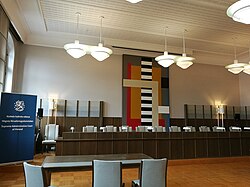
Civil law is deeply rooted in Roman law, specifically the Corpus Juris Civilis. This body of law was rediscovered in the late eleventh century and became the cornerstone of legal education at the University of Bologna in Italy, eventually spreading across continental Europe. Today, civil law is firmly established in the French and German legal systems. Most civil law jurisdictions utilize an inquisitorial system, where the court is actively involved in investigating the facts of the case.
Common Law Systems
Common law emerged in England following the Norman Invasion of 1066. Royal judges from the King's Council traveled across various jurisdictions, combining local customs into a unified standard known as "Common Law." This tradition is the basis for the English and American legal systems. Unlike civil law, common law typically employs an adversarial system, where two opposing parties present their cases before an impartial judge or jury.
Regardless of the tradition, procedural law dictates how these courts operate, with separate rules for civil procedure (private disputes) and criminal procedure (violations of criminal law).
International Courts
As global interactions increase, international courts have been established to resolve matters that fall outside the jurisdiction of any single nation. These institutions handle cross-border disputes, human rights violations, and international crimes.
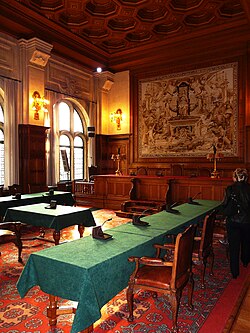
Notable examples include the International Criminal Court and the International Court of Justice, both based in The Hague, Netherlands, as well as the Court of Permanent Lok Adalat (Public Utility Services) in India.
Key Facts
- Trial Courts: The first instance where facts are determined via jury or bench trials.
- Appellate Courts: Review decisions made by lower courts.
- Civil Law: Based on Roman law (Corpus Juris Civilis) and typically uses an inquisitorial system.
- Common Law: Based on English royal customs and typically uses an adversarial system.
- International Courts: Resolve disputes beyond national jurisdictions, such as the International Court of Justice.
Summary of Court Types and Functions
| Category | Primary Function / Origin | Examples |
|---|---|---|
| General Jurisdiction | Initial trials and appeals | District Court, Supreme Court, Circuit Court |
| Specialized Courts | Focused legal areas | Tax Court, Family Court, Probate Court, Patent Court |
| International | Global dispute resolution | International Criminal Court, International Court of Arbitration |
| Administrative/Regulatory | Government and state oversight | Administrative Court, Court of Marine Inquiry |
Frequently Asked Questions
What is the difference between a jury trial and a bench trial?
In a jury trial, a group of citizens acts as the finder of fact to determine the outcome. In a bench trial, the judge fulfills both the role of the finder of fact and the arbiter of the law.
How does an inquisitorial system differ from an adversarial system?
In an inquisitorial system (common in civil law), the court takes an active role in investigating the case. In an adversarial system (common in common law), the court acts as a neutral referee while opposing parties present their arguments.
What is the purpose of an appellate court?
Appellate courts review the decisions of trial courts to ensure that the law was applied correctly and that the trial was fair; they do not typically conduct new trials or hear new evidence.
Where did the common law tradition originate?
Common law was established by English royal judges after the Norman Invasion of 1066, who synthesized various local customs into a standardized body of law.
What are specialized courts?
Specialized courts are judicial bodies that handle specific types of cases, such as drug courts, veterans' courts, mental health courts, or maritime (admiralty) courts, to provide expertise in those particular fields.