Coronets in Heraldry: Symbols of Rank and Nobility
In the intricate world of British heraldry, a coronet (pronounced KORR-uh-nit) is a specific type of crown that serves as a mark of rank. Unlike the sovereign's crown, which symbolizes supreme authority, the coronet is reserved for non-reigning members of the royal family and the peerage. While many languages use a single word for any crown—such as the German Krone or French couronne—English maintains this technical distinction to separate the monarch's crown from the symbols of the nobility.
A coronet is not merely a piece of jewelry but a visual code. The specific design, materials, and attributes of a coronet signify the exact hierarchy and ranking of its owner. While physical coronets are crafted for rare ceremonial events, they are most commonly encountered as pictorial symbols in heraldry, adorning a person's coat of arms.
Key Facts
- Definition: A coronet is a crown used by non-reigning royals and peers to denote rank.
- Usage: Physical coronets are worn primarily during coronations, though they are more frequently used as heraldic symbols.
- British Design: Many British peerage coronets feature strawberry leaves, symbolizing perfection and righteousness.
- Restrictions: In the UK, peerage coronets may not contain precious or semi-precious stones.
- Global Variation: While the British system is highly regulated, continental European traditions (such as French and Holy Roman Empire) vary in rigidity and design.
Etymology and Origins
The term originates from the Old French coronete, a diminutive of co(u)ronne (crown). This traces back to the Latin corona and the Ancient Greek korōnē, both meaning a garland or wreath. Historically, this headgear distinguished the nobility and princes from the monarch, a concept mirrored in German and Scandinavian languages as rangkrone (rank crown).
Coronets in the United Kingdom and Commonwealth
Royal Usage
Members of the British royal family use coronets in their coats of arms and may wear them during coronations. The current regulations were largely instituted by Charles II in 1661, influenced by the lavish court style of Louis XIV in France. Designs vary based on the individual's relationship to the monarch, with the most comprehensive modern guidelines established by George V in 1917.
The heir apparent possesses a unique coronet featuring a single arch topped with a globe and cross. Notably, during the 2023 coronation of Charles III, the King opted against the wearing of coronets for both royals and peers, though the tradition remains intact.
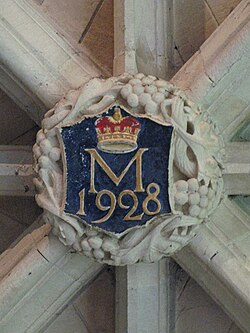
Usage by the Peerage
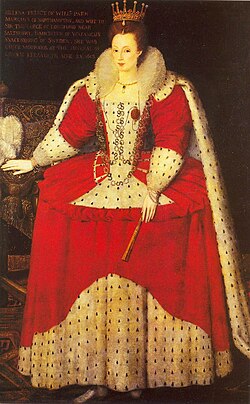
For the British peerage, a coronet is traditionally worn only during a royal coronation, paired with standardized coronation robes. Because coronations occur infrequently, many peers never commission a physical coronet, relying instead on the heraldic depiction above their shield and below the helmet in their coat of arms.
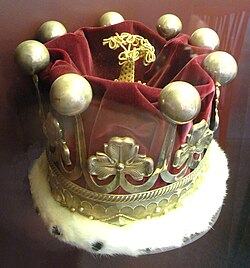
The authorization to wear coronets was granted incrementally: dukes were first, followed by marquesses in the 15th century, earls in the 16th, and finally viscounts and barons in the 17th. A distinctive feature of British coronets is the use of strawberry leaves. Some traditions suggest the three parts of the leaf represent the Trinity, the red fruit represents Christ's blood, and the five-petalled flower represents the wounds of Christ.
Rank Classifications
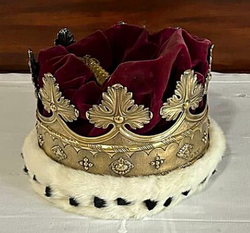
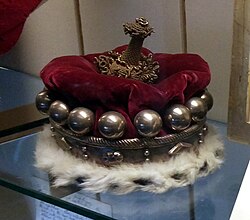
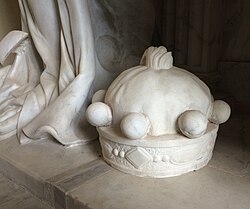
The design of the coronet provides an immediate clue to the wearer's rank. For example, a duke's coronet features eight strawberry leaves, while a viscount's consists of sixteen silver spheres (referred to as "pearls" but not actually made of pearl).
| Rank | Design Details |
|---|---|
| Heir Apparent | Single arch with a globe and cross. |
| Child of Sovereign | Crosses and fleurs-de-lis. |
| Duke / Duchess | Silver-gilt circlet with eight strawberry leaves (five visible in 2D). |
| Marquess / Marchioness | Four strawberry leaves and four silver spheres (three leaves, two balls visible in 2D). |
| Earl / Countess | Eight strawberry leaves and eight pearls on stalks (four leaves, five pearls visible in 2D). |
| Viscount / Viscountess | Sixteen pearls touching one another (nine visible in 2D). |
| Baron / Baroness | Plain silver-gilt circlet with six pearls (four visible in 2D). |
International Heraldic Traditions
Continental Europe
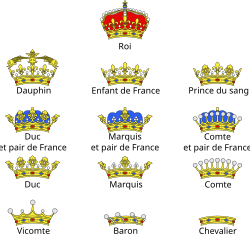
In the former Kingdom of France, the hierarchy was less rigid than in Britain. While the title of duc (duke) was highly protected due to its legal prerogatives in the Parlement of Paris, other titles were often assumed as courtesy titles. French coronets utilized acanthus leaves (often called strawberry leaves in English) and pearls.
The Holy Roman Empire and its successor states (Austria, Germany) used a system similar to the British. This included the Herzogskrone (duke's crown) with five visible leaves and a globus cruciger, and the Grafenkrone (count's crown) featuring nine visible tines with pearls.
Other Global Examples
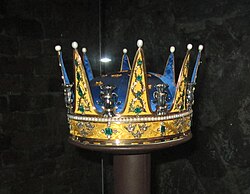
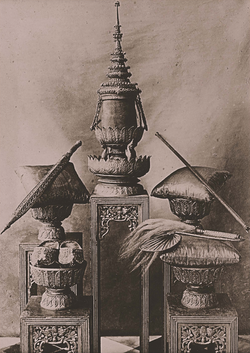
In Canada, the Canadian Heraldic Authority introduced the Loyalist military and civil coronets in 1989 for descendants of United Empire Loyalists. Other nations, such as Sweden, Denmark, Spain, and Thailand, maintain their own distinct systems of rank-based crowns.
Frequently Asked Questions
What is the difference between a crown and a coronet?
In English heraldry, a crown is specifically associated with the sovereign (the monarch). A coronet is a smaller crown used to denote the rank of non-reigning royals and members of the peerage.
Why are strawberry leaves used in British coronets?
Strawberry leaves are traditional symbols of perfection and righteousness. Some interpretations link the plant's features to the Trinity and the passion of Christ.
Do all peers own a physical coronet?
No. Because they are only worn on extremely rare occasions, such as coronations, many peers never have a physical coronet made and only use the symbol in their heraldic coats of arms.
Can British peerage coronets contain diamonds or rubies?
No, according to tradition, coronets of the British peerage may not bear any precious or semi-precious stones.
How does the heir apparent's coronet differ from others?
The coronet of the British heir apparent is distinctive because it features a single arch topped with a globe and cross, separating it from the open circlets used by other peers.