Common Raven: The World's Most Widely Distributed Corvid
The common raven (Corvus corax), also known as the northern raven, is a large, all-black passerine bird renowned for its intelligence and adaptability. As the most widely distributed member of the corvid family, it occupies a vast range across the Northern Hemisphere. While they are often seen as solitary or paired adults, young ravens frequently travel in social flocks before establishing their own territories.
These birds are among the largest in the order Passeriformes (perching birds), characterized by their imposing size and deep, iridescent plumage. While they typically have shorter lifespans, some individuals have been recorded living for more than 23 years in the wild.
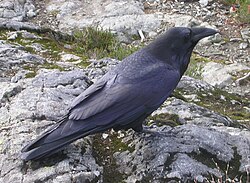
Key Facts
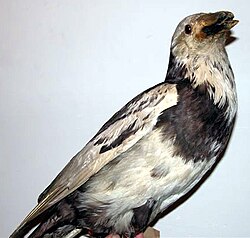
![Leucistic. This individual is locally well known in Anchorage (Alaska).[43]](/images/63/9f/639f3ab880745a7568171eda61fb6c004984991e43dfabb0d89d53d04ff07fd3.jpg)
- Scientific Name: Corvus corax
- Weight: Averages 1.47 kg (3.2 lb), reaching up to 2 kg (4.4 lb).
- Length: Averages 63 cm (25 in).
- Distribution: Found throughout the Holarctic region, including North America, Eurasia, and North Africa.
- Conservation Status: Least Concern (IUCN 3.1).
- Social Structure: Mates for life and defends a specific territory.
Physical Characteristics
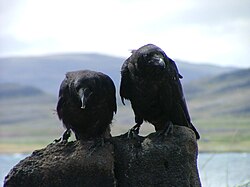
A mature common raven typically measures between 54 and 71 cm (21 to 28 in) in length, with a wingspan ranging from 116 to 153 cm (46 to 60 in). They are one of the heaviest passerines, with recorded weights between 0.69 and 2.25 kg (1.52 to 4.96 lb). Interestingly, size varies by climate: birds from colder regions, such as Greenland and the Himalayas, tend to be larger with longer bills than those in warmer climates.
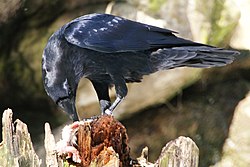
Their plumage is primarily iridescent black, which can shimmer with blue or purple tones in sunlight. Other distinguishing features include a large, slightly curved bill, a strongly graduated tail, and elongated, pointed throat feathers. Juveniles possess similar plumage but with a duller appearance and a blue-grey iris.

Distribution and Habitat

The common raven possesses one of the largest ranges of any passerine bird. They thrive in diverse environments, from the Arctic and temperate zones of North America and Eurasia to the arid deserts of North Africa and various Pacific islands. Their adaptability is further evidenced by their altitude range; they have been recorded in Tibet at 5,000 m (16,400 ft) and as high as 6,350 m (20,600 ft) on Mount Everest.
While some ornithologists previously believed ravens did not overwinter in the Arctic, they are now known to be year-round residents in Alaska and Arctic Canada.

Taxonomy and Subspecies

The species is divided into 8 to 11 accepted subspecies. While these populations look similar, genetic research has revealed significant differences between them. These subspecies are distributed across various global regions, from the Faroe Islands to the Himalayas.
| Subspecies | Primary Distribution | Notes |
|---|---|---|
| C. c. principalis | Northern North America, Greenland | South to the Appalachian Mountains |
| C. c. clarionensis | SW USA (California), NW Mexico | Includes Baja California |
| C. c. varius | Iceland, Faroe Islands | North Atlantic population |
| C. c. corax | Northern and Central Europe | East to Lake Baikal, south to Iran |
| C. c. tibetanus | Himalayas | High altitudes (2,500–8,000 m) |
| C. c. tingitanus | North Africa | Regional population |
Life Cycle and Behavior

Ravens are known for their complex social behaviors. While juveniles may disperse in flocks, adults typically form lifelong pair bonds and defend a territory. Their breeding habits involve nesting in high locations, such as cliffs or man-made structures like pylons.
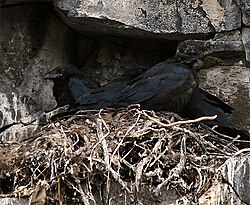
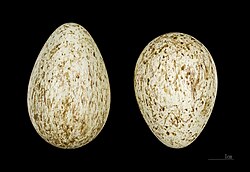
The eggs of Corvus corax are laid in these nests, where the young are raised by the parents. As they mature, they transition from their duller juvenile plumage to the striking iridescent black of the adults.
Cultural Significance
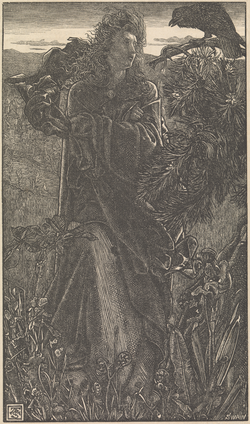
Due to their intelligence and striking appearance, ravens have featured prominently in human culture and mythology. They appear in Haida creation myths and Old Norse poetry, such as the Hrafnsmál ("raven song"), where they are often depicted as messengers or symbols of wisdom.

Frequently Asked Questions


How does a common raven differ from an American crow?
The common raven is significantly larger and heavier than the American crow, with a larger, more curved bill and a more wedge-shaped, graduated tail.
Where can common ravens be found?
They are found across the Northern Hemisphere (Holarctic), ranging from the Arctic regions of North America and Eurasia to the deserts of North Africa.
Do common ravens migrate?
Generally, common ravens are resident birds within their range for the entire year, though young birds may disperse locally.
What is the maximum altitude a raven can reach?
Common ravens are highly adaptable to altitude and have been recorded as high as 6,350 m (20,600 ft) on Mount Everest.
How long do common ravens live?
While their typical lifespan is shorter, some common ravens have been known to live for more than 23 years in the wild.