Common Ostrich
The common ostrich (Struthio camelus) is a marvel of avian evolution, holding the title of the tallest and heaviest living bird on Earth. These flightless giants are perfectly adapted for life in the demanding environments of Africa and parts of Western Asia, combining immense physical power with sophisticated biological systems to survive extreme heat and dehydration.
From their towering stature to their incredible sprinting capabilities, ostriches represent a unique branch of the Palaeognathae (an infraclass of birds characterized by a primitive palate structure). While they cannot fly, their evolution has prioritized ground-based speed and endurance, making them the fastest bipedal animals in existence.
Key Facts
- Maximum Height: Males can reach up to 2.75 meters (9 feet).
- Top Speed: Capable of exceeding 70–80 km/h (43–50 mph).
- Weight: Adult males typically weigh between 100 and 130 kg.
- Conservation Status: Listed as Least Concern by the IUCN.
- Defense: A single forward kick can yield 225 kgf of force.
Physical Description and Growth

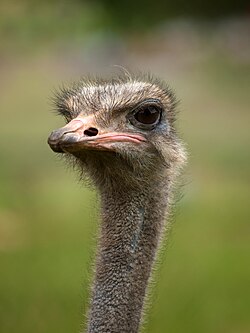
The common ostrich exhibits significant sexual dimorphism. Males are larger, standing between 2.1 and 2.75 meters tall and weighing 100 to 130 kg, though some exceptional specimens can reach 156.8 kg. Females are slightly smaller, typically ranging from 1.75 to 1.9 meters in height and weighing 90 to 120 kg.
Growth in ostriches is rapid. New chicks are fawn-colored with dark brown spots. By four or five months, they are already half the size of an adult. While they reach their full adult height within a year, they do not attain their full adult weight until approximately 18 months of age.
Taxonomy and Subspecies

The common ostrich is divided into several recognized subspecies, each adapted to specific regional environments. Additionally, the Somali ostrich (S. molybdophanes) is recognized as a separate species.
| Subspecies | Common Names | Primary Distribution |
|---|---|---|
| S. c. camelus | North African, Red-necked, Barbary | Western Africa (e.g., Senegal, Nigeria, Cameroon) |
| S. c. australis | South African, Black-necked, Cape | Southern Africa (e.g., South Africa, Namibia, Botswana) |
| S. c. massaicus | Masai, Pink-necked, East African | East Africa |
| S. c. syriacus | Arabian, Syrian, Middle Eastern | Western Asia (Extinct) |
Behavior and Ecology
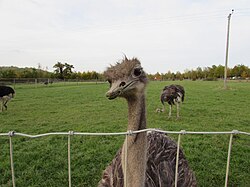
![The Ketola Ostrich Farm in Nurmijärvi, Finland[109][110]](/images/ad/fa/adfa0a6d74f60967cde09cc28233225f990d17d16ba6bf6e6bb51d0a4f93a28a.jpg)
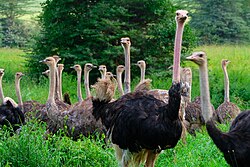
Ostriches are diurnal (active during the day), though they may show activity on moonlit nights. Their social structure varies by season; they often spend winter months alone or in pairs. However, during the breeding season or periods of extreme drought, they form nomadic groups of 5 to 100 birds, led by a dominant female. These groups often travel alongside other grazers like antelopes and zebras.
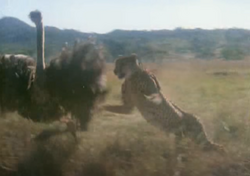
To survive in the wild, ostriches rely on acute eyesight and hearing to detect predators from a distance. When threatened, they may lay their heads and necks flat against the ground to blend in with the terrain, appearing as a mound of earth. If pursued, they utilize their incredible speed, maintaining a steady 50 km/h (31 mph) and peaking at 80 km/h (50 mph).
Physiology and Survival Adaptations

Respiratory System
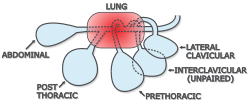
Unlike mammals that use a diaphragmatic pump, the ostrich uses a costal pump for ventilation. This system utilizes a series of air sacs connected to the lungs, which is a hallmark of avian respiration, allowing for highly efficient oxygen exchange.
Thermoregulation and Water Balance
Living in savannas and deserts, ostriches are endotherms that maintain a body temperature between 38.1 and 39.7 °C. To manage extreme heat (up to 50 °C), they employ several strategies:
- Feather Fluffing: By contracting muscles to raise feathers, they create an insulating air space of 7 cm to regulate convective heat loss.
- Thermal Windows: They expose unfeathered skin to increase radiative heat loss.
- Hyperthermia: They can allow their body temperature to rise slightly (around 40 °C) for up to 8 hours to equilibrate with ambient heat.
Kidney Function and Dehydration
The ostrich kidney is highly adapted to water scarcity. Under normal hydration, the glomerular filtration rate (GFR)—the rate at which kidneys filter blood—is approximately 92 ml/min. During severe dehydration (48 hours or more), the GFR drops to just 25% of its normal rate. This drastic reduction minimizes water loss, with the urine flow rate dropping from 15% to 1% of the GFR.
Reproduction and Life Cycle

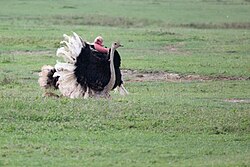
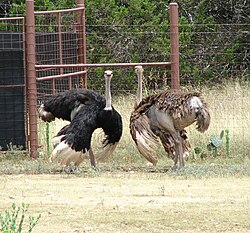
Mating rituals often involve complex "dancing" behaviors. Once eggs are laid, the birds engage in incubation processes to protect the developing embryos.

Frequently Asked Questions



Do ostriches really bury their heads in the sand?
No, this is a common misconception. When hiding from predators, ostriches lay their heads and necks flat on the ground to blend in with the landscape, which can look like their heads are buried from a distance.
How fast can a common ostrich run?
The common ostrich is the fastest bipedal animal, capable of reaching speeds between 70 and 80 km/h (43 to 50 mph) and maintaining a steady pace of 50 km/h (31 mph).
What is the difference between the subspecies of ostriches?
The primary differences lie in their geographic distribution and physical characteristics, such as the color of their necks. For example, the North African ostrich is known as the red-necked ostrich, while the South African ostrich is known as the black-necked ostrich.
How do ostriches survive extreme desert heat?
They use a combination of behavioral and physiological adaptations, including "feather fluffing" to create insulation, exposing unfeathered skin to release heat, and the ability to tolerate slight increases in body temperature (hyperthermia).
Can an ostrich be dangerous to humans?
Yes, ostriches can cause serious injury or death using their powerful legs. They can deliver a forward kick with a force of 225 kgf.