Common Nightingale: The Master Songbird of Europe and Africa
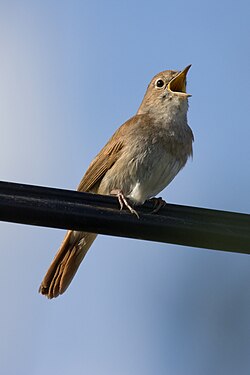
The common nightingale (Luscinia megarhynchos), also known as the rufous nightingale, is a small passerine bird celebrated for possessing one of the most powerful and beautiful songs in the natural world. A member of the Old World flycatchers, it belongs to a terrestrial group known as chats. While it shares some similarities with the more northerly thrush nightingale (Luscinia luscinia), the common nightingale is distinguished by its unique vocalizations and specific migratory patterns.
The name "nightingale" is a combination of the word "night" and the Old English galan, meaning "to sing." This reflects the bird's habit of singing throughout the night, a trait that has captivated humans for millennia.
Key Facts
- Scientific Name: Luscinia megarhynchos
- Conservation Status: Least Concern (IUCN 3.1)
- Primary Characteristic: Complex, loud song with up to 250 different song types.
- Diet: Insectivorous.
- Migration: Breeds in Europe and the Palearctic; winters in Sub-Saharan Africa.
- National Symbol: Official national bird of Iran.
Taxonomy and Classification
Historically, nightingales were classified as thrushes. However, modern genetic analysis revealed they are actually types of flycatchers (family Muscicapidae). The physical resemblance to thrushes is a result of convergent evolution, where unrelated species evolve similar traits independently.
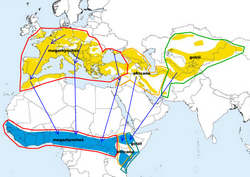
There are three recognized subspecies of the common nightingale:
- Western nightingale (L. m. megarhynchos): Found in western Europe, North Africa, and Asia Minor; winters in tropical Africa.
- Caucasian nightingale (L. m. africana): Found in the Caucasus and eastern Turkey to southwestern Iran and Iraq; winters in East Africa.
- Eastern nightingale (L. m. golzii): Found from the Aral Sea to Mongolia; winters in coastal East Africa.
Physical Description
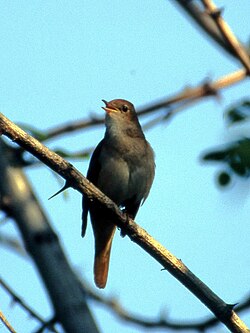
The common nightingale is slightly larger than the European robin, measuring between 15 and 16.5 cm (5.9–6.5 in) in length. It features a plain brown upper body contrasted by a distinctive reddish tail and a buff to white underside. Both males and females look similar, though the eastern and Caucasian subspecies exhibit paler upper parts and a more pronounced face pattern, including a pale supercilium (the stripe of feathers above the eye).
Distribution and Habitat
This migratory species breeds in the forests and scrublands of Europe and the Palearctic, nesting on or near the ground within dense vegetation. In Germany, research indicates that their preferred breeding habitats meet specific criteria: altitudes below 400 m, mean growing season temperatures above 14 °C, and annual precipitation under 750 mm.
While the European population is stable—estimated between 3.2 and 7 million pairs—the situation is more precarious in the U.K. At the northern limit of its range, the U.K. population saw a 53 percent decline between 1995 and 2008, leading to its placement on the red list for conservation. Most remaining territories are clustered in South East England and East Anglia.
Behavior and Ecology
Nightingales are elusive and secretive, spending most of their time hidden in thickets and undergrowth to avoid human activity and predators. Despite their shy nature, the males are prolific singers. A male nightingale can have a repertoire of 190 to 250 different song types, with exceptional individuals exceeding 300. Their syllable repertoire is vast, reaching approximately 1,160 syllables—far exceeding that of the blackbird or skylark.
The nocturnal singing is primarily performed by unpaired males to attract mates. Dawn singing, conversely, is used to defend territories. In urban environments, nightingales have been observed to sing more loudly to overcome background noise. A key identifier of the common nightingale's song is a loud whistling crescendo, which is absent in the thrush nightingale.
Cultural Significance
Due to its creative and spontaneous song, the nightingale has become a universal symbol of poetry and longing. In Ancient Greece, it appeared in the works of Aristophanes and Ovid. William Shakespeare compared his love poetry to the song of the nightingale (Philomel) in Sonnet 102.
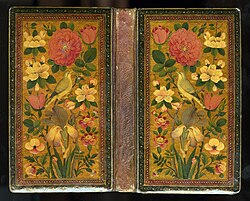
In Persian culture, the nightingale (bulbul) is a central figure in poetry and art, often paired with the rose. In this metaphor, the nightingale represents the active, passionate lover, while the rose embodies an arrogant, earthly beauty. This symbolism extends to the Baha'i Faith, where the nightingale represents the founder, Baha'u'llah, reflecting the beauty of his writings.
Summary Table: Common Nightingale Overview
| Feature | Details |
|---|---|
| Length | 15–16.5 cm |
| Plumage | Brown above, reddish tail, buff/white below |
| Diet | Insectivorous |
| Song Repertoire | Avg. 190 types (up to 300+); ~1,160 syllables |
| Breeding Range | Europe and Palearctic |
| Wintering Range | Sub-Saharan Africa |
Frequently Asked Questions
Do female nightingales sing?
No, female nightingales do not sing. Historically, many people believed both sexes sang, but the complex and loud songs are produced exclusively by the males.
What is the difference between a common nightingale and a thrush nightingale?
The common nightingale is found further south than the thrush nightingale and features a characteristic loud whistling crescendo in its song that the thrush nightingale lacks.
Why do nightingales sing at night?
Nocturnal singing is primarily used by unpaired males to attract a mate. Because few other birds sing at night, their song is more prominent and audible.
Is the common nightingale an endangered species?
Globally, it is listed as "Least Concern" with a large population. However, in the U.K., it is on the red list due to significant habitat loss and population decline.
What does the nightingale symbolize in Persian poetry?
In Persian literature, the nightingale represents the passionate, eloquent lover who is often doomed to love in vain, typically pursuing the rose, which symbolizes perfection and beauty.