Bird Vocalization: The Science of Songs and Calls
From the melodic trills of a songbird to the sharp alarm of a crow, bird vocalizations are a complex form of communication essential for survival and reproduction. While the general public often uses the term "birdsong" to describe any pleasant sound a bird makes, ornithologists—scientists who study birds—make a critical distinction between songs and calls based on their structure and purpose.
Defining Songs vs. Calls
The primary difference between a song and a call lies in complexity, length, and context. Songs are typically longer, more intricate vocalizations. They are primarily used for territory defense, courtship, and attracting a mate. Some experts define songs by their syllabic diversity and temporal regularity, mirroring the repetitive patterns found in human music.
Calls, by contrast, are shorter and simpler. These serve immediate functional needs, such as sounding alarms to warn of predators or maintaining contact between members of a flock during flight.
Interestingly, some authorities expand the definition of "song" to include non-vocal sounds. Examples include the rhythmic drumming of woodpeckers or the "winnowing" sound produced by the wings of snipes during display flights.
![Wing feathers of a male club-winged manakin, with the modifications noted by P. L. Sclater in 1860[4] and discussed by Charles Darwin in 1871.[5] The bird produces sound with its wings.](/images/83/41/83415f799a6386aac5da57c06dd2df1ea7087bcb23286b6b59ad874af1f18f33.jpg)
Key Facts
- Songs are complex and used for mating and territory; calls are simple and used for alarms and flock cohesion.
- Some birds produce sound through non-vocal means, such as modified wing feathers.
- Vocal learning involves a complex neuroanatomical pathway and auditory feedback.
- Mirror neurons in the brain allow birds to respond specifically to their own "primary song type."
- Environmental factors, such as urban noise, can cause birds to shift the pitch of their songs.
The Mechanics of Avian Sound
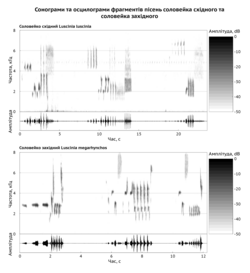
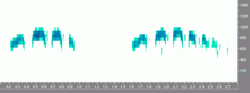
Bird vocalizations vary wildly in frequency and volume. Some species have evolved to be exceptionally loud to penetrate dense forests, while others adjust their pitch to be heard over the low-frequency hum of city traffic. To analyze these sounds, scientists use sonograms—visual representations of sound frequencies over time—which allow researchers to distinguish between species that might sound similar to the human ear.
Beyond the throat, some birds use unique physical adaptations. For instance, the male club-winged manakin uses specialized wing feathers to create sound, a process known as stridulation.
![The Western Australian raven (Corvus coronoides, ssp. perplexus) makes a slow, high-pitched ah-ah-aaaah sound.[15] Australian raven territorial callⓘ](/images/a0/c0/a0c00cdadc803b6ca401fa5ca732a1e7cea9c12e57d65f9f72a4fc9de48da49d.jpg)
Neuroanatomy and the Learning Process
Many birds do not simply inherit their songs; they learn them. This process involves a specialized song-learning pathway in the brain. Learning typically occurs in stages, where a young bird listens to a tutor and then practices its own version through a process of trial and error.
![Song-learning pathway in birds[69]](/images/f5/2a/f52a3be59fc18dbc68de3d6b1ab7d64987c4ee4fca0ce24c2ec1fbf70759007b.webp)
This learning is supported by auditory feedback. Birds use an error-correction model—comparing their own output to a stored mental template—to refine their song. If a bird cannot hear itself, it may lose the ability to maintain the correct song structure.
![A timeline for song learning in different species. Diagram adapted from Brainard & Doupe, 2002.[89]](/images/94/7b/947bdd8454ec73f896480d886634b963819bf4437e1ad1feacda35f467d5fef5.webp)
Mirror Neurons and Vocal Imitation
Research into the avian brain has revealed the presence of mirror neurons. Located in the premotor area, these neurons exhibit both sensory and motor properties. They are action-specific, meaning they fire when a bird either hears or produces its own primary song type, but remain silent in response to other song types.
![Song selectivity in HVCx neurons: neuron activity in response to calls heard (green) and calls produced (red). a. Neurons fire when the primary song type is either heard or sung. b, c. Neurons do not fire in response to the other song type, regardless of whether it is heard or sung.[106]](/images/8b/7a/8b7a37db2cd7585634f517b93c7b52597ef24e3c5abf22ec3befe876ef8bdeec.webp)
Cultural Transmission and Evolution
Birdsong is often passed down through cultural transmission, leading to the development of regional dialects. This process is influenced by dopamine circuits in the brain and can create a "cultural trap." In this scenario, a male's ability to develop a song is limited by his internal filter, while a female's mate choice is limited by the range of songs she finds acceptable.
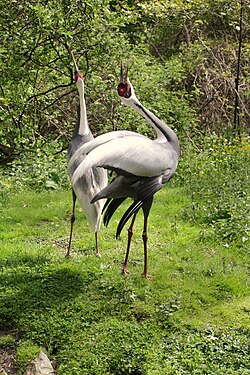
Social bonding also plays a role in vocalization. Some species, such as white-naped cranes, perform "unison calls" to strengthen the bond between a mated pair and warn other cranes to stay away from their territory.
Summary of Bird Vocalization Types
| Feature | Bird Songs | Bird Calls |
|---|---|---|
| Complexity | High (Syllabic diversity) | Low (Simple sounds) |
| Duration | Longer | Shorter |
| Primary Function | Courtship and Territory | Alarms and Flock Contact |
| Learning | Often learned/cultural | Often innate |
Frequently Asked Questions
What is the difference between a bird song and a bird call?
Songs are complex, longer vocalizations used primarily for mating and defending territory. Calls are shorter, simpler sounds used for immediate communication, such as warning others of danger or keeping a flock together.
Do all birds learn their songs?
No, not all birds learn their songs; some are innate. However, many species rely on a song-learning pathway in the brain, where they listen to adults and use auditory feedback to perfect their own vocalizations.
How do mirror neurons help birds sing?
Mirror neurons in the premotor brain area fire both when a bird hears a specific song and when it sings that same song. This helps the bird stay "in tune" by linking the sensory experience of hearing with the motor action of singing.
Can city noise change how birds sing?
Yes. Some urban birds have been observed singing at a higher pitch to ensure their songs are not drowned out by the low-frequency noise of city environments.
What is a sonogram in the context of bird study?
A sonogram is a visual graph of a sound's frequency over time. It allows ornithologists to precisely analyze and distinguish between the vocalizations of different species that might sound identical to humans.