Commandant General: Military Ranks and Appointments Across Nations
The term Commandant General serves as a significant designation within various global military and security structures. While it is generally equivalent to the rank of major general, its specific application varies wildly depending on the country. In some jurisdictions, it represents a formal rank, while in others, it is an appointment—a specific job title assigned to an officer regardless of their base rank.
A key linguistic distinction often exists: when written as "commandant general," it typically refers to a rank, whereas "commandant-general" often denotes an honorary title or a specific appointment.
Key Facts
- General Equivalence: Often corresponds to the rank of major general.
- Rank vs. Appointment: In the UK and Italy, it is an appointment (a role) rather than a permanent rank.
- Highest Authority: It is the highest rank in the Argentine National Gendarmerie.
- Historical Usage: Used by the Boer republics and the IRA during the Irish War of Independence.
- Diverse Application: Applies to army, marine, air force, and police forces globally.
Regional Applications of the Title
Argentina
In Argentina, the Commandant General is the highest rank within the Argentine National Gendarmerie. This title is held by the national director of the gendarmerie and his senior deputies. Depending on the specific appointment, the rank may be equivalent to any Argentine army rank ranging from brigade general to the highest rank, lieutenant general.
Ireland
During the Irish War of Independence and the Irish Civil War (1919–1923), the IRA and Anti-Treaty IRA used the term to describe the leaders of their various brigades. This terminology was adopted from the Boer ranks, introduced by veterans of the Irish Transvaal Brigade.
Italy
In Italy, Comandante generale is an appointment rather than a rank. It is the title given to the general officers who command the Carabinieri, the Guardia di Finanza, and the Corps of the Port Captaincies – Coast Guard. Historically, during the era of Fascist Italy, the head of the Blackshirts held this title; Benito Mussolini held the position from 1922 to 1943.
Portugal and Brazil
Historically, comandante-geral has been the traditional title for commanding officers in several security forces across Portugal and Brazil.
- Portugal: Currently, it is the title of the general officer commanding the National Republican Guard (GNR). It was previously used for the commanding officers of the Public Security Police, the former Fiscal Guard, and the former Portuguese Legion.
- Brazil: The title is used for the commanding officers of state military fire departments and state military police.
South Africa
The title has a deep history in South Africa, appearing in the South African Republic, the Orange Free State Republic, and later in the Union and Republic of South Africa. In the Boer republics, the commandant-general served as the head of the armed forces.
In 1956, the rank of full general in the South African Army was renamed "commandant-general," a designation that remained in use until 1967, when it reverted to "general." At other times, it functioned as a post designation. For example, Brigadier-General CF Beyers was the first Commandant-General of the Active Citizen Force until 1914, followed by Major-General J C Smuts on September 16, 1914.
United Kingdom
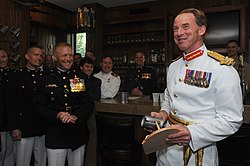
In the United Kingdom, the term is strictly a military appointment and not a rank. Notable examples include the Commandant General Royal Marines and the Commandant-General of the RAF Regiment.
Summary of Global Usage
| Country | Nature of Title | Primary Organization(s) |
|---|---|---|
| Argentina | Highest Rank | National Gendarmerie |
| Italy | Appointment | Carabinieri, Guardia di Finanza, Coast Guard |
| United Kingdom | Appointment | Royal Marines, RAF Regiment |
| Portugal | Appointment | National Republican Guard (GNR) |
| Brazil | Appointment | State Military Police and Fire Departments |
| South Africa | Rank/Appointment | Boer Republics, South African Army |
Frequently Asked Questions
Is a Commandant General always a major general?
Generally, the rank is equivalent to a major general, but this varies. In Argentina, for example, it can range from brigade general to lieutenant general.
What is the difference between a rank and an appointment?
A rank is a permanent grade in a military hierarchy (e.g., Major General), whereas an appointment is a specific job or role (e.g., Commandant General) that an officer is assigned to fill.
How did the IRA adopt the term Commandant General?
The IRA acquired the term from the Boer ranks via veterans of the Irish Transvaal Brigade during the period of 1919–1923.
Who held the title of Comandante Generale in Fascist Italy?
Benito Mussolini held the title of comandante generale as the head of the Blackshirts from 1922 to 1943.
When did the South African Army stop using the rank of Commandant-General?
The rank, which had replaced "full general" in 1956, reverted to the title of "general" in 1967.