Colorado Party
The Colorado Party (Spanish: Partido Colorado, literally the "Red Party") is one of the oldest and most influential political organizations in Uruguay. Founded in 1836 by General Fructuoso Rivera, the nation's first president, the party's origins are deeply intertwined with the establishment of Uruguay as an independent state. For much of the 20th century, the Colorado Party was the dominant force in Uruguayan politics, shaping the country's social and economic landscape.
While historically characterized by a broad and diverse ideological spectrum, the party currently identifies as right-wing and is a key member of the Republican Coalition. In recent decades, its role has shifted from a dominant hegemon to a critical coalition partner, often aligning with its historic rival, the National Party, to oppose the leftist Broad Front (Frente Amplio).
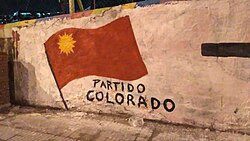
Key Facts
- Founded: September 17, 1836, by Fructuoso Rivera.
- Current Ideology: Conservatism (historically Liberalism, Republicanism, and Batllism).
- Political Position: Right-wing.
- Current General Secretary: Andrés Ojeda.
- Headquarters: Martínez Trueba 1271, Montevideo.
- Regional Affiliation: COPPPAL.
Ideological Evolution
The Colorado Party has long been known for its ideological diversity. In the early 20th century, the party was defined by Batllism—a philosophy named after José Batlle y Ordóñez. This movement championed a radical social reform agenda that included the expansion of workers' and women's rights, the establishment of a generous welfare state, and the promotion of secularization and direct democracy.
By the 1940s and 1950s, under Luis Batlle Berres, the party embraced dirigisme—an economic system where the state exerts strong directive influence over investment—and pushed for state-led industrialization. However, by the late 1960s, the party began to move away from these radical social and economic policies, gradually shifting toward the center and center-right of the political spectrum.
Historical Dominance and Decline
From the 1830s until the late 1990s, the Colorado Party held power almost uninterruptedly, alternating occasionally with the National Party (the Partido Blanco). This era of dominance saw the party lead Uruguay through its transition into a modern republic and through various periods of social upheaval.
The party's long streak of dominance ended abruptly in the 2004 national elections. Facing an economic crisis and criticism of aging leadership, the party suffered an electoral collapse. Presidential candidate Guillermo Stirling received only 10.4% of the vote, ending the traditional two-party system and allowing the leftist Broad Front to rise as the primary electoral force.
The Rise of Pedro Bordaberry
Following the 2004 defeat, the party sought renewal through the Vamos Uruguay movement led by Pedro Bordaberry. Bordaberry served as the presidential candidate in 2009 and 2014, securing 17% and 13% of the vote respectively. While these results showed a recovery from the 2004 nadir, the party has struggled to cross the 20% threshold in any election between 2009 and 2024.
Current Political Standing
Today, the Colorado Party operates as a significant minority party within a larger coalition. In the 2024 elections, candidate Andrés Ojeda secured 16.89% of the vote. The party continues to maintain a presence in the legislature and local government, though it remains the third-largest party behind the National Party and the Broad Front.
| Metric | Representation / Value |
|---|---|
| Chamber of Deputies | 17 / 99 seats |
| Senate | 5 / 30 seats |
| Intendencias (Departments) | 1 / 19 |
| Mayors | 3 / 125 |
| 2024 Presidential Vote % | 16.89% |
Frequently Asked Questions
Who founded the Colorado Party?
The party was founded on September 17, 1836, by General Fructuoso Rivera, who served as the first president of Uruguay.
What is Batllism?
Batllism refers to the ideological legacy of José Batlle y Ordóñez, which promoted a strong welfare state, secularism, workers' rights, and extensive public services during the early 20th century.
Why did the party decline in 2004?
The party's collapse in 2004 was attributed to a combination of a severe economic crisis and a perception that the party leadership had become outdated, leading to a historic low of approximately 10% of the popular vote.
What is the party's current political position?
The Colorado Party is currently positioned on the right-wing of the political spectrum and is a member of the Republican Coalition.
Who are some of the party's most significant historical leaders?
Key figures include Fructuoso Rivera, José Batlle y Ordóñez, Luis Batlle Berres, Julio María Sanguinetti, and Jorge Batlle.