Classic of Poetry
The Classic of Poetry, known in Chinese as the Shijing or Shih-ching, stands as the oldest existing collection of Chinese poetry. Often translated as the Book of Songs or the Book of Odes, this monumental work comprises 305 poems dating from the 11th to the 7th centuries BC. As one of the "Five Classics" of traditional Chinese scholarship, it has been studied, memorized, and revered for over two millennia across China and neighboring East Asian cultures.
Beyond its literary value, the Shijing is a vital linguistic resource. It provides a foundation for the study of Old Chinese phonology and is a rich source of chengyu—four-character classical idioms that remain integral to both formal discourse and everyday modern Chinese language.
Key Facts
- Composition: 305 works dating from the 11th to 7th centuries BC.
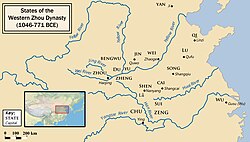
- Core Content: Primarily poems from the Western Zhou period (1046–771 BCE) and the Central Plains (Zhongyuan).
- Canonical Status: One of the Five Classics associated with Confucianism.
- Structure: Divided into the Airs of the States, Lesser Court Hymns, Major Court Hymns, and Eulogies.
- Historical Significance: The earliest chronologically authenticated Chinese poetry.
Structure and Content
The collection is organized into several distinct sections based on the nature and origin of the poems. The majority of the works originate from the Western Zhou period, though the latest material, such as the "Tree-Stump Grove" in the Odes of Chen, dates to approximately 700 BCE during the Spring and Autumn period.
| Section | Meaning | Number of Poems | Approximate Date (BCE) |
|---|---|---|---|
| Guó fēng | Airs of the States | 160 | 8th & 7th centuries |
| Xiǎo yǎ | Lesser Court Hymns | 74 | 9th & 8th centuries |
| Dà yǎ | Major Court Hymns | 31 | 10th & 9th centuries |
| Zhōu sòng | Eulogies of Zhou | 31 | 11th & 10th centuries |
| Lǔ sòng | Eulogies of Lu | 4 | 7th century |
| Shāng sòng | Eulogies of Shang | 5 | 7th century |
Textual History and Compilation
The Role of Confucius
Tradition long held that Confucius personally edited the Shijing, selecting 300 poems from an original collection of 3,000 to ensure they conformed to ritual propriety. While the Records of the Grand Historian attributes the work to him, modern scholars generally discredit this claim. Evidence from the Zuo Zhuan suggests the collection already existed in a definitive form when Confucius was a young child.
Evolution of Versions
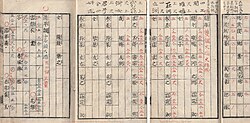
During the Han dynasty, three official versions of the text were recognized at the Imperial Academy: the Lu, Qi, and Han Poetry. However, the Mao Tradition, attributed to the scholar Mao Heng, eventually became the dominant version. By the 2nd century CE, the influential dictionary Shuowen Jiezi quoted almost exclusively from the Mao text. In 653 CE, the "Right Meaning of the Mao Poetry" became the officially authorized imperial text.
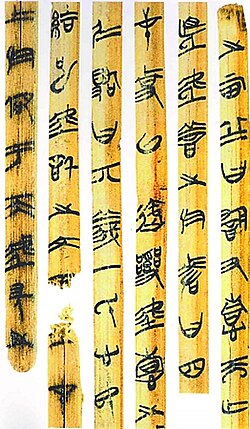
Recent archaeological finds have further illuminated the text's history. In 2015, Anhui University acquired manuscripts from the Warring States period (c. 330 BC), providing one of the oldest known scribal copies of the collection.
Legacy and Interpretation
From Allegory to Literalism
For centuries, the Shijing was read through a lens of complex political and moral allegory. These interpretations were used to justify the study of seemingly simple verses by relating them to high statecraft. This trend persisted until the 12th century, when scholar Zheng Qiao began to express skepticism.
Modern scholarship, influenced by European sinologists like Marcel Granet, has largely rejected these symbolic interpretations. Current readers generally favor a more literal understanding of the poems, viewing them as authentic expressions of ancient life and emotion rather than coded political messages.
Frequently Asked Questions
What is the Classic of Poetry?
It is the oldest existing collection of Chinese poetry, consisting of 305 works from the 11th to 7th centuries BC, and is one of the Five Classics of Confucianism.
Did Confucius actually write the Shijing?
No. While tradition suggests he edited it down from 3,000 poems, historical evidence indicates the collection existed before his time. He is viewed more as a promoter and curator than an author.
What are the different sections of the book?
The book is divided into the Airs of the States (folk songs), the Lesser and Major Court Hymns (courtly songs), and the Eulogies of Zhou, Lu, and Shang (ritual songs).
Why is the Mao Tradition important?
The Mao Tradition became the authoritative version of the text during the Eastern Han period and served as the basis for the imperially authorized version used for centuries.
How does the Shijing influence modern Chinese?
It is a primary source of chengyu (four-character idioms) and provides essential data for the study of Old Chinese phonology and linguistics.