Cinclosomatidae: The Quail-Thrushes and Jewel-Babblers of Australasia
The Cinclosomatidae are a family of passerine birds—perching songbirds—native to the diverse landscapes of Australia and New Guinea. Comprising the quail-thrushes and jewel-babblers, these birds are specialized for life on the ground, blending seamlessly into their environments through evolved camouflage and behavioral adaptations.
Key Facts
- Distribution: Found exclusively in Australia and New Guinea (including Yapen, Batanta, Misool, and Salawati).
- Physical Traits: Medium-sized birds (17–28 cm) with strong legs and bills.
- Diet: Primarily insectivorous, feeding on invertebrates and occasionally seeds in desert regions.
- Behavior: Terrestrial birds that prefer running or squatting over flying when threatened.
- Taxonomy: Includes two primary genera: Cinclosoma (quail-thrushes) and Ptilorrhoa (jewel-babblers).
Taxonomic History and Classification
The classification of Cinclosomatidae has been historically complex. Traditionally, these birds were grouped with logrunners (Orthonyx) in the family Orthonychidae. Some earlier classifications even included the blue-capped ifrit and the Malaysian rail-babbler.
In 1985, researchers Sibley and Ahlquist determined that logrunners were not closely related to the others, leading to a reorganization where quail-thrushes and jewel-babblers were treated as a subfamily (Cinclosomatinae) within the Corvidae family. Later, many authors adopted the family name Cinclosomatidae, established by Gregory Mathews in 1921–1922.
Modern genetic studies have further refined these relationships. The Malaysian rail-babbler has been identified as an early offshoot of the Passerida and is unrelated to this family. While quail-thrushes and jewel-babblers are confirmed to be related, evidence does not show a close link to Psophodes or Ifrita.
Physical Characteristics
Members of this family are medium-sized songbirds, typically ranging from 17 to 28 cm in length. They are built for a terrestrial lifestyle, possessing strong bills and sturdy legs for foraging on the forest floor or stony ground.
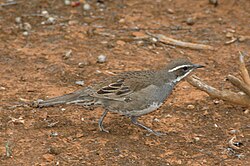
Plumage varies significantly between the two main groups. Quail-thrushes are generally brown on their upperparts to provide camouflage against the soil, while their undersides feature bolder black and white markings. In contrast, jewel-babblers are characterized by extensive blue plumage. In many species, there is a noticeable difference in plumage markings between males and females. Most species are known for their loud, distinctive songs.
Distribution and Habitat
The distribution of Cinclosomatidae is split between the island of New Guinea and the Australian mainland:
- New Guinea: Jewel-babblers inhabit the forests of New Guinea and neighboring islands such as Yapen, Batanta, Misool, and Salawati. They typically occupy different altitudes to avoid direct competition. The painted quail-thrush is also found in New Guinean forests.
- Australia: The remaining quail-thrush species are restricted to Australia, where they favor drier habitats, including scrub, open forests, and stony ground.
While most species are not considered threatened, one specific subspecies of the spotted quail-thrush is listed as critically endangered and may possibly be extinct.
Behavior and Ecology
Because they are terrestrial, these birds are relatively weak flyers. When disturbed, they typically squat low to the ground or run away rather than taking flight. Their foraging habits center on the ground, where they hunt for insects and other invertebrates. In arid desert environments, quail-thrushes supplement their diet with seeds.
Their nesting habits involve constructing cup-shaped nests, which are placed either on the ground or tucked among shrubs. A typical clutch consists of two to three eggs.
Species Summary
| Genus | Common Name Group | Notable Species |
|---|---|---|
| Cinclosoma | Quail-thrushes | Painted, Spotted, Chestnut, Copperback, Chestnut-breasted, Western, Nullarbor, and Cinnamon quail-thrushes |
| Ptilorrhoa | Jewel-babblers | Spotted, Blue, Brown-headed, Chestnut-backed, and Hooded jewel-babblers |
Frequently Asked Questions
What is the primary difference between quail-thrushes and jewel-babblers?
The primary differences are their appearance and distribution. Quail-thrushes are mostly brown for camouflage and are found largely in Australia's drier habitats. Jewel-babblers feature extensive blue plumage and are found in the forests of New Guinea and its surrounding islands.
Are Cinclosomatidae birds strong flyers?
No, they are terrestrial birds and are considered fairly weak flyers. They prefer to run or squat when they feel threatened.
What do these birds eat?
Their diet consists mainly of insects and other invertebrates found on the ground. Those living in desert regions also consume seeds.
Is any species of quail-thrush currently at risk?
While most species are not threatened, one subspecies of the spotted quail-thrush is considered critically endangered and may already be extinct.
How do they build their nests?
They build cup-shaped nests located either directly on the ground or hidden within shrubs, typically laying two to three eggs.