Church of the Holy Mother of God
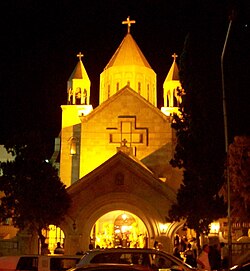
The Church of the Holy Mother of God (Armenian: Սուրբ Աստուածածին Եկեղեցի; Arabic: كنيسة السيدة العذراء مريم) stands as a vital spiritual and cultural center for the Armenian community in Aleppo, Syria. Located in the Suleimaniyeh district, this active Armenian Apostolic church serves as a beacon of faith and a gathering place for the Diocese of Beroea.
The current structure is more than just a place of worship; it is a continuation of a deep historical legacy. It succeeds the historic church of the Holy Mother of God in the old Christian Jdeydeh quarter, which first opened in 1429. While that original site eventually transitioned into a library and later the Zarehian Museum in 1991, the spirit of the congregation moved to its current home in Suleimaniyeh.
Key Facts
- Consecration Date: May 1, 1983
- Location: Elias IV Patriarch Street, Suleimaniyeh Area, Aleppo, Syria
- Affiliation: Armenian Apostolic Church, Diocese of Beroea
- Architects: Kevork Karajerjian and Kegham Khrigian
- Groundbreaking: September 10, 1972
- Key Memorial: A Khachkar (Armenian cross-stone) erected in 1993
History and Construction
The drive to build a new church in the Suleimaniyeh area arose from the need to serve a growing Armenian population. The project was made possible through the generosity of Armenian benefactors, particularly those with roots in the Cilician city of Aintab (modern-day Gaziantep), and the leadership of Father Zarmayr Hindoyan, the spiritual leader of Aintabian Armenians in Aleppo.
The timeline of the current church's establishment began with a ground-blessing ceremony on September 10, 1972, attended by Khoren I, Catholicos of the Holy See of Cilicia, during the tenure of Bishop Datev Sarkissian. Construction concluded in 1982, leading to the official consecration on May 1, 1983, under the patronage of Karekin II.
Architectural Style and Expansion
Designed by architects Kevork Karajerjian of Lebanon and Kegham Khrigian, the church follows traditional Armenian architectural styles. Beyond the sanctuary, the complex has expanded to serve the community's broader needs. In 1987, a large hall featuring a downstairs stage was opened to host seminars, concerts, cultural meetings, and celebrations.
To ensure the longevity of the site, the church underwent a complete renovation in 1998. The complex is further enriched by its proximity to the Armenian Gertasirats High School and the Zohrab Kaprielian Theatre.
Cultural and Spiritual Significance
The Church of the Holy Mother of God remains a bustling hub for the faithful, particularly during Sunday masses. It serves not only as a religious site but also as a place of remembrance. In 1993, a Khachkar—a traditional Armenian carved memorial stone—was installed by Sarkis Balmanougian to the right of the main entrance to honor the victims of the Armenian genocide.
| Feature | Details |
|---|---|
| Ecclesiastical Status | Active |
| Coordinates | 36°13′11″N 37°09′31″E |
| Consecrated By | Catholicos Karekin II |
| Associated Institutions | Gertasirats High School, Zohrab Kaprielian Theatre |
| Style | Armenian |
Frequently Asked Questions
When was the current church consecrated?
The church was officially consecrated on May 1, 1983, by Karekin II, the Catholicos of the Holy See of Cilicia.
What is the historical connection to the Jdeydeh quarter?
The current church is considered a continuation of the historic church of the Holy Mother of God in the Jdeydeh quarter, which operated from 1429 until the early 20th century.
What is a Khachkar and why is one located at the church?
A Khachkar is a traditional Armenian cross-stone. The one at this church was erected in 1993 by Sarkis Balmanougian to commemorate the victims of the Armenian genocide.
Who funded the construction of the church?
The church was built through donations from Armenian benefactors, specifically those with ancestral roots in Aintab (now Gaziantep).
What facilities are available at the church complex besides the sanctuary?
The complex includes a large cultural hall opened in 1987, the Armenian Gertasirats High School, and the Zohrab Kaprielian Theatre.