Understanding China's Single Time Zone: History, Geography, and Local Variations
China is a geographical marvel, spanning nearly five different natural time zones. However, despite its vast longitudinal extent, the country officially observes only one single standard time offset: UTC+08:00. This makes China the largest sovereign nation in the world to operate under a single unified time zone.
Known domestically as Beijing Time (BJT) and internationally as China Standard Time (CST), this unified system ensures administrative consistency across the mainland, though it creates fascinating geographical and social dynamics in the country's western reaches.
Key Facts
- Official Time Zone: UTC+08:00 (Beijing Time / China Standard Time).
- Geographical Span: Covers five natural time zones (73°26'E to 134°46'E).
- Daylight Saving Time: Not observed since 1991.
- Special Regions: Xinjiang uses a parallel unofficial time (UTC+06:00).
- International Alignment: Shared with Singapore, Philippines, Malaysia, and parts of Indonesia and Russia.
The Evolution of Time in China
Early Observatories and Coastal Time
The history of standardized time in China began in the late 19th century. In the 1870s, a French Catholic missionary constructed the Shanghai Xujiahui Observatory. By the 1880s, officials in the Shanghai French Concession used the observatory's Shanghai Mean Solar Time to provide time announcements for maritime vessels. By the end of the 19th century, this standard had shifted to GMT+08:00, a practice that eventually spread to other coastal ports.
The Era of Multiple Time Zones
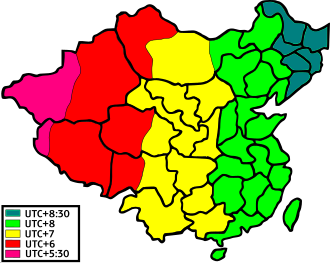
For much of the early 20th century, China experimented with various time standards. Until 1913, the official time was based on the apparent solar time of Beijing. By 1918, the Republic of China's Central Observatory proposed five distinct time zones: Kunlun (UTC+05:30), Sinkiang-Tibet (UTC+06:00), Kansu-Szechwan (UTC+07:00), Chungyuan (UTC+08:00), and Changpai (UTC+08:30).
This period was marked by significant complexity. During the Second Sino-Japanese War, the government briefly mandated that the entire country use Kansu-Szechwan Time (UTC+07:00). Following World War II, the five-zone system was briefly resumed before the political shifts of 1949–1950 led to the adoption of the current UTC+08:00 standard across most of the country.
Geography and the "Time Gap"
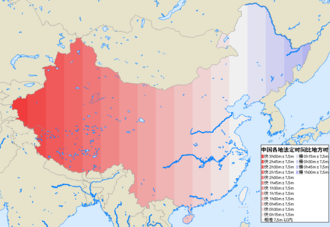
Because China uses a single time zone for such a massive area, the difference between legal time (the clock on the wall) and local mean time (the actual position of the sun) is extreme. In the far east, the sun rises very early, while in the far west, the sun may not rise until mid-morning by Beijing Time.
Extreme Daylight Variations
To illustrate the impact, consider the daylight hours in different provinces during the year 2010:
| Location Type | County | Province | Jan 1st Daylight | July 1st Daylight |
|---|---|---|---|---|
| Westernmost | Akto | Xinjiang | 10:16 – 19:44 | 07:34 – 22:26 |
| Westernmost (excl. Xinjiang) | Zanda | Tibet | 09:40 – 19:48 | 07:39 – 21:50 |
| Easternmost | Fuyuan | Heilongjiang | 06:54 – 15:18 | 03:05 – 19:08 |
One of the most striking transitions occurs at the border with Afghanistan at the Wakhjir Pass, where the time jumps from UTC+08:00 in China to UTC+04:30 in Afghanistan.
Regional Variations and Special Regulations
The Dual-Time System in Xinjiang
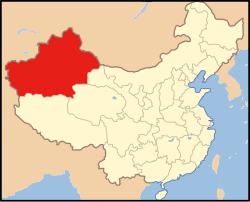
In the Xinjiang region, a unique situation exists where two time standards are used in parallel. While Beijing Time is the official national standard, many locals use Xinjiang Time (also known as Ürümqi Time), which is UTC+06:00—two hours behind Beijing.
This dual system affects daily life and communication. For example, Xinjiang Television schedules its Chinese-language programming according to Beijing Time, while its Uyghur and Kazakh channels follow Xinjiang Time. To accommodate the local rhythm, many businesses and government offices in Xinjiang operate on a "work/rest" schedule that aligns with Xinjiang Time (e.g., 08:00 to 17:00 local time), even though their official clocks show Beijing Time (10:00 to 19:00).
Hong Kong and Macau
Following the transfer of sovereignty in 1997 (Hong Kong) and 1999 (Macau), these Special Administrative Regions (SARs) maintained their own time authorities. However, because they are geographically located within the UTC+08:00 zone, Hong Kong Time and Macau Standard Time remain perfectly aligned with Beijing Time. Notably, Hong Kong has not observed daylight saving time since 1979.
Frequently Asked Questions
Does China use Daylight Saving Time?
No. While China observed daylight saving time between 1945–1948 and again from 1986–1991, it has not been used since 1991.
Why is the time in Xinjiang different from Beijing?
Officially, Xinjiang follows Beijing Time (UTC+08:00). However, due to its western location, many residents and local authorities use Xinjiang Time (UTC+06:00) to better align with the natural solar cycle.
Is Hong Kong Time the same as Beijing Time?
Yes. Although Hong Kong maintains its own time authority, Hong Kong Time is UTC+08:00, which is identical to Beijing Time.
What is the difference between Beijing Time and China Standard Time?
There is no difference. "Beijing Time" is the name used within China, while "China Standard Time" (CST) is the term used for international purposes.
How many time zones does China have?
Geographically, China spans five time zones, but politically and administratively, the entire country observes only one: UTC+08:00.