Chestnut-winged Hookbill
The Chestnut-winged hookbill (Ancistrops strigilatus) is a distinctive member of the ovenbird family, Furnariidae. Found deep within the lush landscapes of South America, this bird is characterized by its unique plumage and a specialized bill that reflects its foraging habits. As the sole representative of its genus, it occupies a specific ecological niche within the tropical forests of the Amazon Basin.
Key Facts
- Scientific Name: Ancistrops strigilatus
- Conservation Status: Least Concern (IUCN 3.1)
- Primary Habitat: Tropical lowland evergreen forest, specifically terra firme.
- Distribution: Bolivia, Brazil, Colombia, Ecuador, and Peru.
- Diet: Primarily arthropods.
- Distinctive Feature: A moderately hooked bill and bright rufous tail.
Taxonomy and Systematics
The chestnut-winged hookbill is the only species within the genus Ancistrops. While some taxonomic authorities, such as the Clements taxonomy, recognize two subspecies (A. s. strigilatus and A. s. cognitus), other major bodies like the International Ornithological Committee and BirdLife International treat the species as monotypic, meaning it has no recognized subspecies.
Within the broader ovenbird family, this species is most closely related to the foliage-gleaners of the genus Dendroma.
Physical Description
Measuring between 17 and 19 cm (6.7 to 7.5 in) in length and weighing 30 to 39 g (1.1 to 1.4 oz), the chestnut-winged hookbill is a relatively large furnariid. Both males and females share the same plumage. The bird is easily identified by its supercilium (the stripe of feathers above the eye), which ranges from whitish to buff, and its dark brown crown accented with narrow gold-buff streaks.
Its back is a grayish olive-brown, while the rump and uppertail coverts are a lighter brown. The most striking features are the dull chestnut wing coverts and the bright rufous tail. The bill is moderately hooked—similar to those of antshrikes—with a blackish maxilla (upper mandible) and a blue-gray to bluish ivory mandible (lower mandible).
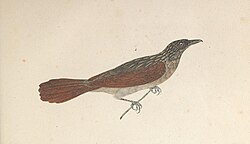
Juvenile birds differ slightly from adults, exhibiting less regular streaks on their upperparts and darker, narrower streaks on their underparts.
Distribution and Habitat
This species is native to the Amazon Basin, spanning from southeastern Colombia through eastern Ecuador and eastern Peru, extending into northern Bolivia and east into Brazil as far as the Rio Tapajós. While primarily found south of the Amazon River in Brazil, it has also been recorded in Jaú National Park to the north.
The chestnut-winged hookbill inhabits tropical lowland evergreen forests. It shows a strong preference for terra firme forest (non-flooded upland forest), though it is occasionally found in várzea (seasonally flooded forest). Most populations reside below 500 m (1,600 ft), though some have been spotted as high as 900 m (3,000 ft).
Behavior and Ecology
Movement and Social Structure
The chestnut-winged hookbill is a year-round resident within its range, meaning it does not migrate. It typically forages alone or in pairs, often joining mixed-species feeding flocks.
Feeding Habits
The bird feeds on arthropods, utilizing a technique known as gleaning—picking prey off surfaces. It primarily operates between the forest mid-storey and the canopy, moving slowly through vine tangles and along branches, often searching for insects among dead leaves.
Vocalizations
Its song is a fast, ascending trill that increases in volume as the pitch levels off, ending abruptly; these songs can last for over 30 seconds. Other descriptions characterize the sound as a gently undulating, "angry-sounding" rattle. Common calls include a harsh, buzzing "bzzt" and a "teejuw" sound.
Conservation Status
The IUCN classifies the chestnut-winged hookbill as Least Concern. Due to its vast geographic range and the lack of immediate threats, its population is believed to be stable. The species is considered uncommon to locally common and benefits from the protection of several nature reserves within its range.
| Feature | Details |
|---|---|
| Length | 17–19 cm |
| Weight | 30–39 g |
| Primary Diet | Arthropods |
| Preferred Habitat | Terra firme evergreen forest |
| IUCN Status | Least Concern |
| Range | Amazon Basin (Bolivia, Brazil, Colombia, Ecuador, Peru) |
Frequently Asked Questions
What is the diet of the chestnut-winged hookbill?
The chestnut-winged hookbill feeds primarily on arthropods, which it finds by gleaning from branches and dead leaves in the forest canopy and mid-storey.
Where can the chestnut-winged hookbill be found?
It is found in the Amazon Basin across Bolivia, Brazil, Colombia, Ecuador, and Peru, primarily in tropical lowland evergreen forests.
Is the chestnut-winged hookbill an endangered species?
No, it is currently listed as Least Concern by the IUCN because it has a very large range and a stable population with no immediate threats identified.
How does the chestnut-winged hookbill differ from other ovenbirds?
It is the only member of its genus (Ancistrops) and is distinguished by its moderately hooked bill, chestnut wing coverts, and bright rufous tail.
Does the chestnut-winged hookbill migrate?
No, the chestnut-winged hookbill is a year-round resident throughout its entire geographic range.